Botanical family
Boraginaceae
Description
Botanical characteristics
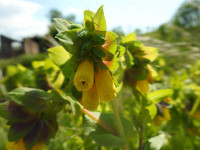
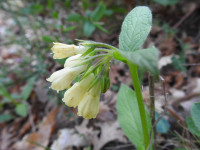
The Boraginaceae are a family of angiosperm plants, predominantly herbaceous, but also including shrubs, occasionally lianas, and a few trees, such as those of the genus Cordia. The typical habit therefore varies from herbaceous to woody, with stems and leaves often covered by rough hairs, giving the vegetation a bristly and coarse feel to the touch. These hairs can be calcareous cells or bristles, sometimes with basal tubercles; only some genera, such as Cerinthe, have glabrous leaves.
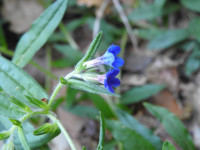
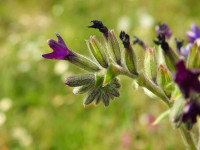
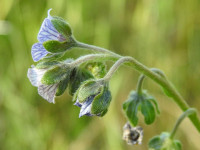
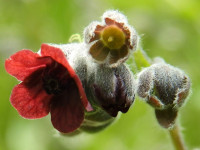
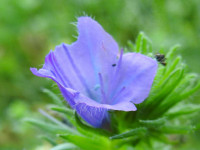
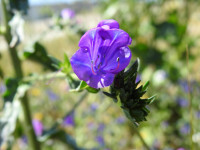
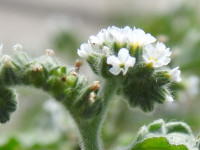
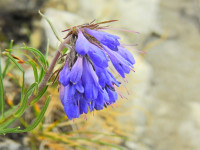
The leaves are generally alternate, simple, and entire, lacking stipules. Leaf arrangement can also be opposite, but rarely. The inflorescences are very characteristic: they consist of scorpioid or helicoid cymes, that is, spiral inflorescences that progressively unfold during flowering. The flowers, mostly regular in shape, are pentamerous and bisexual, with colors varying between light blue, blue, yellow, pink, purple, and white. Some species show a color change in the flowers after fertilization, often due to variations in cellular pH that modify anthocyanin pigments, shifting from purple or pink to blue or violet shades.
The sepals are toothed or lobed, free or joined at the base, generally persistent and sometimes enlarging after anthesis. The corolla varies greatly among genera: it can be tubular, campanulate, rotate, funnel-shaped, or irregular, often with scaly or hairy appendages at the throat. The stamens are epipetalous (inserted in the corolla tube), numbering five, and may present particular adaptations such as a connective horn or length differences to favor pollination.
The ovary is superior, formed by two fused carpels that may appear divided into four lobes due to false septa. The style is single, simple or bifid, sometimes with a four-lobed apex. The fruit is typically a schizocarp formed by four nutlets, rarely two, or sometimes a drupe (as in Cordia). Dissemination can occur by zoochory, favored by spines or rough calyces that attach to animals, or by myrmecochory, with ants attracted by nutrient structures such as elaiosomes.
Distribution and diversity
The family has a cosmopolitan distribution, absent or poorly represented in equatorial regions and humid tropical forests. The main biodiversity centers are found in temperate or arid subtropical climates, especially in the Mediterranean region, the Holarctic realm, and the Cape of Good Hope. Other important centers are located in North and South America, Australia, and tropical Africa.
Worldwide, the family includes about 118 genera and a very high number of species, estimated in the several thousands. In Italy, 31 genera are present, of which 26 have native species, significantly contributing to the country's spontaneous flora.
Main genera and representative species
Among the best-known and widespread genera are Borago, Myosotis, Pulmonaria, Symphytum, and Echium. These genera include species frequently encountered in the spontaneous Italian and Mediterranean flora.
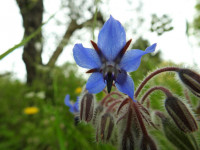
- Borago officinalis (borage): an annual herbaceous plant, known for its blue flowers and culinary and medicinal use.
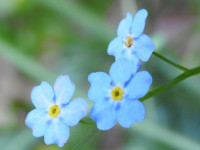
- Myosotis (common name: forget-me-not): a small genus of herbaceous plants with very characteristic blue flowers.
- Pulmonaria officinalis (lungwort): a perennial plant with spotted leaves and flowers that change color from pink to blue.
- Symphytum officinale (comfrey): traditionally used in phytotherapy.
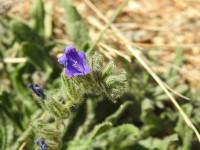
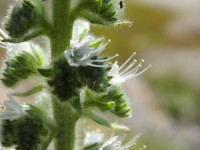
- Echium spp.: include herbaceous or shrubby species with often irregular and showy flowers.
Other notable genera in Italy include Anchusa, Cynoglossum, Onosma, and Lithospermum. Taxonomically, the family is divided into several subfamilies and tribes, reflecting the remarkable morphological and genetic diversity within it.
Etymology
The family name derives from the type genus Borago, which in turn has Latin origins. The term "borago" could derive from ancient Latin or Greek words referring to plants with a rough or velvety appearance, typical characteristics of many species in this family.
Curiosities and uses
Many species of Boraginaceae have significant ecological importance, as their flowers attract numerous pollinating insects, particularly bees and other hymenopterans, contributing to the biodiversity of natural and cultivated environments.
Some species are used in cooking, such as Borago officinalis, whose flowers and leaves are edible and appreciated in salads or as seasoning. Others have uses in traditional medicine, for example Symphytum officinale for its anti-inflammatory and healing properties.
Besides culinary and medicinal uses, some Boraginaceae are cultivated as ornamental plants for their showy and colorful flowers, such as Myosotis and Echium, highly valued in Mediterranean and temperate gardens.
Sources
- Wikipedia
Species of the family
16 species catalogued
Explore
Other botanical families