Botanical species
Echium plantagineum
L.
Purple Viper's-bugloss
Description
Morphological description
Annual or biennial herbaceous plant, Purple Viper's-bugloss has an erect or ascending habit, with branched stems that can reach a variable height between 20 and 60 cm, sometimes up to 80 cm. The stems are covered with short, soft hairs and soft bristles, sometimes tuberculate, giving the plant a slightly rough but not rigid surface.
The basal leaves form an overwintering rosette, are lanceolate or ovate-lanceolate, measuring between 2-4 cm in width and 8-14 cm in length, with petioles and characterized by well-marked lateral veins and a hairy surface with appressed hairs. The cauline leaves are sessile, oblanceolate-linear, wider at the base and often semi-clasping, with margins and surface also covered by soft hairs.
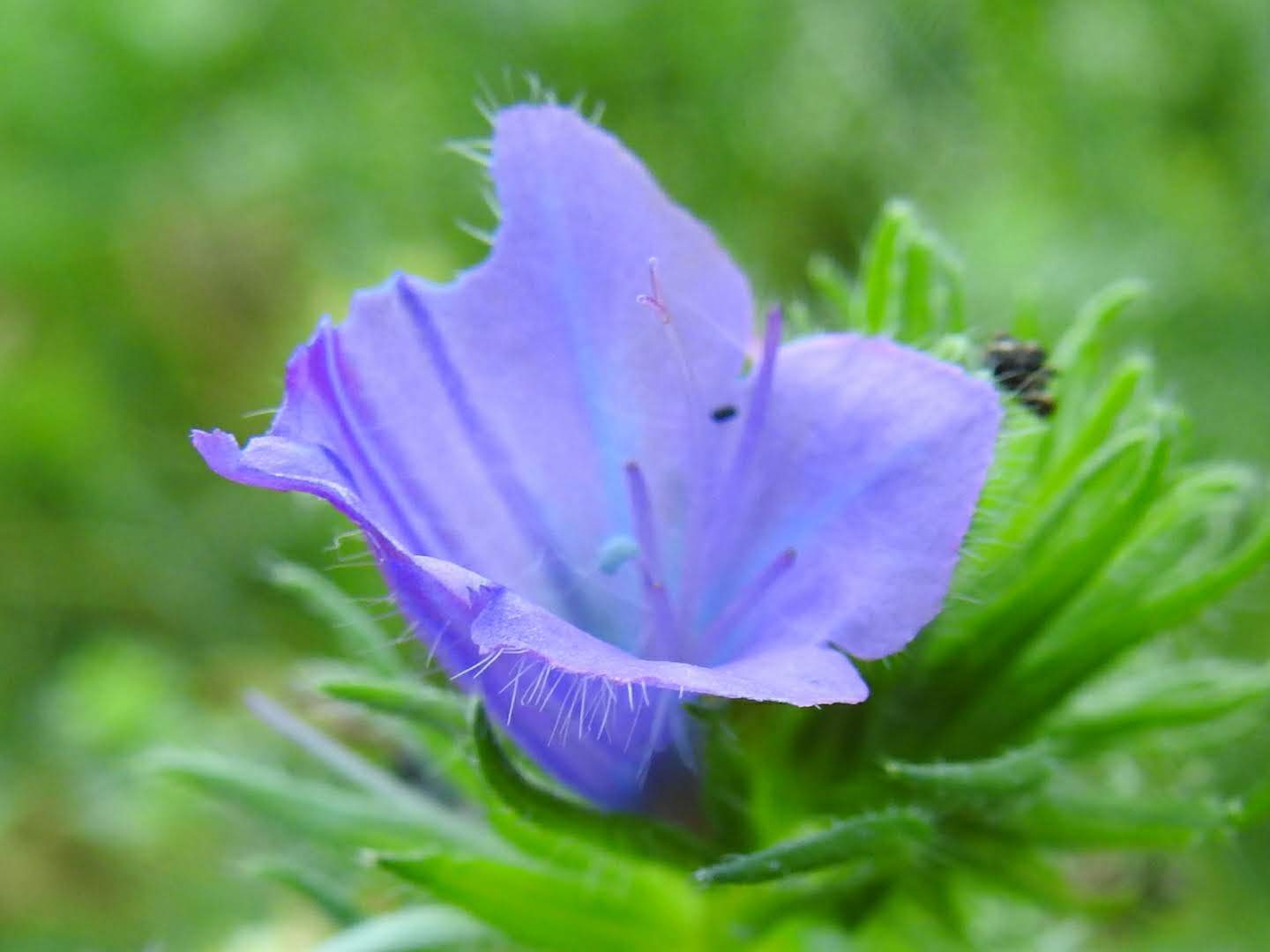
The inflorescence consists of short scorpioid cymes, which elongate at maturity, arranged in the axils of the upper leaves, with branches sometimes slightly pendulous. The flowers are hermaphroditic, zygomorphic, broadly funnel-shaped, with corollas measuring between 15 and 30 mm, initially of an intense purplish color that tends to fade towards bright blue, rarely white. The corolla is slightly oblique at opening, with five obtuse and unequal lobes, hairy only on the veins and on the outer margins. The calyx is gamosepalous, villous, with five linear teeth 8-10 mm long during flowering, which elongate up to 15 mm in fruiting.
The stamens, numbering five, are fused to the corolla tube; generally only two lower stamens protrude, while the others remain included. The ovary is superior.
The fruit is a schizocarp composed of four one-seeded mericarps, triangular in shape and light gray-brown in color, covered with prominent tubercles. The mericarps measure about 2-3 mm.
The root system, not described in detail in the sources, is typical of Mediterranean herbaceous plants, with a taproot system that allows the plant to anchor effectively even in poor and dry soils.
Habitat and distribution
Purple Viper's-bugloss is mainly distributed in the Mediterranean regions of Europe, Western Asia, and North Africa, with a range centered on the Mediterranean coasts and extensions towards the north and east. In Italy, it is present throughout the territory, from sea level up to about 1300 meters in altitude.
It prefers habitats characterized by dry, sandy or rocky soils, especially uncultivated areas, roadside edges, ruderal zones, and disturbed lands. It also grows well in pasture areas and abandoned agricultural fields. The preferred exposure is sunny or partially sunny, with well-drained and poor soil conditions.
This species adapts well to low fertility conditions and is frequently found in open and sunny environments typical of Mediterranean regions.
Flowering period
The flowering of Purple Viper's-bugloss generally extends from spring to summer, with a period from March to July, with some variations related to latitude and altitude. In milder or Mediterranean climates with mild winters, flowering can begin as early as March and continue until July, while in cooler areas it is concentrated in the warmer months.
Ecology and pollination
The flowers of Purple Viper's-bugloss are adapted to entomophilous pollination, mainly by pollinating insects such as bees and bumblebees, attracted by the bright color of the corollas and the availability of nectar. The zygomorphic symmetry and funnel-shaped structure of the corolla facilitate pollination by medium-small bodied insects.
The presence of two protruding stamens favors direct contact with pollinating insects, while the other stamens remain included, a reproductive strategy that can increase pollination efficiency.
Seed dispersal occurs through the natural fall of the tuberculate mericarps, which can adhere to substrates or be transported by small animals or abiotic agents. The annual or biennial life cycle of the plant allows rapid adaptation to variable environmental conditions.
Curiosities and traditional uses
Purple Viper's-bugloss is known as a toxic medicinal species due to the presence of pyrrolizidine alkaloids, toxic substances for grazing animals, particularly horses. This toxicity limits its use in agricultural and livestock contexts.
In the past, the plant was used in folk medicine as an emollient to treat skin irritations and boils, exploiting its soothing properties. However, it is important to emphasize that such uses are indicative and that medicinal use must be carried out with caution due to its toxicity.
The common name “Purple Viper's-bugloss” refers to the shape of the basal leaves, which resemble those of the genus Plantago, while the genus name derives from the Greek “ékhis,” meaning “viper,” probably referring to the shape of the style or the triangular fruit that resembles a snake's head.
Etymology
The scientific name of the genus derives from ancient Greek “ékhis,” meaning “viper,” a reference to the particular shape of the bifurcated stigma style, which remains after the corolla falls and resembles the forked tongue of a snake, or to the triangular fruits similar to a viper's head. The specific epithet “plantagineum” derives from the Latin “plantagineus,” related to “planta” (sole of the foot), probably referring to the shape of the basal leaves that resemble those of the genus Plantago.
The Italian common name “Purple Viper's-bugloss” reflects these morphological characteristics and the association with the viper and Plantago-like leaves.
Sources
- Prof. S. Pignatti, "Flora d'Italia"
- Acta Plantarum - Flora delle regioni italiane (scheda di Anja Michelucci)
- Tela Botanica / H. Coste, "Flore descriptive et illustrée de la France"
- World Flora Online (WFO)
Characteristics
Scheda botanica
| Famiglia | Boraginaceae |
|---|---|
| Fioritura | marzo – luglio |
| Forma biologica | Scapose |
| Habitat | with purple flowers, with blue flowers, annual plant |
Domande frequenti
- Quando fiorisce Purple Viper's-bugloss?
- Purple Viper's-bugloss fiorisce marzo – luglio.
- Che tipo di pianta è Purple Viper's-bugloss?
- Purple Viper's-bugloss è una Therophytes (Scapose) secondo la classificazione di Raunkiaer.
- A quale famiglia appartiene Purple Viper's-bugloss?
- Purple Viper's-bugloss appartiene alla famiglia botanica Boraginaceae.
Where I found it (4 sightings)
Classification
- Kingdom
- Plantae
- Family
- Boraginaceae
- Full name
- Echium plantagineum L.
- Life form
- Therophytes scapose
Similar species
Search for species with similar characteristicsFurther reading
Noticed an error in the identification? Write to me
Other species of the same family
Boraginaceae
Explore
Other species of Boraginaceae