Botanical species
Echium arenarium
Guss.
Sand Bugloss
Description
Morphological description
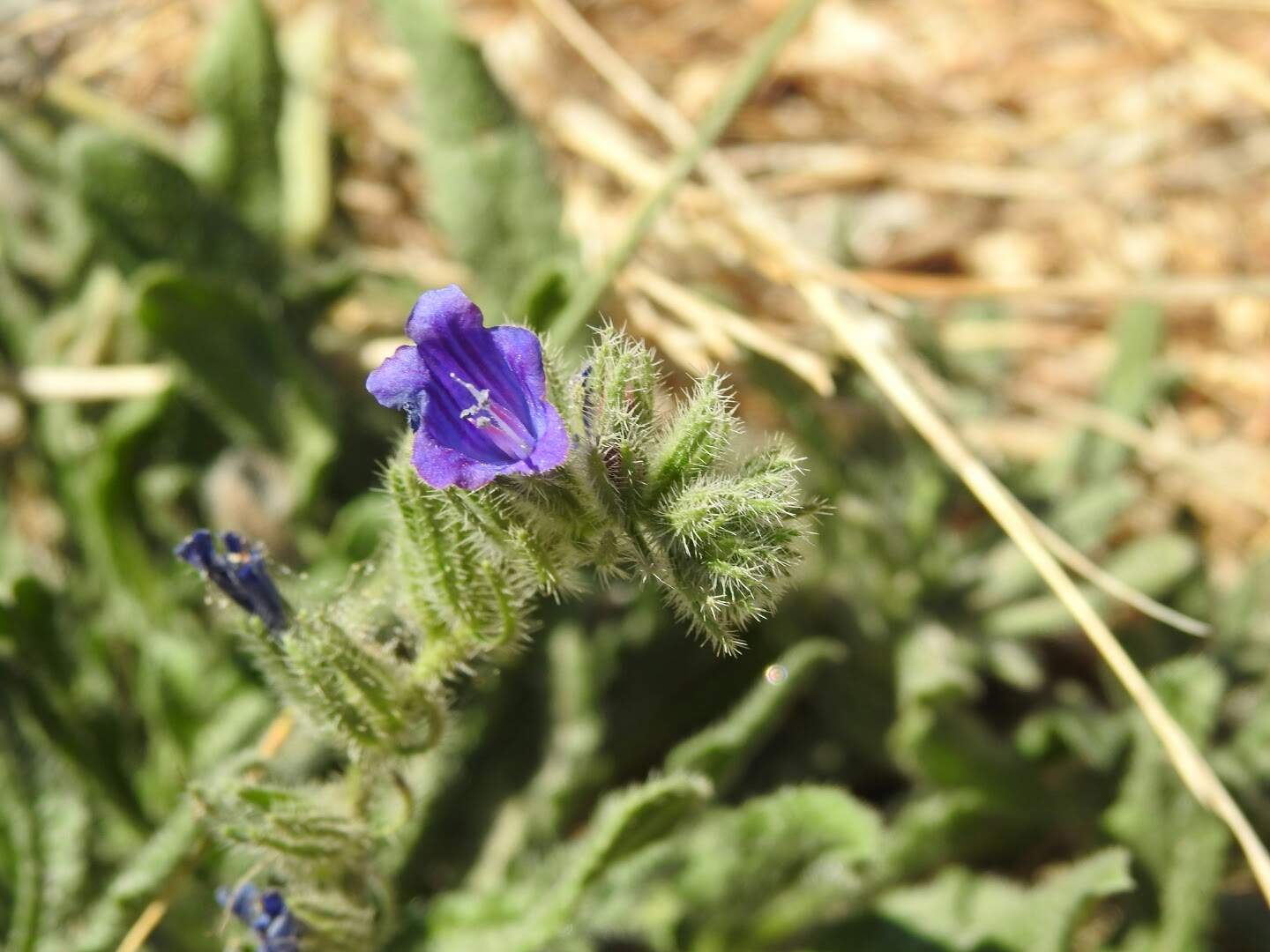
The plant is a biennial species with low growth, generally reaching a height between 10 and 25 cm. It has numerous thin stems, ascending or sometimes prostrate, sparsely branched, covered with more or less appressed hairs and bristles, with a slight underlying pubescence. These hairs can have a yellowish coloration, giving the stem a slightly rough and tuberculate appearance.
The leaves show some variability in shape along the plant. The basal and lower leaves are petiolate, linear-spatulate in shape, generally measuring between 0.5-1 cm in width and 3-6 cm in length; they are also obtuse and have a well-visible central vein. The upper and bracteal leaves are lanceolate, semi-clasping the stem in a heart shape, and covered with flattened hairs.
The flowers are small, intense bluish-violet in color, with tubulo-conical corollas 6 to 10 mm long, often only slightly longer than the calyx. The surface of the corolla is velvety and uniformly hairy. The calyx is 5-7 mm, very softly hairy with yellow-greenish hairs, with lanceolate lobes; it does not increase much during the fruiting phase. The inflorescences are formed by elongated clusters, often with subsessile flowers also arranged in an extra-axial position, i.e., not exactly at the leaf axil.
The internal reproductive organs, such as stamens and style, are included within the corolla and do not protrude. The fruits consist of mericarps of more or less triangular shape, about 2 x 2.5 mm, with a rough surface and gray-brown color, characterized by a tuberculate dorsal ridge that makes them distinctive.
The root system, typical of coastal plants, is presumably well adapted to sandy and rocky soils, but no detailed specific data exist in the literature.
Habitat and distribution
The species is typical of Mediterranean coastal areas, preferring sandy or rocky environments along the seashore. In Italy it is mainly reported on the Tyrrhenian coasts, including Sardinia, particularly in littoral environments with sandy or mixed rocky debris substrates. The distribution extends throughout the Mediterranean basin, from southern France (Pyrénées-Orientales, Aude, Hérault) to Corsica and North Africa.
It grows at very low altitudes, generally close to sea level, where the microclimate is influenced by proximity to the sea, with high salinity and constant ventilation. The species adapts well to sunny exposures and to poor, well-drained soil conditions.
Flowering period
Flowering is concentrated between March and May, with greater prominence between April and May. In some particularly favorable coastal areas, it can begin as early as March. The flowering duration is relatively short, consistent with the biennial cycle of the plant.
Ecology and pollination
The coastal Viperina relies mainly on entomophilous pollination: pollinating insects such as bees and other hymenopterans attracted by the vivid blue-violet flower color and the presence of nectar. The structure of the corolla, with included stamens and style, promotes effective contact with pollinating insects that visit the flowers to collect pollen and nectar.
Seed dispersal presumably occurs by falling near the mother plant, facilitated by the position of the fruits and their rough structure which could also favor some anchoring to the sandy or rocky substrate. No mechanisms of wider dispersal by wind or animals are documented.
Curiosities and traditional uses
There are no specific data on medicinal, food, or traditional uses of the coastal Viperina in the literature. However, related plants of the genus Echium have historically been used in phytotherapy for their emollient and anti-inflammatory properties, although there is no direct evidence for this particular species.
The common name “coastal Viperina” may derive from the shape of the flowers or from the traditional reputation attributed to the genus Echium, which in some cultures was associated with the treatment of viper bites, although there is no specific confirmation for this Mediterranean species.
Etymology
The generic name Echium derives from the Greek “echis” (ἐχῖς), meaning “viper”, probably referring to the elongated and curved shape of the seeds or flowers that resemble a viper’s head. The specific epithet arenarium indicates the plant’s preference for sandy environments (“arena” = sand in Latin).
The Italian common name “Sand Bugloss” reflects these references, emphasizing both the marine habitat and the morphological association with the term “viper”.
Sources
- Prof. S. Pignatti, "Flora d'Italia"
- Tela Botanica / H. Coste, "Flore descriptive et illustrée de la France"
Characteristics
Where I found it (1 sightings)
Classification
- Kingdom
- Plantae
- Family
- Boraginaceae
- Full name
- Echium arenarium Guss.
- Life form
- Emicriptofite bienni
Similar species
Search for species with similar characteristicsNoticed an error in the identification? Write to me
Other species of the same family
Boraginaceae
Explore
Other species of Boraginaceae