Botanical species
Echium vulgare
L.
Blueweed
Description
Morphological description
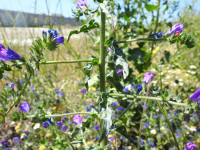
Biennial herbaceous plant, sometimes annual, with a variable height between 30 and 90 cm, exceptionally up to 1 m. It has an erect habit, often very branched especially in the ascending lateral branches. The stem is angular, branched-ascending, covered by a dense indumentum of two types of hairs: long, dense, patent bristly hairs, inserted on reddish or bluish-violet tubercles at the base, and shorter, cobwebby hairs that give the whole surface a rough, tomentose, and wrinkled appearance.
The basal leaves are arranged in a rosette flattened to the ground and are oblanceolate or linear-spatulate in shape, generally measuring between 1-1.5 cm in width and 6-10 cm in length. These leaves are characterized by a hairy surface, with tuberculate bristles directed towards the apex and soft hairs. The cauline leaves are alternate, sessile, rounder in shape and progressively smaller towards the apex of the stem, with an attenuated base. All leaves retain a more or less dense indumentum of appressed or more erect hairs.
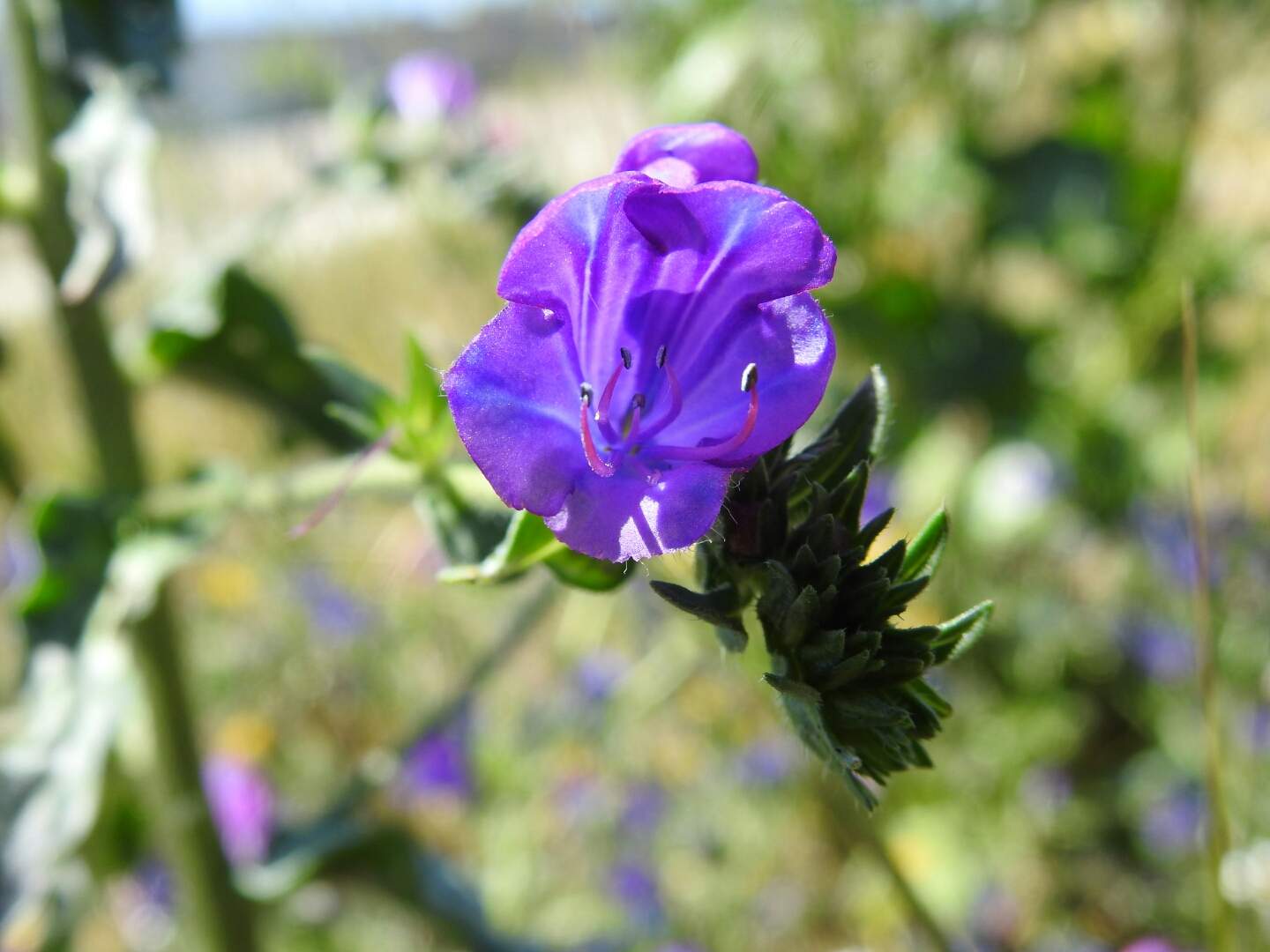
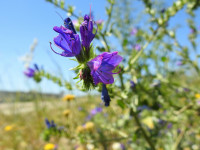
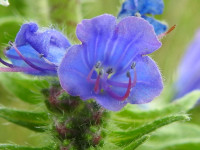
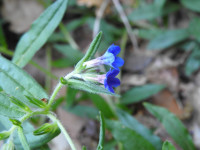
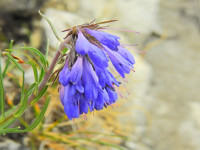
The inflorescence is a spike-like panicle, sparsely branched, formed by scorpioid clusters (shaped like a scorpion's tail) that can develop into a cylindrical-pyramidal, loose, and elongated structure. The flowers are zygomorphic, campanulate, with a corolla of blue-violet color, sometimes with bluer shades or rarely reddish. The corolla generally measures 10-17(20) mm in length and has 5 unequal lobes: the two posterior lobes are longer, while the median and anterior ones are smaller and reflexed. The calyx is formed by linear, acute lobes, 4-9 mm long, which often elongate further during fruiting.
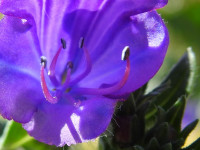
The stamens are inserted in the corolla tube, with glabrous filaments of variable length, generally from 2 to 3.5 mm; they are clearly visible and in an exserted position relative to the corolla. The fruit consists of 4 angular nutlets (mericarp), 2-3.5 mm long, with a tuberculate surface and evident raised lines, enclosed by slender sepals.
The root system, typical of biennial species, is taprooted and allows good anchorage and resource gathering in poor and dry soils.
Habitat and distribution
Species widespread throughout the European area, present in Italy and the Mediterranean basin, with a distribution ranging from 0 up to 1700 meters altitude. It preferably grows in open and sunny environments, such as uncultivated lands, dry pastures, rocky places, and along the edges of paths or roads. It is a typical plant of well-drained soils, often poor and calcareous, in disturbed or semi-natural sites. It can also colonize subalpine mountain areas, provided they have sunny exposure.
The species is adapted to thermophilic and xerophilous conditions, thus frequenting dry and stony environments. In Italy, it is commonly found in all regions, from the plains up to the lower mountain zones.
Flowering period
Flowering occurs from April to September, with a peak usually between May and August. The flowering duration may vary slightly depending on altitude and latitude, occurring earlier in warmer Mediterranean areas and later towards more northern or mountainous regions.
Ecology and pollination
Blueweed is a melliferous species highly appreciated by pollinating insects, especially bees and bumblebees, which are attracted by its brightly colored flowers and abundant nectar production. The zygomorphic shape and the position of the stamens facilitate entomogamous pollination, with four exserted stamens that favor contact with insects.
The plant has a predominantly allogamous reproductive strategy (cross-pollination), but it can also show some capacity for autogamy under limiting conditions. Seeds are mainly dispersed by falling near the mother plant and subsequent secondary dispersion by abiotic agents or animals, although there are no particular adaptations for long-distance dispersal.
Curiosities and traditional uses
The common name “viperina” derives from ancient traditions linked to the so-called "doctrine of signatures": it was believed that the shape of the roots resembled the head of a viper and that the plant could be used to treat viper bites. A transmitted legend recounts how Nicander and Alcibiades, bitten by a viper, healed themselves by chewing the plant and applying it to the wound.
Historically, in folk medicine, both roots and leaves were used as emollients, expectorants, and remedies against cough. Furthermore, the seed infusion was used to stimulate milk flow in mothers and to alleviate states of melancholy.
The plant is also highly valued in beekeeping, being an important nectar source for bees. Selected varieties are cultivated in gardens for their decorative appearance thanks to the intensely colored flowers.
It should be emphasized that traditional medicinal and food uses are for informational purposes only and do not replace professional medical advice.
Etymology
The scientific name Echium derives from the Greek “èchis” meaning “viper”: this reference is linked to the shape of the roots that resemble the reptile’s head and to ancient beliefs about the plant’s antidote properties against viper bites. The specific epithet vulgare indicates the common and widespread distribution of this species in the territory.
The Italian common name “viperina azzurra” recalls both the ancient association with the viper and the characteristic color of the flowers.
Sources
- Prof. S. Pignatti, Flora d'Italia, Edagricole, Bologna 1982
- Acta Plantarum – Flora delle regioni italiane (scheda di Nino Messina)
- Tela Botanica / H. Coste, Flore descriptive et illustrée de la France
- World Flora Online (WFO)
Characteristics
Scheda botanica
| Famiglia | Boraginaceae |
|---|---|
| Fioritura | aprile – settembre |
| Forma biologica | Biennials |
| Habitat | with purple flowers, with blue flowers, with blue-purple flowers |
Domande frequenti
- Quando fiorisce Blueweed?
- Blueweed fiorisce aprile – settembre.
- Che tipo di pianta è Blueweed?
- Blueweed è una Hemicryptophytes (Biennials) secondo la classificazione di Raunkiaer.
- A quale famiglia appartiene Blueweed?
- Blueweed appartiene alla famiglia botanica Boraginaceae.
Where I found it (26 sightings)
Classification
- Kingdom
- Plantae
- Family
- Boraginaceae
- Full name
- Echium vulgare L.
- Life form
- Hemicryptophytes biennials
Similar species
Search for species with similar characteristicsFurther reading
Noticed an error in the identification? Write to me
Other species of the same family
Boraginaceae
Explore
Other species of Boraginaceae