Botanical species
Cynoglossum creticum
Mill.
Blue Hound's tongue
Description
Morphological description
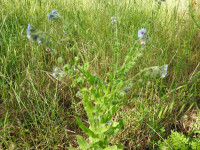
Biennial herbaceous plant of medium size, which can reach a height between 20 and 90 cm, with an erect and branched habit especially in the upper part. The stem is angular, hirsute and tomentose, covered by a dense layer of white felt-like hairs, which give the plant a grayish and green-grayish appearance. The root is taproot and well developed, typical of biennial plants.
In the first year of development, a basal rosette of leaves is observed, oblong-lanceolate in shape, narrow and elongated, about 8-12 cm long and 2-3 cm wide, with a hirsute blade on both sides and equipped with a winged petiole of 7-9 cm. The lower cauline leaves are oblong, shortly petiolate and semi-clasping the stem, while the upper ones are sessile, amplexicaul and oblong-lanceolate with a rounded base.
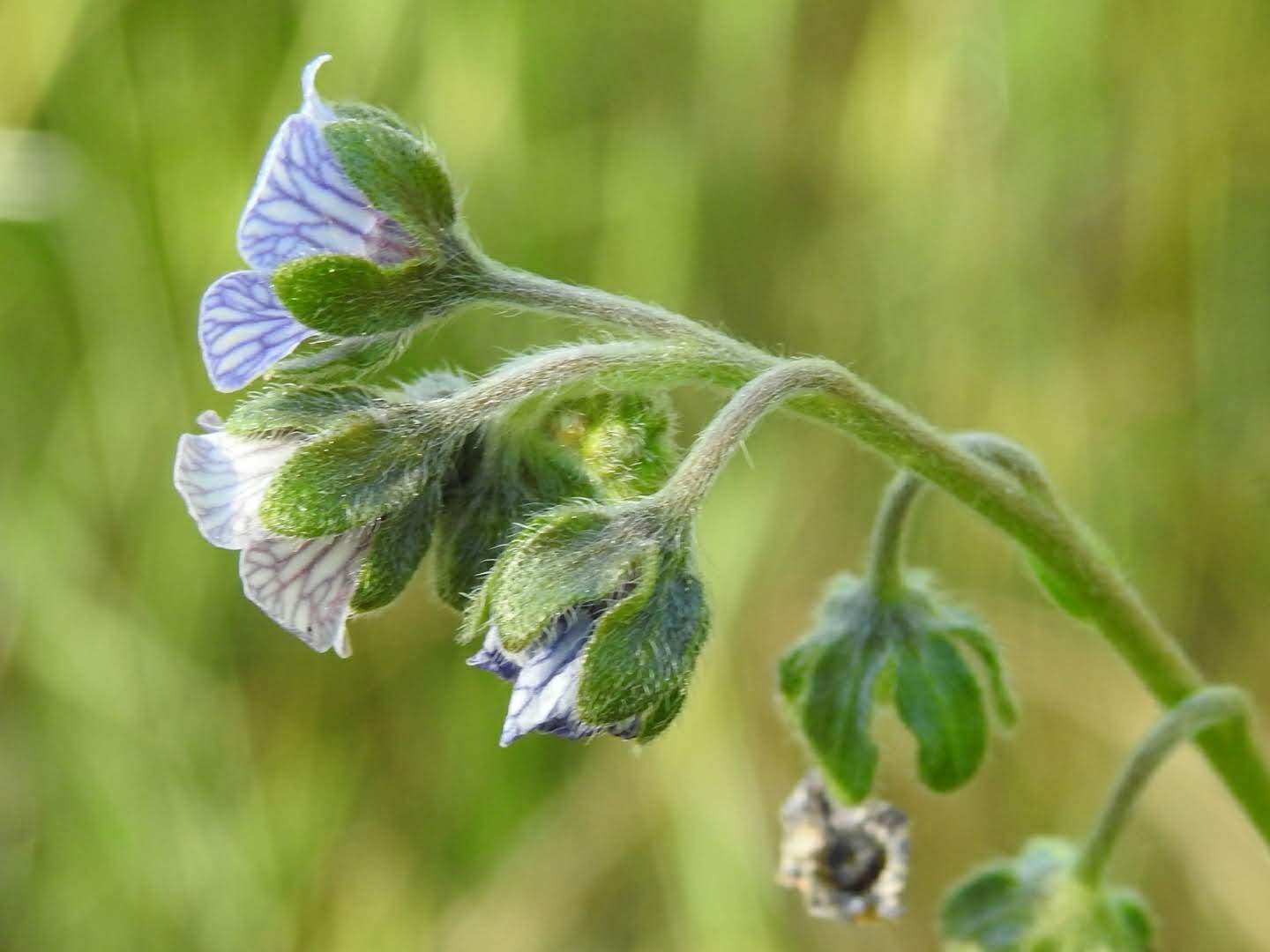
The inflorescence consists of numerous branched scorpioid cymes, bearing flowers of variable color: initially reddish, then whitish or rarely white, with a characteristic network of blue-violet streaks visible on the upper face of the corolla. The calyx is formed by five oblong and hirsute lobes, 6-8 mm long, divided almost to the base. The corolla, funnel-shaped or rotate, has five petals measuring between 5 and 9 mm in diameter, with a tube of 1-2 mm equipped with five scales at the throat. The stamens (five) are inserted in the corolla tube, with anthers of 1.1-1.3 mm and a style shorter than the tube.
The fruit is an indehiscent achene 5-7 mm long, without a thickened margin, consisting of obovate carpels with a convex back, densely covered with small hooked spines and conical tubercles. The infructescences tend to turn downward due to the curvature of the fruiting peduncles, 7-9 mm long.
Habitat and distribution
It is a eurymediterranean species, widespread along the coasts and dry hilly environments of the Mediterranean basin, with a distribution covering most of the Italian territory, including Liguria, the Peninsula, Sicily, Sardinia and also Corsica. In Italy it is absent in most of the Po Valley, but it is present on dry reliefs and hilly foothills from the Trieste area to the Maritime Alps. In Sicily, a variety with thinner leaves called var. siculum is observed.
It grows preferably on calcareous soils or on soils with near-neutral pH, in environments such as uncultivated lands, dry riverbeds, ditch edges and vineyards, from sea level up to 1200 meters altitude. The plant prefers sunny exposures and fairly dry conditions.
Flowering period
Flowering generally extends from April to June, with possible variations linked to the latitude and altitude of the growth sites. The flowers initially present reddish colors, then lighten to whitish or rarely white shades, characterized by the typical blue-violet venation.
Ecology and pollination
The species is well known for its melliferous capacity, attracting various pollinating insects that favor pollination. The flowers, with their showy and reticulated corolla, are structured to facilitate pollen deposition by bees and other pollinating insects. Seed dispersal occurs through achenes equipped with hooked spines, which can attach to animal fur or be transported by wind or water, facilitating colonization of new habitats.
Curiosities and traditional uses
This species has historically been used in folk medicine, especially for its medicinal properties. The leaves were used in ointments based on lard for the treatment of wounds and burns. In Sardinia, for example, fresh leaves have been used as anti-eczematic and healing agents through direct applications. Emollient and expectorant properties are also attributed to it.
However, medicinal use has been progressively abandoned due to the presence of toxic pyrrolizidine alkaloids (such as pyrrolizidine, echinatine, heliosupine, rinderine and cynoglossamine), which can be harmful if ingested in uncontrolled doses. Besides alkaloids, the plant also contains other compounds such as tannins, resins, gum, inulin and saponins.
In folklore, the name "dog's tongue" refers to the shape of the leaves, similar to dog tongues, a common image also in other related species.
Etymology
The generic name derives from the Greek "kýon" (dog) and "glôtta" (tongue), referring to the shape of the leaves that resemble a dog's tongue. The specific epithet "creticum" means "of Crete," indicating the original provenance of the species or at least one of its regions of origin in the Mediterranean. The Italian common name “lingua di cane a fiori variegati” highlights both the shape of the leaves and the particular variegated coloration of the flowers.
Sources
- Prof. S. Pignatti, "Flora d'Italia"
- Acta Plantarum - Flora delle regioni italiane (scheda di Nino Messina)
Characteristics
Where I found it (7 sightings)
Classification
- Kingdom
- Plantae
- Family
- Boraginaceae
- Full name
- Cynoglossum creticum Mill.
- Synonyms
- Cynoglossum mediterraneum Sutorý
- Life form
- Emicriptofite bienni
Similar species
Search for species with similar characteristicsNoticed an error in the identification? Write to me
Other species of the same family
Boraginaceae
Explore
Other species of Boraginaceae