Botanical species
Cynoglossum officinale
L.
Hound's-tongue
Description
Morphological description
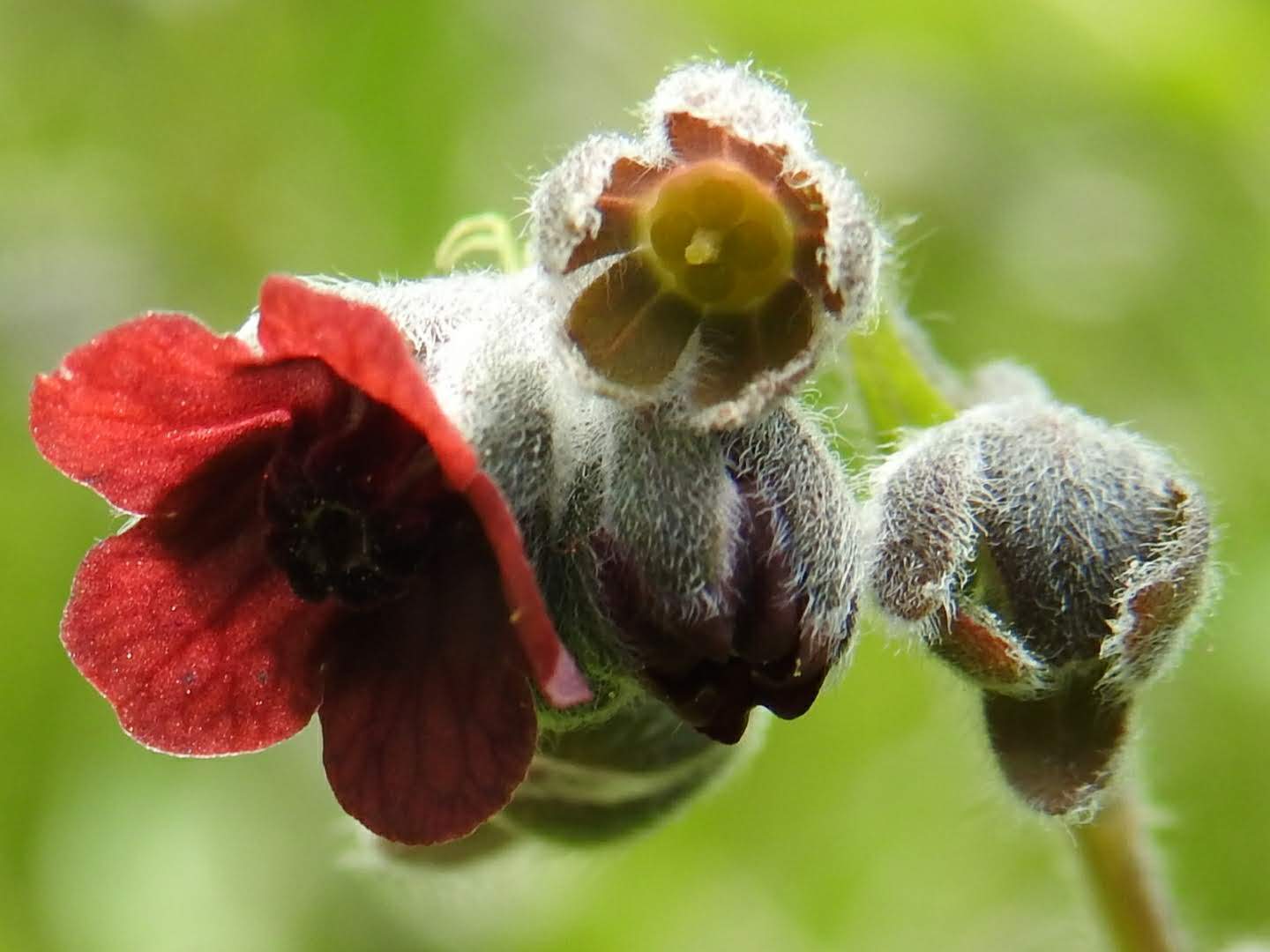
Biennial herbaceous plant with an erect habit, generally 20 to 80 centimeters tall, sometimes up to 90 cm. The stem is robust, often branched in the upper part with erect-spreading branches, covered by a dense and soft gray-white pubescence, which gives the entire plant a velvety appearance and a soft texture to the touch. The stem surfaces are hirsute or villous, with more or less long hairs.
The basal leaves are gathered in a rosette in the first year of life, with a lanceolate or ovate-lanceolate blade, 9 to 12 cm long and 3-6 cm wide, acute at the apex and gradually narrowed into a petiole 7-9 cm long; they are often absent at flowering time. The cauline leaves are progressively smaller, lanceolate-linear, sessile or with a short petiole, arranged alternately along the stem, with entire margins and herbaceous texture, covered by whitish pubescence.
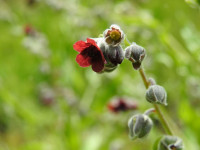
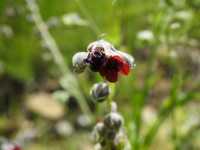
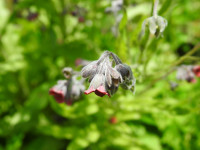
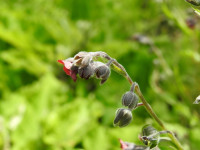
The inflorescences consist of numerous initially subspherical cymes that then elongate and open into more or less spreading corymbs, with fruiting peduncles curved or spreading, 5-7 mm long. The flowers, hermaphroditic and pentamerous, have a calyx divided into five oval sepals 4-6 mm long, which elongate up to 10 mm at fruiting, with oval calyx teeth. The corolla, 5-7 mm in diameter, is tubular cylindrical with a rotate limb and five spreading oval lobes; the color varies from dark red or violet to rarer blue shades. Inside the corolla are included stamens and style; the throat is closed by connivent scales.
The fruit consists of four ovate-subglobose mericarps (nutlets), 5-8 mm long, with a flat dorsal surface and raised margins on which curved prickles are arranged more densely along the edges, while they are sparser in the center of the faces. The mericarps remain attached to the style after separation from the gynobase, forming a low and wide pyramid-shaped fruit. The fruit peduncles are curved downward, facilitating dispersal.
The root system is not specifically described in the provided sources, but as typical of biennial herbs, it is presumably well developed to ensure reserve accumulation in the first year.
Habitat and distribution
The species is widespread throughout Europe and is stably found in many Italian regions, with confirmed presence especially in northern Italy, the Tuscan Apennines, Sardinia, and Corsica. However, its exact distribution is sometimes confused with related species of the genus Cynoglossum, especially Cynoglossum creticum.
It grows mainly in woodland environments, uncultivated areas, field edges, paths, vineyards, and livestock fences. It prefers well-drained soils, often calcareous or light-textured, with exposure from sunny to semi-shaded. It is a thermophilic species and is found from sea level up to 1300 meters, with occasional reports up to 2400 meters in subalpine or alpine environments.
Flowering period
Flowering mainly occurs between May and July (months 5-7), with some variations related to altitude and latitude. During this period the plant produces visible and attractive flowers, essential for sexual reproduction.
Ecology and pollination
The plant is pollinated by pollinating insects attracted by the bright colors of the flowers, especially bees and other hymenopterans. The corolla, with a cylindrical tube and throat closed by scales, is suitable to favor entomogamous pollination, allowing access only to insects with appropriate morphology.
Seed dispersal occurs mainly through the mericarps equipped with curved prickles that easily attach to animal fur or clothing, favoring zoochorous dissemination. The curvature of the fruiting peduncles helps facilitate the detachment and dispersal of the fruits.
Curiosities and traditional uses
The common name "Hound's-tongue" derives from the shape and texture of the leaves, which resemble a dog's tongue, a clear and significant characteristic also reflected in the scientific name. Historically, it was a medicinal plant used for its sedative, calming, astringent, vulnerary, and emollient properties. The roots were used to prepare remedies against insomnia, anxiety, and nervous agitation, such as the famous “Pill of Cinoglossa” which also contained opium and henbane.
Internal use is now abandoned because the plant contains hepatotoxic pyrrolizidine alkaloids, which preclude its use in dietary supplements and medicines. However, external use persists in some traditions: poultices of cooked leaves or decoctions are used to treat burns, skin cracks, eczema, and to promote healing.
In the past, it was believed that bandages with its leaves could protect against the consequences of rabid dog bites, while the juice boiled in lard was used to prevent baldness. In folklore, the plant is associated with the planet Venus and is considered a bearer of wisdom, happiness, and financial prosperity, as well as being used in love rituals.
An interesting coincidence is that in 1962 Romanian scientists isolated a powerful rodenticide from Hound's-tongue, confirming its presumed effectiveness against rodents, consistent with the ancient belief that the plant was hostile to mice.
Etymology
The genus name derives from the Greek κυνός (kynos), meaning "dog," and γλῶσσα (glôssa), "tongue," clearly referring to the shape and texture of the leaves, similar to a dog's tongue. The specific epithet "officinale" indicates the traditional use of the plant in herbalism and medicine.
The Italian common name “Lingua di cane medicinale” recalls both the shape of the leaves and the historical therapeutic use of the plant.
Sources
- Prof. S. Pignatti, "Flora d'Italia"
- Acta Plantarum - Flora delle regioni italiane (sheet by Marinella Zepigi)
- World Flora Online (WFO)
Characteristics
Scheda botanica
| Famiglia | Boraginaceae |
|---|---|
| Fioritura | maggio – luglio |
| Forma biologica | Biennials |
| Habitat | with red flowers, biennial plant |
| Uso officinale | Pianta officinale |
Domande frequenti
- Quando fiorisce Hound's-tongue?
- Hound's-tongue fiorisce maggio – luglio.
- Che tipo di pianta è Hound's-tongue?
- Hound's-tongue è una Hemicryptophytes (Biennials) secondo la classificazione di Raunkiaer.
- A quale famiglia appartiene Hound's-tongue?
- Hound's-tongue appartiene alla famiglia botanica Boraginaceae.
Where I found it (7 sightings)
Classification
- Kingdom
- Plantae
- Family
- Boraginaceae
- Full name
- Cynoglossum officinale L.
- Life form
- Hemicryptophytes biennials
Similar species
Search for species with similar characteristicsFurther reading
Noticed an error in the identification? Write to me
Other species of the same family
Boraginaceae
Explore
Other species of Boraginaceae