Botanical family
Balsaminaceae
Description
Botanical characteristics
Plants belonging to the family Balsaminaceae are herbaceous, predominantly annual or perennial, characterized by a habit often erect or creeping. The leaves are arranged spirally, oppositely, or sometimes whorled and are without stipules.
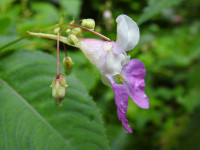
The flowers are hermaphroditic, zygomorphic (i.e., with bilateral symmetry), and present a typical structure of four whorls: generally they are 5-merous, although the distinction of the whorls may be unclear. The sepals are 3-5, with the upper sepal often modified into a petaloid structure forming a hood or a conical spur, which serves as a nectary. The petals are 5, with the two lateral petals often fused in pairs. The stamens are 5, with anthers united to form a structure enveloping the gynoecium. The gynoecium is formed by 5 carpels fused into a superior ovary; the style and stigma are small in size.
The flowers can be solitary or grouped in racemes. The family presents a specialized pollination mechanism involving dipterans and hymenopterans, attracted by the nectar spur. The fruit is a many-seeded loculicidal and elastic capsule, which at maturity opens explosively, projecting the seeds far away, facilitating their dispersal.
Distribution and diversity
Balsaminaceae are distributed mainly in temperate and tropical regions of Europe, Asia, Africa, and North America. The family includes only two genera:
- Hydrocera, monospecific (only one species);
- Impatiens, with over 1100 species.
This wide diversity is concentrated especially in the genus Impatiens, which shows a great variety of forms and ecological adaptations. Their distribution ranges from the humid environments of tropical forests to temperate zones, with some species native also to the Italian territory.
Main genera and representative species
The main and richest genus of the family is Impatiens, with over 1100 species distributed globally. Among these, some species are spontaneously present in Italy, such as Impatiens noli-tangere (commonly known as "touch-me-not" or "do not move"), which grows in humid and shady environments.
The other genus, Hydrocera, includes only one species: Hydrocera triflora, which is less widespread but represents an important taxonomic component of the family.
Etymology
The name of the family derives from the type genus Impatiens, which in Latin means "impatient." This name refers to the characteristic mechanical explosion of the fruits, which at maturity open suddenly projecting the seeds far away, as if they were "impatient" to disperse.
Curiosities and uses
Balsaminaceae are known for their particularly effective and spectacular seed dispersal mechanism, which has attracted the attention of both scholars and gardeners. Some species of Impatiens are cultivated as ornamental plants for the beauty of their colorful flowers and long blooming period.
Pollination is specialized and involves insects such as dipterans and hymenopterans, which are attracted by the spur containing nectar. From an ecological point of view, these plants contribute to maintaining the biodiversity of the humid and shady habitats in which they grow.
Sources
- Wikipedia
Species of the family
1 species catalogued
Explore
Other botanical families