Botanical species
Borago officinalis
L.
Borage
Description
Morphological description
Annual herbaceous plant, generally 20 to 70 cm tall, with an erect habit and fleshy stems, branched mainly in the upper part. The stem is often rough, covered with stiff, white, and somewhat spiny hairs, which make the plant rough to the touch; sometimes it shows well-marked reddish veins.
The basal leaves are arranged in a rosette, ovate-lanceolate, with crenate-toothed margins and herbaceous texture. They are long-petiolate, with a blade that narrows abruptly into a petiole shorter than the leaf itself. The cauline leaves are progressively smaller, lanceolate, alternate, often sessile or with a very short petiole, and may have wavy or toothed margins; some are clasping, partially enveloping the stem. The leaf surface is wrinkled, hirsute, and covered with hairs, especially along the veins.
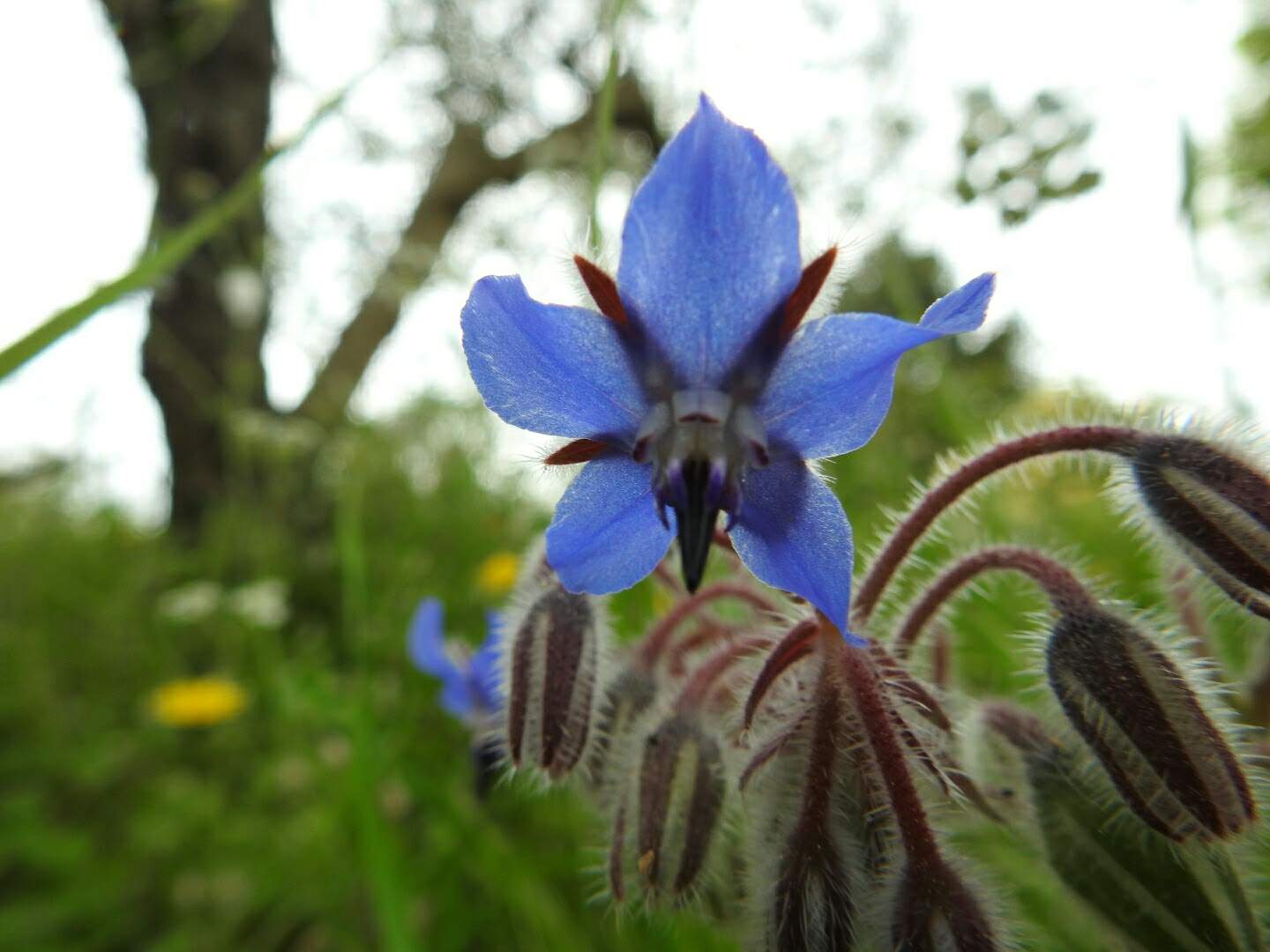
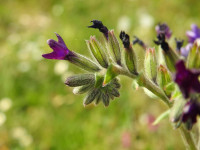
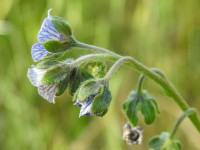
The inflorescence consists of terminal or axillary racemes, often short, with pedunculate flowers as long as or longer than the leaves; the pedicels are initially erect, then curved or turned downward at full bloom. The calyx is formed by 5 narrow, lanceolate, and linear sepals, divided almost to the base and covered with stiff hairs; during flowering it opens star-like and then closes over the fruit. The corolla is rotate, deep blue or blue-violet in color, rarely white, with a very short tube (throat) whitish or yellowish and 5 oval and acuminate lobes, 2-3 cm in diameter. In the throat of the corolla there are 5 white or cerulean scales. The stamens are 5, with filaments widened at the base and sagittate anthers of violet or blackish color, united to form a tubular structure.
The fruits are tetrachene (composed of four nutlets) oval in shape, light brown in color, with a finely ribbed and tuberculate surface at the apex. They are very hard and contain small seeds. The root system is not described in detail in the available sources, but as an annual herbaceous plant it has a superficial taproot.
Habitat and distribution
Borage is a common and widespread species throughout the Italian territory, also present in the rest of the Mediterranean area and Central Europe. It prefers ruderal environments, cultivated soils, vineyards, gardens, and uncultivated areas, especially if moist but well-drained. It grows on sandy, clayey, or mixed soils, generally fertilized or rich in organic matter. It is frequent from the plains up to about 800 meters in altitude, with occasional records up to 1500 m.
Its natural distribution is centered on the Mediterranean coasts, but it also extends northwards and eastwards, reaching continental areas. It is often naturalized in many regions, cultivated, and sometimes invasive.
Flowering period
Flowering extends from April to September, with some geographical variations related to local climate. Flowers appear in terminal or axillary racemes and last briefly, hanging as they mature. The plant produces flowers throughout the warm season, ensuring a long presence of blooms.
Ecology and pollination
Borage is a melliferous species highly appreciated by pollinating insects, particularly bees and bumblebees, which are attracted by its blue flowers and available nectar. The structure of the corolla and the presence of scales in the throat favor entomogamous pollination. The plant is hermaphroditic and thus equipped with both sexes, facilitating self-fertilization but also cross-pollination.
Seed dispersal occurs mainly by falling near the mother plant but can be facilitated by humans or animals that carry the seeds nearby. The plant tends to rapidly colonize disturbed environments and can behave as a weed in certain contexts.
Curiosities and traditional uses
Historically, borage has been used since the Middle Ages for its medicinal properties. Saint Albertus Magnus described it as a healing plant in the 13th century. In folk medicine, it is recognized for diuretic, sudorific, and anti-inflammatory properties, used to purify the blood, relieve rheumatism, cough, and sore throat. The seeds are a valuable source of gamma-linolenic acid, an omega-6 fatty acid that regulates the hormonal system and lowers blood pressure. The oil extracted from the seeds is free of toxic alkaloids and therefore safe for use.
In cooking, young leaves and flowers are edible and appreciated. They can be eaten raw in salads or cooked like spinach, used in soups, omelets, and fillings for fresh pasta. It is a traditional component of the Ligurian “preboggion,” a mix of wild herbs, and is also consumed in Campania with lentils. Its delicate aroma resembles cucumber, so it is often used as an aromatic herb, also for preserving cucumbers themselves. Candied flowers are used in pastry and can be frozen in ice cubes to decorate drinks. Macerated in white vinegar, they release a natural blue color.
Its therapeutic use is now discouraged due to the presence of pyrrolizidine alkaloids in the aerial parts, substances that are hepatotoxic, genotoxic, and potentially carcinogenic. However, these alkaloids are absent in the seeds and the oil derived from them, which can be used without risks. In folklore, borage was considered a plant of courage and cheerfulness: it was added to wine to lift the spirits, used by the Celts to inspire courage in warriors, and by the ancient Romans to combat melancholy and sadness.
Etymology
The generic name “Borago” has controversial origins. Some scholars derive it from the Arabic “abou rach” (father of sweat), referring to the plant’s sudorific properties. Others link it to the Latin “burra,” meaning coarse and hairy fabric, due to the roughness of the hairs covering stem and leaves. Some believe it derives from a corruption of “corago,” from “cor” (heart) and “ago” (I act), for its stimulating effects on the heart and mood. Finally, a Celtic origin “barrach,” meaning brave man, has been proposed.
The specific name “officinalis” indicates the traditionally attributed medicinal properties of the plant. In Italian it is commonly called “borragine” or “borraggine.”
Sources
- Acta Plantarum - Flora delle regioni italiane (actaplantarum.org)
- Acta Plantarum - Scheda di Mariella Zepigi
- Tela Botanica / H. Coste, "Flore descriptive et illustrée de la France"
- World Flora Online (WFO)
Characteristics
Where I found it (4 sightings)
Classification
- Kingdom
- Plantae
- Family
- Boraginaceae
- Full name
- Borago officinalis L.
- Life form
- Terofite scapose
Similar species
Search for species with similar characteristicsFurther reading
Noticed an error in the identification? Write to me
Other species of the same family
Boraginaceae
Explore
Other species of Boraginaceae