Botanical species
Moltkia suffruticosa
(L.) Brand
Erba perla rupestre
Description
Morphological description
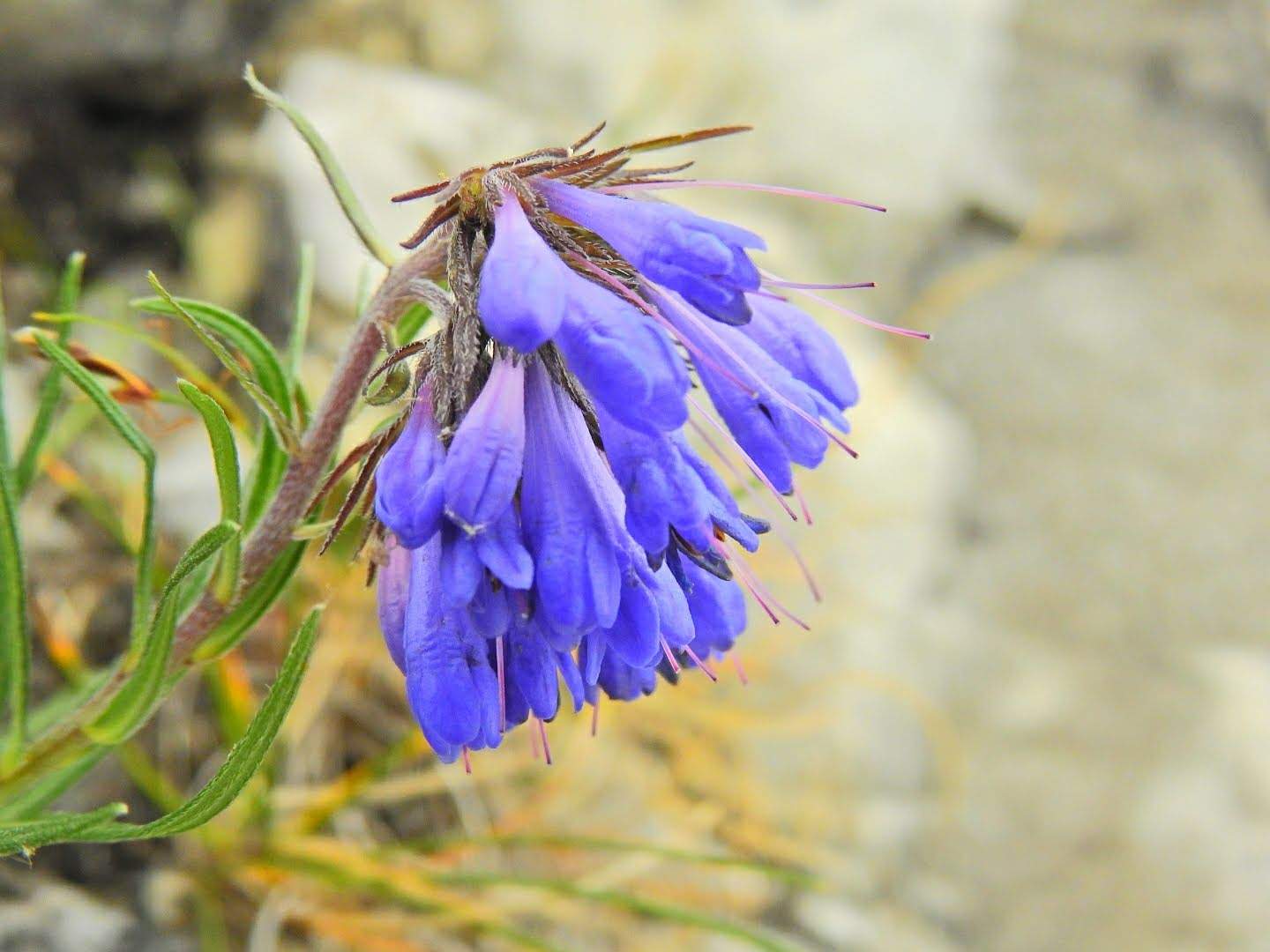
Perennial suffrutescent plant belonging to the family Boraginaceae, it has a tufted and ascending-branched habit with woody stems at the base, often twisted and divided into numerous flowering branches that can be nodding (pendulous) or ascending. The stem is characterized by a hirsute surface, covered with erect-appressed hairs about 0.6-1 mm long, giving a rough texture to the touch.
The leaves are linear, narrow and elongated in shape, with a length ranging from 3 to 6 cm. The lower leaves are very thin, with a width less than 1 mm, while the upper ones are slightly wider, between 1.7 and 2.5 mm. The upper surface of the leaf blade is dark green, while the lower surface is lighter.
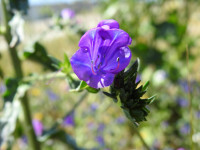
The inflorescence consists of dense cymes, often accompanied by bract leaves. The flowers are characterized by a corolla of violet-cerulean color, with a tube about 10 mm long and lobes of 3 mm. The calyx has linear teeth 4-5 mm long, fused only at the base. The style is protruding, 3-4 mm long, and stands out clearly beyond the corolla tube. The fruit consists of ovoid and curved mericarps, about 3 mm long.
The root system, typical of mountain plants, is well developed and anchoring, suitable for stabilizing the plant in rocky environments with thin soils.
Habitat and distribution
Endemic plant of Italy, its distribution is mainly limited to the Apuan Alps and the Venetian Prealps, particularly in the areas of Monte Grappa and the Vicenza area. It is also present in coastal and mountain environments, demonstrating some adaptability to different ecological conditions, provided they are characterized by rocky and well-drained substrates.
It prefers sunny or slightly shaded exposures, typical of mountain and prealpine areas, with generally poor soils, calcareous or siliceous, often very draining and shallow. Its presence is mainly reported at medium-high altitudes, typical of the Apuan Alps and the Venetian Prealps, where it manages to thrive in rock crevices and dry slopes.
Flowering period
Flowering mainly occurs between May and June. This period allows the plant to take advantage of spring and summer climatic conditions, with mild temperatures and a good availability of pollinating insects. No significant variations in flowering are known between the different distribution regions.
Ecology and pollination
The species mainly relies on entomogamous pollination, attracted by the violet and blue colored flowers that appear in dense cymes. The main pollinating insects are probably bees and other hymenopterans, attracted by the color and shape of the corolla, which facilitates access to nectar by pollinators.
Seed dispersal occurs through the mericarps, which, being ovoid and curved, could fall in the immediate vicinity of the mother plant or be transported by abiotic agents such as water or gravity, given the rupicolous and steep nature of the habitat.
Curiosities and traditional uses
There is currently no detailed information available on medicinal, food, or folkloric uses specific to this species. Its rarity and limited distribution make it a plant of interest mainly for botanical and conservation studies, rather than for traditional or popular uses.
Etymology
The scientific name Moltkia suffruticosa is a tribute to the German naturalist Joachim Godske Moltke, who was the founder of the Natural History Museum of Copenhagen. The term "suffruticosa" derives from Latin and indicates the suffrutescent characteristic of the plant, that is having woody stems only at the base, with the upper part herbaceous.
The Italian common name "Erba perla rupestre" probably refers to the rocky habitat ("rupestre") and the delicate beauty of its flowers, which evoke the brightness and preciousness of a “pearl”.
Sources
- Prof. S. Pignatti, "Flora d'Italia"
- Acta Plantarum - Flora delle regioni italiane (sheet by Giuliano Salvai)
Characteristics
Where I found it
The sighting locations of this species are not public for conservation reasons.
Classification
- Kingdom
- Plantae
- Family
- Boraginaceae
- Full name
- Moltkia suffruticosa (L.) Brand
- Life form
- Camefite suffruticose
Similar species
Search for species with similar characteristicsNoticed an error in the identification? Write to me
Other species of the same family
Boraginaceae
Explore
Other species of Boraginaceae