Botanical species
Myosotis scorpioides
L.
Water Forget-me-not
Description
Morphological description
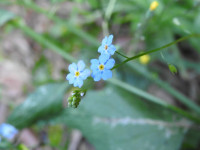
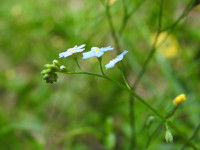
Perennial herbaceous plant of medium-small size, 15 to 50 cm tall, with generally ascending habit and sometimes prostrate at the base thanks to a creeping and stoloniferous rhizome. The stem is cylindrical or slightly angled, glabrous in the upper part and with sparse, appressed hairs oriented upwards, while at the base it has patent hairs directed outwards. The plant blackens upon drying.
The leaves are alternately arranged along the stem and have an oblanceolate or linear-oblanceolate shape, with dimensions ranging from 1 to 1.5 cm in width and 5 to 8 cm in length. Their surface is glabrescent or with appressed hairs directed towards the apex; rarely the lower leaves have reflexed hairs. The leaves are sessile, with attenuated base and acute apex.
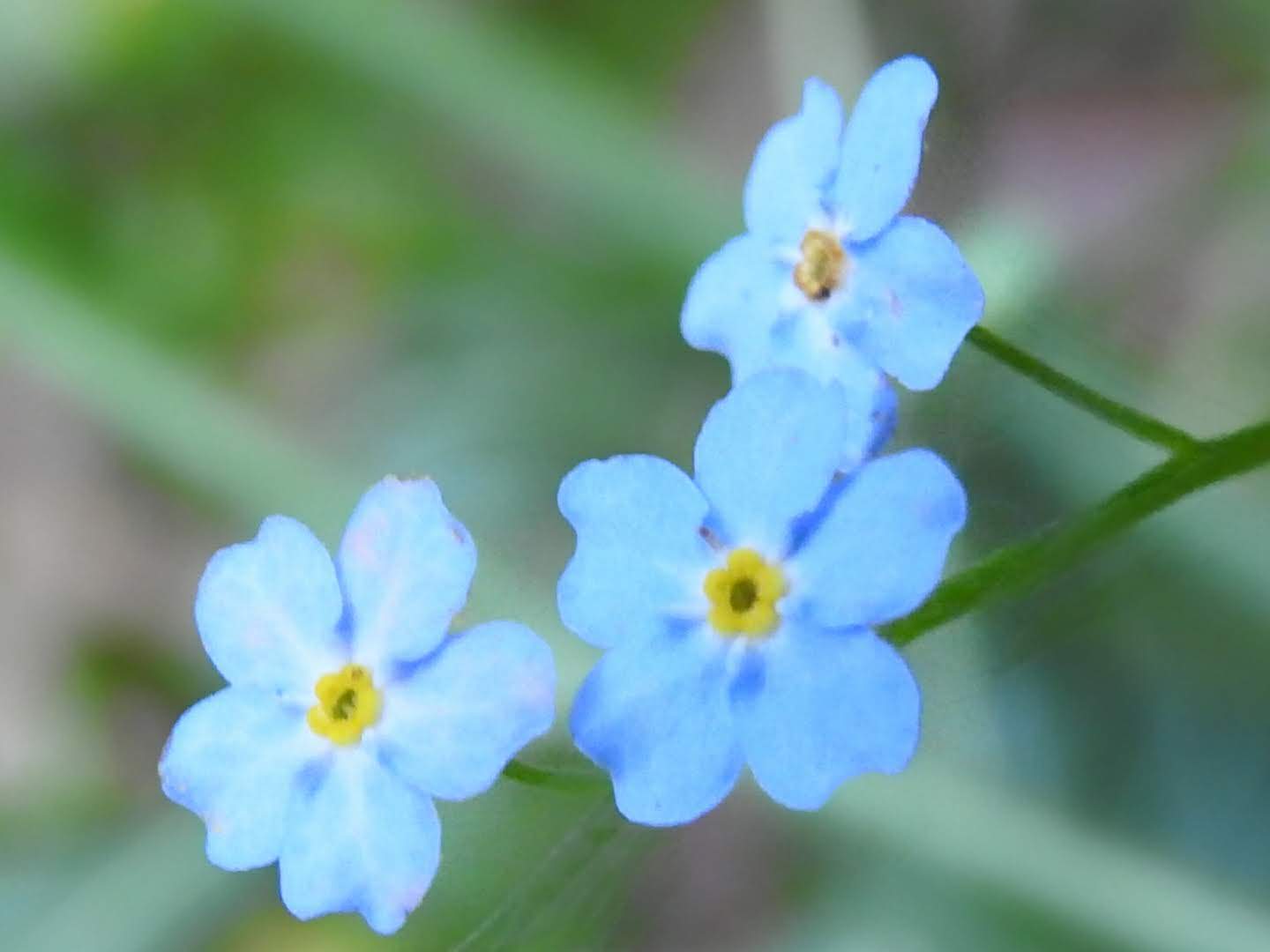
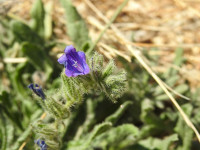
The inflorescence is terminal, short and dense, with the axis covered by appressed hairs. The flowers, measuring between 5 and 10 mm in diameter, are borne on peduncles 6-10 mm long that elongate during fruiting. The corolla is predominantly light blue or blue-violet, rarely with pinkish shades in the center, and has a flat corolla limb. The calyx, persistent and divided for about 2/5 or one third of its length, is covered by appressed hairs without crochiform hairs. The styles generally exceed the nutlets, which measure about 1.2-1.8 mm and are margined at the upper part.
The root system is fibrous, with shallow roots and sometimes creeping stolons that allow vegetative expansion of the plant.
Habitat and distribution
This species is widespread in Europe and Western Asia, with presence reported in various Italian regions including Friuli, Piedmont, Tuscany, Sardinia and other areas of the Peninsula, although the exact range requires further clarification. In Italy it grows mainly in wet habitats such as wet meadows, ditches, marshes and areas with moist or partially submerged soil, up to hill and subalpine elevations.
It prefers moist soils, often shallow and rich in organic matter, with variable exposure but generally in open and well-lit places where water stagnates or the soil remains constantly moist.
Flowering period
Flowering extends from June to September, with some geographical variations linked to latitude and altitude. In warmer climates or at lower elevations flowering can start as early as June, while in cooler or higher areas it lasts until September.
Ecology and pollination
The species lives in aquatic or marshy environments, where the soil is constantly moist or partially submerged. The morphology of the flowers, with light blue-violet corollas and flat limb, is suitable for attracting various pollinating insects, such as bees and dipterans, which promote entomogamous pollination.
The plant reproduces both sexually, through seed production (nutlets), and vegetatively thanks to stoloniferous rhizomes that allow local expansion and colonization of new wet areas. The seeds, small and slightly margined, are likely dispersed by water or by the action of small aquatic and terrestrial animals.
Curiosities and traditional uses
No particular ethnobotanical applications or specific traditional uses of this species are known in the Italian or Mediterranean context. However, the common name “Water Forget-me-not” recalls the popular tradition linked to the genus Myosotis, often associated with memory and affection. The ornamental and symbolic value of these plants is significant especially for their beauty and their presence in natural wet environments.
Etymology
The scientific name derives from Greek: Myosotis means “mouse ear”, referring to the rounded shape of the basal leaves, which resemble a mouse’s ear. The specific epithet scorpioides alludes to the shape of the inflorescence, which resembles the curled tail of a scorpion (similar to that of other species of the genus).
The Italian common name “Water Forget-me-not” refers to the best-known characteristic of the genus Myosotis, namely the small blue flower associated with memory and a sense of nostalgic affection, with the addition of “delle paludi” to differentiate it from other forget-me-not species that grow in less humid environments.
Sources
- Prof. P.V. Arrigoni, "Flora analitica della Toscana", "Flora dell'Isola di Sardegna"
- World Flora Online (WFO)
Characteristics
Scheda botanica
| Famiglia | Boraginaceae |
|---|---|
| Fioritura | giugno – settembre |
| Forma biologica | Scapose |
| Habitat | with blue flowers, Perennial plant, with blue-purple flowers |
Domande frequenti
- Quando fiorisce Water Forget-me-not?
- Water Forget-me-not fiorisce giugno – settembre.
- Che tipo di pianta è Water Forget-me-not?
- Water Forget-me-not è una Hemicryptophytes (Scapose) secondo la classificazione di Raunkiaer.
- A quale famiglia appartiene Water Forget-me-not?
- Water Forget-me-not appartiene alla famiglia botanica Boraginaceae.
Where I found it (3 sightings)
Classification
- Kingdom
- Plantae
- Family
- Boraginaceae
- Full name
- Myosotis scorpioides L.
- Life form
- Hemicryptophytes scapose
Similar species
Search for species with similar characteristicsNoticed an error in the identification? Write to me
Other species of the same family
Boraginaceae
Explore
Other species of Boraginaceae