Botanical species
Cerinthe major
L. subsp. major
Greater Honeywort
Description
Morphological description
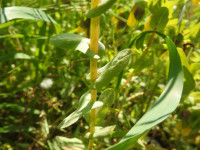
Annual herbaceous plant belonging to the Boraginaceae family, with a scapose habit, often leafless on the floral axis, and height varying between 20 and 80 cm. The stem is cylindrical, glabrous, ascending and strongly branched, with a glabrous surface and sometimes slightly glaucous, giving a waxy bluish-green coating.
The leaves are of two types: the lower ones are petiolate, spatulate in shape, with ciliate margins and herbaceous texture, measuring between 30 and 60 mm long and 7 to 15 mm wide, often spotted with white with well-visible tubercles on the upper surface and patent hairs along the margin. The middle and upper leaves are sessile, amplexicaul with a cordate base and have conspicuous rounded auricles measuring 3-6 cm by 1.5 cm. The upper surface of the leaves tends to blacken after drying.
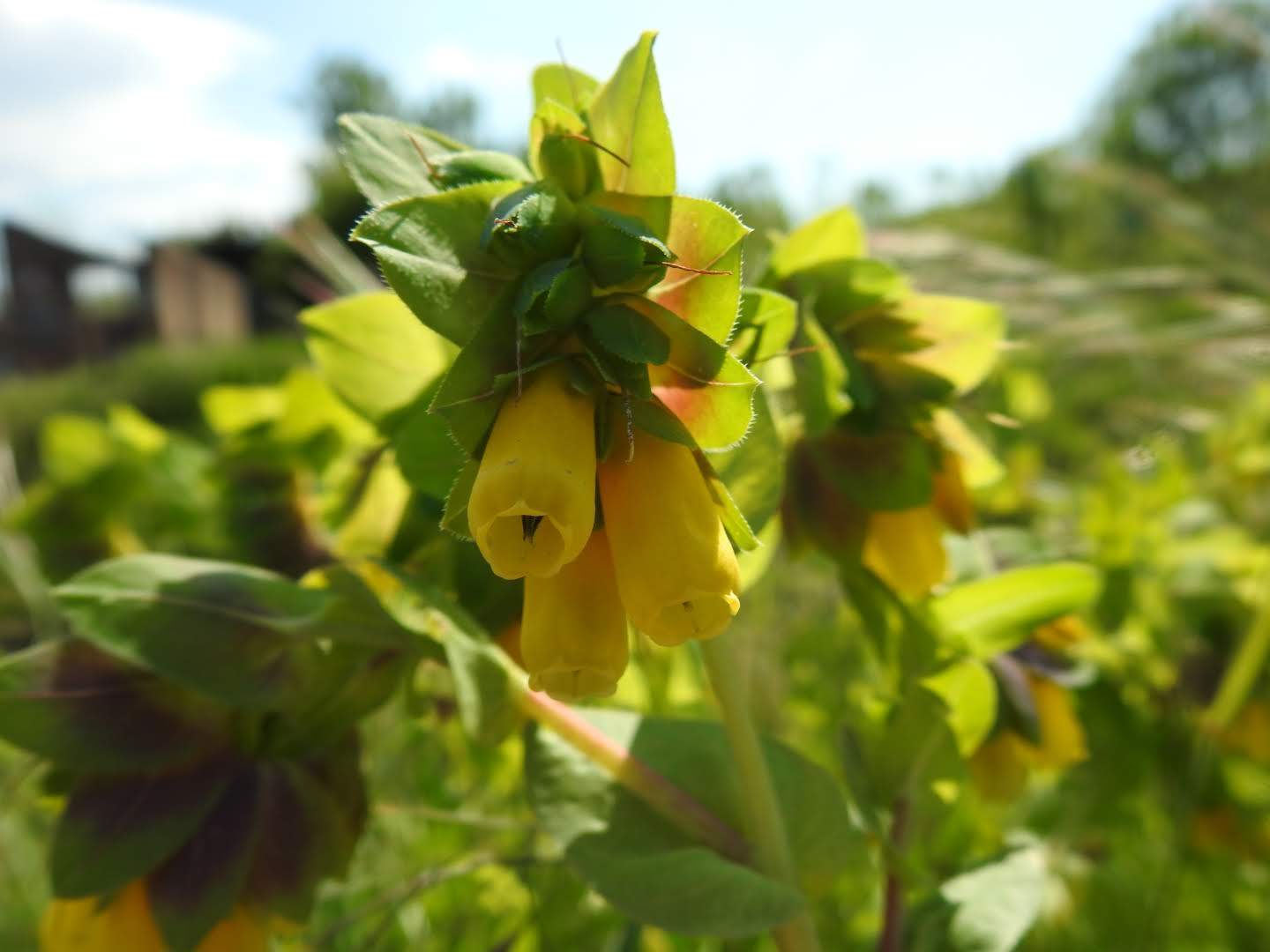
The inflorescence consists of pendulous and leafy racemes located at the ends of the branches. The flowers, with a scapose habit, are characterized by oval bracts, often enriched by a reddish-violet coloration, as long as or longer than the calyx. The calyx is divided into five unequal lobes, with sizes ranging from 1-2 x 7 mm for the smallest, up to 6 x 13 mm for the largest.
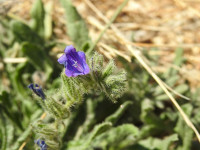
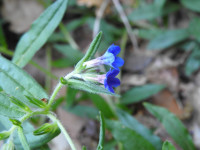
The corolla is tubular, up to 3 cm long and about 8 mm wide, yellow with brown-purple shades at the base and with a characteristic reddish or purplish ring in the throat area (around the middle of the corolla). The corolla lobes are very short, truncated, slightly denticulate and folded backward. Often the purple band can vary in extent, covering half or the entire corolla, or being almost absent, with a yellow-whitish corolla. The stamens are five, with violet anthers about 6 mm long placed on filaments of 4 mm, inserted in the lower part of the corolla at about one quarter of its length. The style protrudes from the corolla by about 2 mm.
The fruit is a microbasarium composed of ovoid mericarps, brown-reddish in color.
Habitat and distribution
Steno-Mediterranean species, its distribution extends along the coasts and Mediterranean areas of Italy, from the North to the Central-South (Italian peninsula with an area including locations such as San Marino, Cesena, Perugia, Volterra, Lucca, Carrara), as well as in Sicily, Sardinia and Corsica. It grows mainly in uncultivated lands, road edges and meadows, preferring sunny exposures and well-drained soils. It is found at altitudes ranging from 0 up to about 1000 meters above sea level.
Flowering period
The flowering typically extends from November to June, with some geographic variations related to the Mediterranean area in which it is found. In particular, in the southernmost zones or with mild climates, flowering can start early and last longer.
Ecology and pollination
This species is particularly appreciated by bees, from which its scientific name also derives (from the Greek "keros" = wax and "anthos" = flower, for the waxy appearance and frequent visits by pollinating insects). The tubular corolla and the characteristic purple ring act as a visual signal for pollinating insects, especially bees and other melliferous insects. The plant is therefore an important melliferous resource in the Mediterranean, contributing to the biodiversity of pollinating insects.
Seed dispersal occurs through the small fruits with ovoid mericarps, which detach easily and can be transported by wind or animals. Being an annual plant, it completes its cycle in one season, relying on seed production for reproduction and population maintenance.
Curiosities and traditional uses
Cerinthe major is an edible and medicinal plant, traditionally used in folk medicine for its diuretic, antihemorrhagic, antineuralgic, anti-inflammatory and astringent properties. In popular phytotherapy it was also used to relieve eye inflammations.
From a dietary point of view, the young leaves and flowers are used as mixed salad greens, both raw in salads and cooked together with other herbs. The taste is similar to peas, with a slightly bitter aftertaste. The plant contains active principles such as mucilages, tannins, essential oils and nitrate salts.
Ornamentally, varieties of Cerinthe major have been selected to beautify gardens, thanks to the vivid color of the flowers and bracts.
Etymology
The scientific name "Cerinthe" derives from the Greek "keros" (wax) and "anthos" (flower), referring to the shape and waxy texture of the flowers, which resemble small candles. This denomination was originally given by Tournefort and confirmed by Linnaeus. The specific epithet "major" indicates the larger size compared to other related species of the genus.
The Italian common name "Greater Honeywort" recalls the characteristic coloration of the flowers and the larger habit of the plant compared to other varieties or similar species.
Sources
- Prof. S. Pignatti, Flora d'Italia
- Acta Plantarum - Flora delle regioni italiane (sheet by Marinella Zepigi)
Characteristics
Where I found it (11 sightings)
Classification
- Kingdom
- Plantae
- Family
- Boraginaceae
- Full name
- Cerinthe major L. subsp. major
- Synonyms
- Cerinthe gymnandra Gasp.; Cerinthe major L. subsp. elegans (Fiori) Giardina & Raimondo; Cerinthe major L. subsp. gymnandra (Gasp.) Rouy
- Life form
- Terofite scapose
Similar species
Search for species with similar characteristicsFurther reading
Noticed an error in the identification? Write to me
Other species of the same family
Boraginaceae
Explore
Other species of Boraginaceae