Botanical species
Myosotis arvensis
(L.) Hill subsp. arvensis
Field Forget-me-not
Description
Morphological description
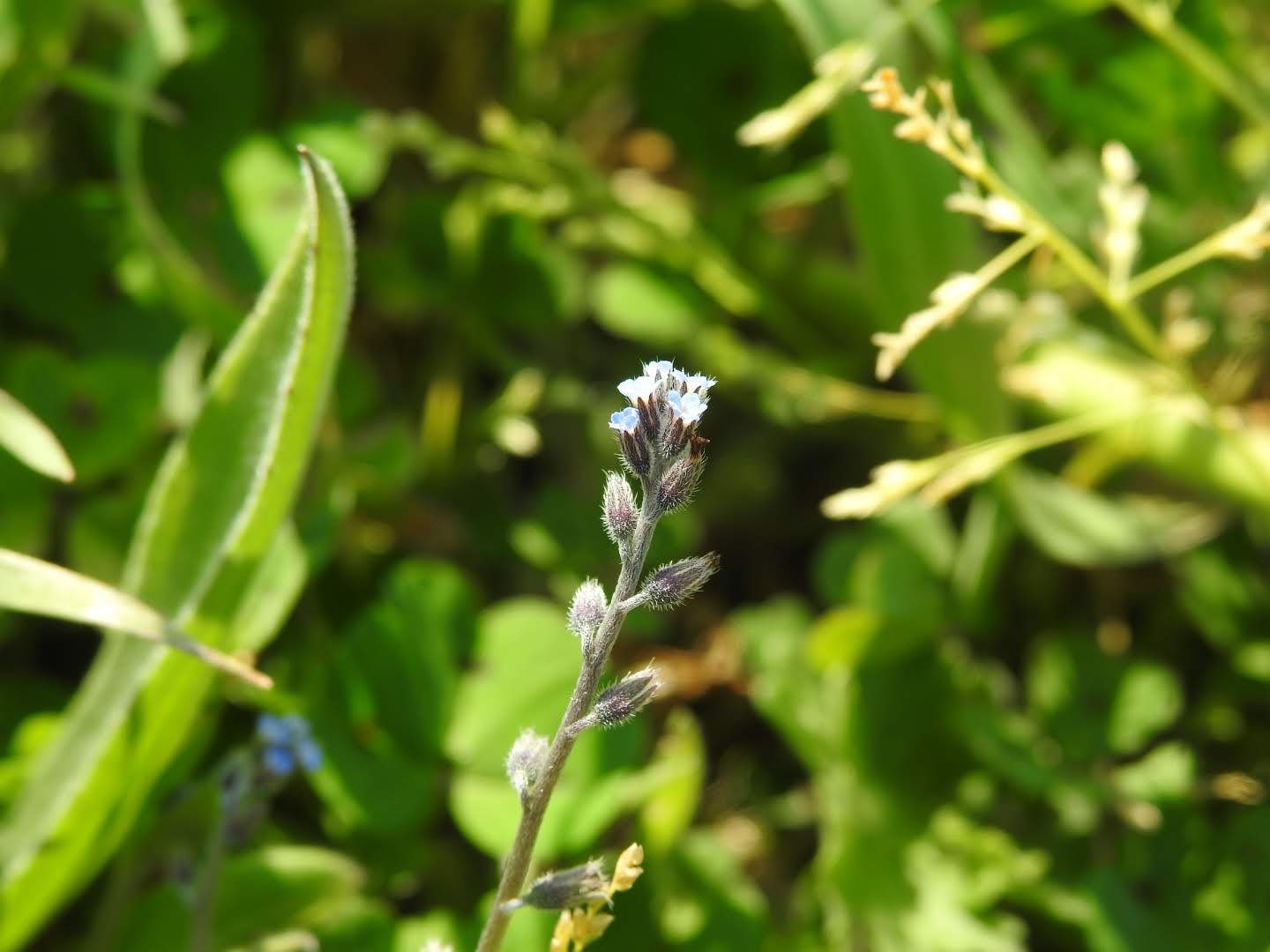
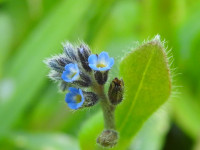
The Field Forget-me-not is an annual herbaceous plant, rarely biennial, belonging to the Boraginaceae family, presenting an erect or ascending herbaceous habit, generally branched from the base. The height ranges between 10 and 30 cm, but can reach up to 60 cm in favorable conditions. The stem is thin, robust, and widely branched, covered with straight hairs: in the lower part the hairs are patent (i.e., spread outward), while in the upper part they become appressed (adhering to the stem).
The basal leaves are gathered in a rosette, oblanceolate in shape, with dimensions ranging from 5-9 mm in width to 15-27 mm in length, up to a maximum of 15 x 80 mm; they are subsessile (thus with very short or absent petiole) and acute at the apex. The cauline leaves are smaller, sessile, alternately arranged along the stem, and all are covered by appressed straight hairs oriented toward the leaf tip.
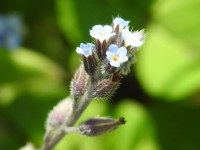
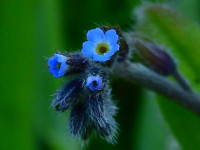
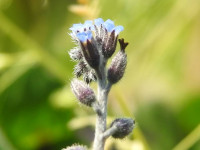
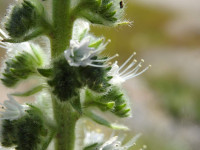
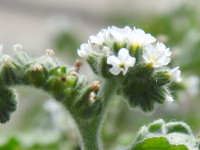
The inflorescence is an elongated multiflorous scorpioid cyme, lacking bracts, with thin, sub-erect peduncles generally longer than the calyx during fruiting. The calyx is gamosepalous, funnel-shaped, 2-2.5 mm long during flowering and elongates up to 5-7 mm during fruiting; the lobes are narrowly triangular and the calyx is covered with patent hooked hairs.
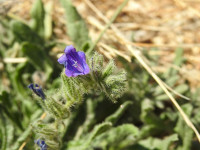
The flowers, characteristic and easily recognizable, have five light blue or bluish petals, about 3 mm in diameter, arranged in a cup shape with a yellow throat in the center. The buds initially appear pinkish. The corolla tube is about 2 mm long. There are five stamens, with white filaments inserted in the upper part of the corolla tube and yellow anthers.
The fruit is a schizocarp composed of four mericarps called nutlets, each about 1.2 x 2 mm, ovate in shape with an acute apex and rounded base; young nutlets are greenish, turning brownish-black at maturity.
The root system is short and oblique, suitable for supporting the plant in the typical conditions of its habitats.
Habitat and distribution
The Field Forget-me-not is a species widely distributed throughout Italy and the Mediterranean basin, extending from Europe to Western Asia. It is common in anthropized and semi-natural environments such as cultivated fields, roadside edges, embankments, flower beds, and paths. It prefers clayey and fresh soils, often in disturbed and sunny or well-lit areas.
In Italy it is present throughout the territory, from the plains up to medium altitudes; the species does not have a precise altitudinal limitation but prefers hilly and low mountain areas where it finds favorable growth conditions.
Flowering period
Flowering mainly occurs between March and July, with possible local variations related to climate and altitude. In warmer areas flowering can start as early as March, while in cooler zones it tends to concentrate between April and June.
Ecology and pollination
The Field Forget-me-not reproduces through seeds developing in small schizocarp fruits. Pollination is entomogamous, mainly carried out by pollinating insects attracted by the blue color of the flowers and the presence of the yellow throat, which acts as a visual guide for pollinators. Common visiting insects include bees, bumblebees, and other hymenopterans, as well as dipterans and beetles. The flower structure, with a corolla tube and stamens inserted in the upper part, facilitates insect contact with the reproductive structures.
Seed dispersal occurs by falling near the mother plant, with possible secondary transport by animals or water, but no specific long-distance dispersal strategies are known.
Curiosities and traditional uses
The common name “Field Forget-me-not” is linked to numerous legends and popular traditions. One of the most well-known tells of a medieval knight who, while picking a bouquet of these flowers for his beloved, fell into a river and, before drowning, shouted “forget me not”. Hence the symbolic meaning of the flower as an emblem of love and affectionate memory.
Historically, the Field Forget-me-not has also had uses in popular herbal medicine, although with limited specific documentation: it was sometimes used in infusions for its soothing properties, especially in the treatment of eye inflammations and as a traditional remedy for cough. However, today it is considered more an ornamental or wildflower than a medicinal plant of significance.
The flower is also highly appreciated in gardening, where some related species are cultivated to beautify flower beds and gardens, thanks to the delicacy of its small bluish flowers.
Etymology
The genus name “Myosotis” derives from the Greek “mys” (mouse) and “ous, otos” (ear), referring to the shape of the leaves that resemble mouse ears. The specific name “arvensis” comes from the Latin “arvum”, meaning field or arable land, highlighting the typical habitat of the species.
The Italian common name “Nontiscordardimè” dates back at least to the 15th century and is closely linked to the romantic and popular tradition associating the flower with memory and love.
Sources
- Prof. P.V. Arrigoni, "Flora analitica della Toscana", "Flora dell'Isola di Sardegna"
- Acta Plantarum - Flora delle regioni italiane (scheda di Roberta Alberti)
Characteristics
Scheda botanica
| Famiglia | Boraginaceae |
|---|---|
| Fioritura | marzo – luglio |
| Forma biologica | Scapose |
| Habitat | with blue flowers, annual plant |
Domande frequenti
- Quando fiorisce Field Forget-me-not?
- Field Forget-me-not fiorisce marzo – luglio.
- Che tipo di pianta è Field Forget-me-not?
- Field Forget-me-not è una Therophytes (Scapose) secondo la classificazione di Raunkiaer.
- A quale famiglia appartiene Field Forget-me-not?
- Field Forget-me-not appartiene alla famiglia botanica Boraginaceae.
Where I found it (23 sightings)
Classification
- Kingdom
- Plantae
- Family
- Boraginaceae
- Full name
- Myosotis arvensis (L.) Hill subsp. arvensis
- Synonyms
- Myosotis scorpioides L. var. arvensis L.
- Life form
- Therophytes scapose
Similar species
Search for species with similar characteristicsFurther reading
Noticed an error in the identification? Write to me
Other species of the same family
Boraginaceae
Explore
Other species of Boraginaceae