Botanical species
Anchusa undulata
L. subsp. hybrida (Ten.) Bég.
Undulate alkanet
Description
Morphological description
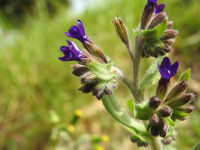
Biennial plant generally 15 to 90 cm tall, Anchusa mollis with wavy leaves has an erect or branched-ascending habit, with darkly angled stems covered by a dense indumentum of fine, long, and more or less dense hairs mixed with shorter hairs. The stems branch from the base, giving the plant a compact and bushy structure.
The leaves are highly variable in shape and size. The basal leaves are lanceolate or elliptic-obovate, with an obtuse apex and often wavy margins, from which the common name derives; at the base they taper forming a short petiole. The cauline leaves are similar but progressively smaller and sessile. The leaf surface is covered by fine hairs contributing to a velvety appearance.
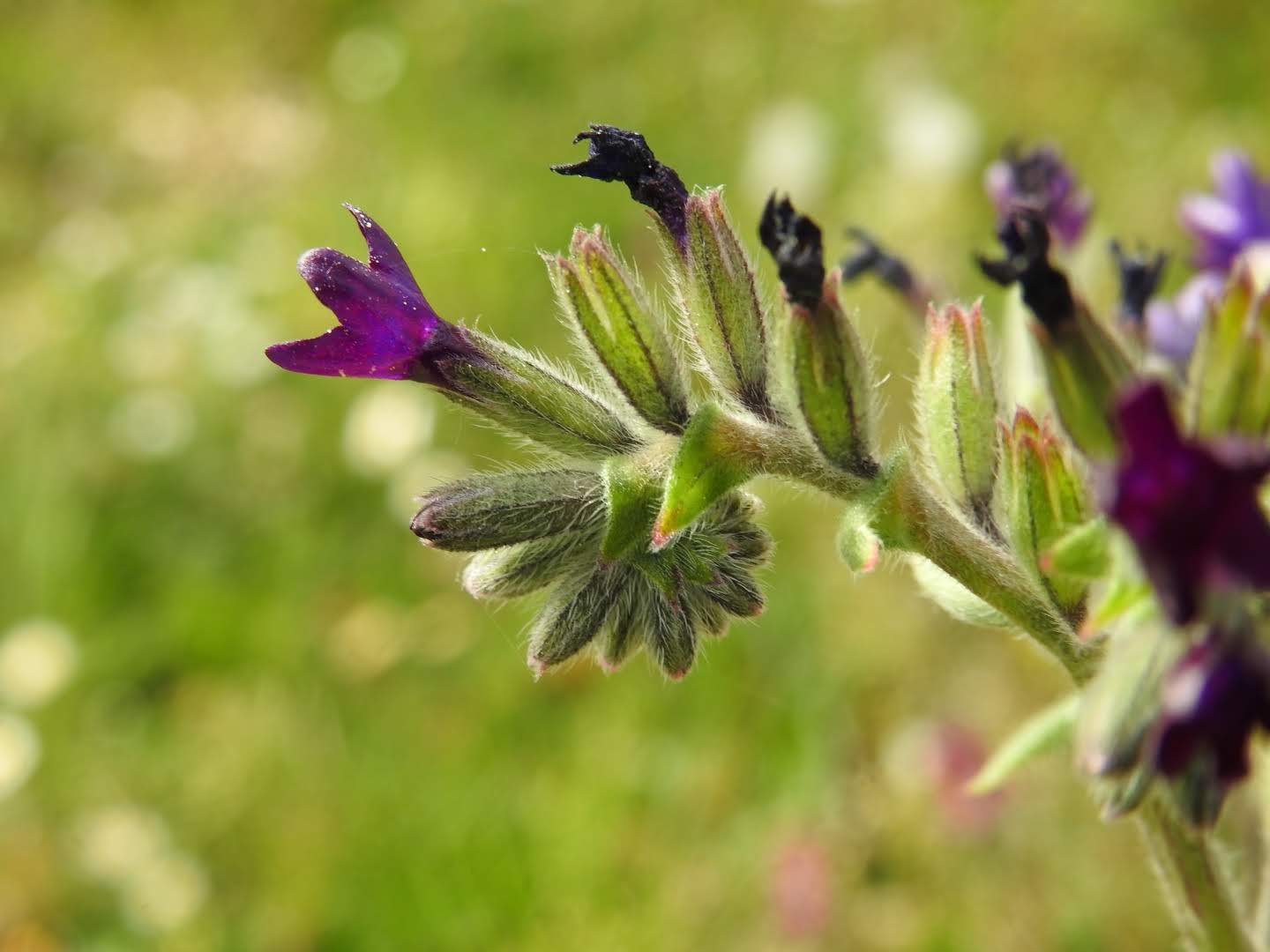
The inflorescence consists of numerous branched cymes, which elongate further during fruiting. The bracts are ovate-lanceolate, acute, not cordate at the base, 3 to 5 mm long during flowering and shorter than the calyx. The calyx measures 5 to 8 mm, is accrescent during fruiting and has five lanceolate, subacute teeth, longer or at least equal to the tube of the calyx itself.
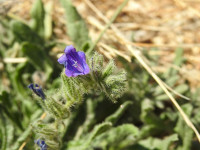
The individual flowers are actinomorphic and dark blue or violet in color, with a campanulate corolla formed by a straight tube 7-10 mm long and a limb with deltate lobes 6-12 mm long, more or less acute and sub-erect. The filaments are inserted below the base of the coralline scales, with the anthers partially or not at all overlapping them. The style measures 4 to 11 mm and the stigma is ovoid and bilobed.
The fruits are obliquely oblong-ovoid mericarps with a blunt apex. The chromosome number is 2n=16. The root system is not described in detail in the available sources.
Habitat and distribution
Anchusa mollis with wavy leaves is a steno-Mediterranean species, widespread along the Mediterranean coasts, with a range that includes the Olive region. In Italy it is mainly present in Sardinia, both in coastal and mountainous environments, and in other mountainous regions of the Mediterranean basin. It is found in rocky mountain pastures, on dry slopes and garrigues, as well as at road margins, in uncultivated and cultivated soils. It grows from lowlands up to mountainous areas, preferring sunny exposures and well-drained soils, often poor and stony.
Flowering period
Flowering extends from March to June, with possible variations related to altitude and geographic location. In milder climates and lower altitudes, flowering can start early in spring, while in mountainous areas it may continue until early summer.
Ecology and pollination
The species is pollinated by pollinating insects, particularly bees and other hymenopterans, attracted by the blue-violet flowers rich in nectar. The campanulate corolla and the arrangement of the stamens favor entomophilous pollination. Seed dispersal probably occurs by falling at a short distance from the mother plant, typical of plants colonizing open and dry habitats, although specific details are not documented.
Curiosities and traditional uses
Anchusa mollis with wavy leaves, like other species of the genus Anchusa, has traditionally been used for medicinal and food purposes. In folk medicine it is used as a laxative, diuretic, refreshing agent, and for the treatment of rheumatism. It is included in the list of spontaneous edible plants of the Basilicata region, where it is locally collected and used.
Historically, the genus Anchusa is known for producing a red dye extracted from the root of Anchusa officinalis, used in antiquity as a “cosmetic” for facial makeup by Greek and Roman women. Although this property is not specifically attributed to subsp. hybrida, it is likely that this subspecies also possesses similar characteristics.
Etymology
The generic name “Anchusa” derives from the Greek “ankousa,” meaning “cosmetic,” recalling the traditional use of the roots of some species to produce a red dye used for makeup. The specific epithet “undulata” refers to the often wavy leaf margins, a distinctive and easily recognizable characteristic of the plant. The Italian common name “buglossa a foglie ondulate” reflects this morphological peculiarity.
Sources
- Prof. S. Pignatti, Flora d'Italia
- Acta Plantarum - Flora delle regioni italiane (scheda di Gianluca Nicolella)
Characteristics
Where I found it (12 sightings)
Classification
- Kingdom
- Plantae
- Family
- Boraginaceae
- Full name
- Anchusa undulata L. subsp. hybrida (Ten.) Bég.
- Synonyms
- Anchusa hybrida Ten.
- Life form
- Emicriptofite bienni
Similar species
Search for species with similar characteristicsNoticed an error in the identification? Write to me
Other species of the same family
Boraginaceae
Explore
Other species of Boraginaceae