Botanical species
Symphytum tuberosum
L. subsp. angustifolium (A.Kern.) Nyman
Tuberous Comfrey
Description
Morphological description
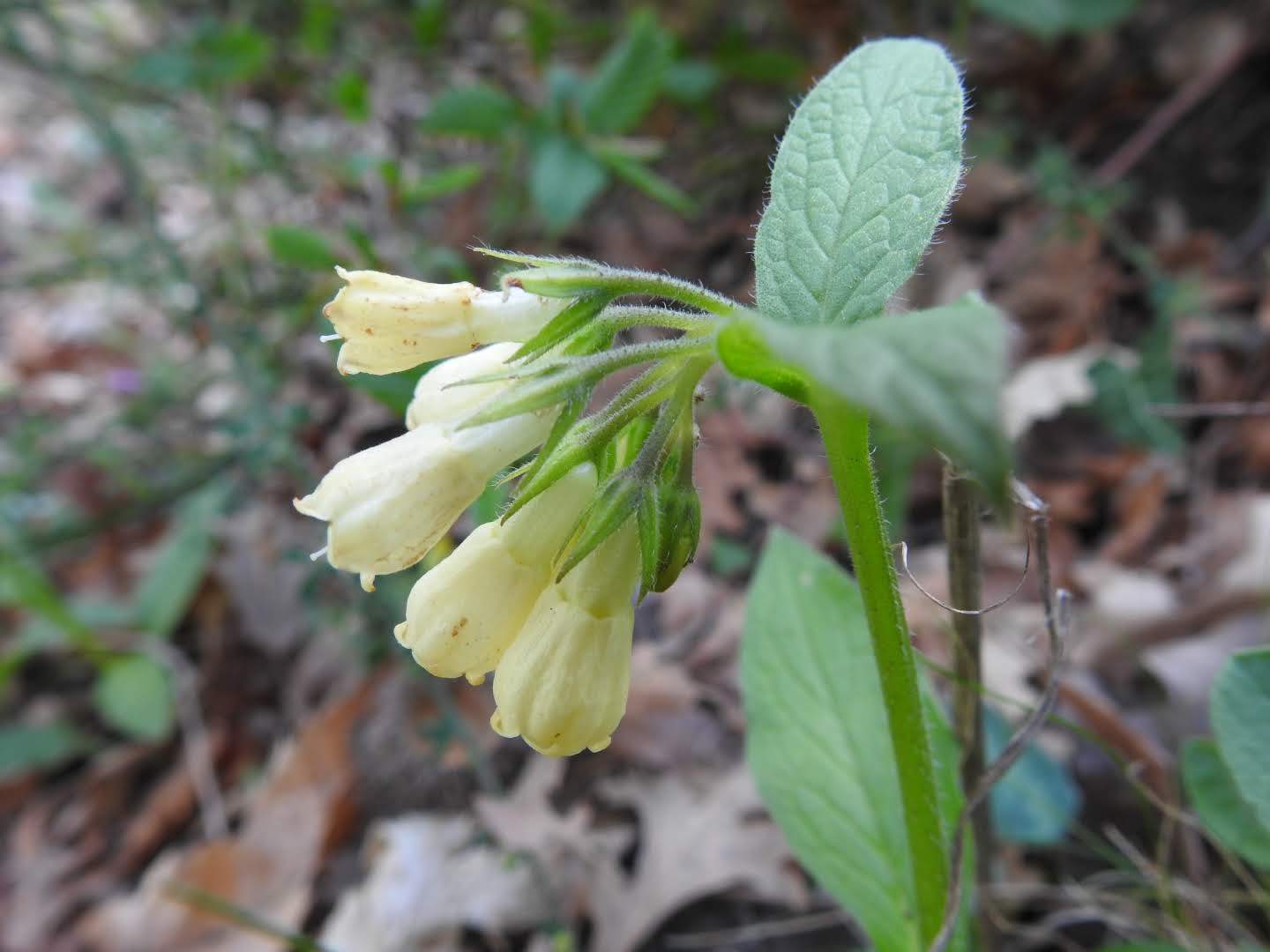
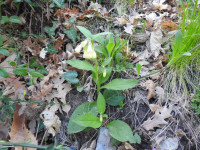
Perennial herbaceous plant belonging to the Boraginaceae family, characterized by an erect habit and a height generally ranging between 15 and 40 cm. The stem is hirsute, with rough hairs and scattered bristles, angular or slightly rounded in cross-section, with narrow wings partially extending along the internodes. The surface of the stem is covered by appressed hairs about 0.1-0.2 mm and rare longer bristles (1.0-1.2 mm).
The leaves are heterophyllous, with entire margins and herbaceous texture. The larger leaves are generally ovate-oblong or obovate in shape, with dimensions reaching 3-12 cm in length and 3-4 cm in width. The median leaves, larger than the lower and upper ones, are sessile or with a short petiole, sometimes winged up to half the internode, but never fully winged. The leaf base narrows and extends into a wing that partially wraps around the stem. The lower leaves are smaller and often have a short petiole.
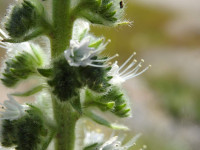
The flowers are grouped in dense, pendulous cymes and are characterized by a pale yellow or ochre corolla, with a tube length between 12 and 20 mm. The corolla has five small, rounded lobes bent backward, about 1.5 mm long. The scales inside the corolla throat are triangular and do not protrude beyond the corolla edge. The calyx is hirsute, deeply notched, with linear teeth about 7-8 mm long, approximately three times longer than the underlying calyx tube. The style slightly protrudes from the corolla (1-2 mm). The anthers are about twice as long as the filament.
The fruits are ovate achenes, smooth, shiny, and gray-brown in color.
The root system consists of a superficial tuberous rhizome, with swellings shaped like nodes or tubers, from which the specific name "tuberosum" derives. The rhizome is not stoloniferous and develops horizontally underground.
Habitat and distribution
A species typical of southeastern European regions, with a Pontic range centered around the Black Sea, Tuberous Comfrey is mainly present in the Carpathian-Danubian region and some areas of continental Italy, excluding the main island archipelagos such as Sicily and Corsica, where its presence is uncertain or replaced by related species. In Italy, it is mainly distributed in woodland areas and along watercourses, where it prefers humid and shady environments.
It grows from the plains up to mountain elevations of 1500-1850 meters, frequenting grassy deciduous forests, forest edges, hedgerows, and areas refreshed by canals or watercourses. The soil is generally moist, well-drained, and rich in organic matter, with exposure predominantly in shade or partial shade.
Flowering period
The species flowers mainly between March and May, with possible extension until June in some areas or under favorable climatic conditions. No significant geographic variations in flowering period have been reported within the Italian range.
Ecology and pollination
Tuberous Comfrey reproduces sexually through seeds and vegetatively through the tuberous rhizome. The pale yellow flowers are pollinated by pollinating insects, which are attracted by the corolla and the scales present in the flower throat. Pollination is entomogamous, and the corolla shape facilitates access for pollinating insects.
Seed dispersal occurs through smooth and shiny achenes that can be transported by abiotic factors such as water or by animals, although no detailed specific data on dispersal mode are available.
Curiosities and traditional uses
Like many species of the genus Symphytum, Tuberous Comfrey has a tradition of medicinal and food uses. The roots and aerial parts are known for their emollient, healing, expectorant, analgesic, and vulnerary properties. They have been traditionally used in folk medicine for treating wounds, inflammations, and respiratory disorders.
From a dietary perspective, the plant is edible, but it is important to emphasize that medicinal and alimentary uses must be practiced with caution and knowledge, considering the presence of active compounds that can be toxic if not properly dosed.
The generic name Symphytum derives from the Greek "syn" (together) and "phyton" (plant), referring to the plant's healing properties, which promote the "union" of broken bones or wounds. The specific epithet "tuberosum" alludes to the presence of tubers in the rhizome, while the subspecies "angustifolium" refers to the narrow leaves compared to other forms.
The Italian common name "consolida tuberosa" precisely recalls this rooting characteristic and its belonging to the comfrey group, plants traditionally used for their medicinal virtues.
Sources
- Prof. S. Pignatti, "Flora d'Italia"
- Acta Plantarum - Flora delle regioni italiane (scheda di Silvano Radivo)
- World Flora Online (WFO)
Characteristics
Scheda botanica
| Famiglia | Boraginaceae |
|---|---|
| Fioritura | marzo – maggio |
| Forma biologica | Rhizomatous |
| Habitat | with yellow flowers, Perennial plant |
| Uso officinale | Pianta officinale |
Domande frequenti
- Quando fiorisce Tuberous Comfrey?
- Tuberous Comfrey fiorisce marzo – maggio.
- Che tipo di pianta è Tuberous Comfrey?
- Tuberous Comfrey è una Geophytes (Rhizomatous) secondo la classificazione di Raunkiaer.
- A quale famiglia appartiene Tuberous Comfrey?
- Tuberous Comfrey appartiene alla famiglia botanica Boraginaceae.
Where I found it (8 sightings)
Classification
- Kingdom
- Plantae
- Family
- Boraginaceae
- Full name
- Symphytum tuberosum L. subsp. angustifolium (A.Kern.) Nyman
- Synonyms
- Symphytum tuberosum L. subsp. nodosum (Schur) Soó
- Life form
- Geophytes rhizomatous
Similar species
Search for species with similar characteristicsFurther reading
Noticed an error in the identification? Write to me
Other species of the same family
Boraginaceae


Explore
Other species of Boraginaceae