Botanical species
Heliotropium europaeum
L.
European heliotrope
Description
Morphological description
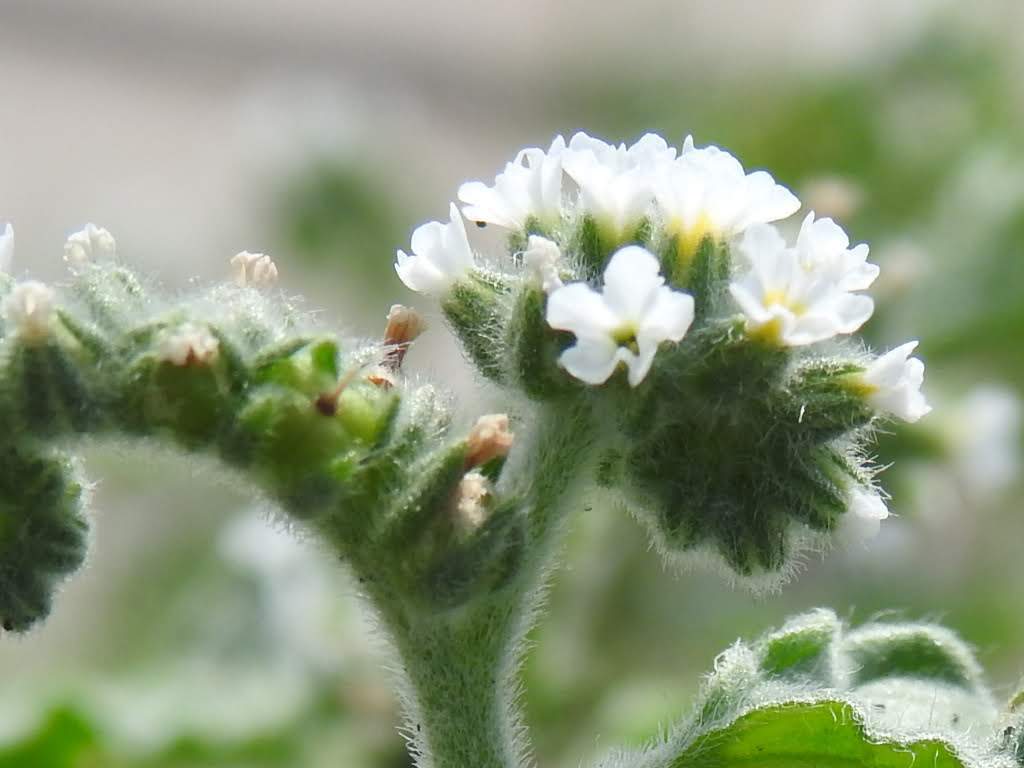
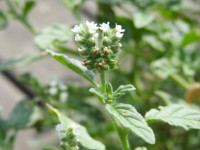
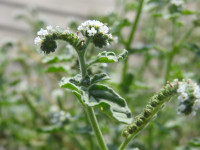
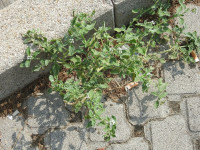
Annual herbaceous plant, the European Heliotrope presents a variable height between 5 and 50 cm. The stem habit can be erect or prostrate-ascending, often very branched and corymbose, with branches developing also laterally. The stem is covered by a dense pubescence of appressed hairs, giving the plant a velvety or tomentose appearance of green-grayish color.
The leaves are arranged alternately along the stem and all have a petiole, generally between 1 and 4 cm long. The leaf blade is elliptic or elliptic-lanceolate in shape, with dimensions approximately between 1.5-4 cm in length and 1-3 cm in width. The leaf surface is pubescent and rough, with bulbous-based hairs, of more or less intense green color, with lighter shades (gray-green) on the lower side. The base is generally cuneate or rounded, while the apex ranges from obtuse to acute. The main and secondary veins are well evident, contributing to the membranous consistency of the leaves.
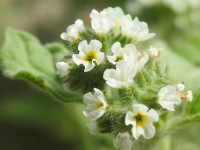
The inflorescence consists of scorpioid cymes, simple or bifurcated, 2-10 cm long, borne on naked peduncles of 1-5 cm, located terminally or axillary. The flowers are small, sessile or shortly pedunculate, grouped in dense and elongated racemes, often gathered in groups of two or three. The corolla is white, sometimes with whitish-lilac shades, measuring between 2 and 5 mm, with a well-developed corolla tube, longer than its diameter, and a limb formed by five rounded lobes, often yellowish at the throat. The calyx is divided to the base into five lanceolate sepals, persistent after flowering, about 0.4-0.8 mm wide, covered with strigose or tomentose hairs, and it widens or folds after fruit drop.
The stamens are five, included in the corolla tube, with ovate-oblong anthers about 1 mm long, attached at half the tube. The ovary is superior, globose, about 0.5-0.7 mm in diameter, with a long, conical, and deeply bifid stigma, about 1.2-1.5 mm long, often glabrous or with slight pubescence at the top.
The fruit is formed by four ovate mericarps (nutlets), about 2-3 mm, arranged to form a globose body. The fruit surface is ridged or tuberculate, glabrous or slightly pubescent, and the mericarps separate only at maturity. The root system is fine and poorly developed, suitable for loose and dry soils.
Habitat and distribution
This species is mainly widespread in Mediterranean regions and some areas of Western Asia and North Africa, present throughout Italy, from the plains up to about 600 meters altitude. It is frequent in anthropized or semi-natural environments, such as cultivated fields, gardens, uncultivated lands, ruins, road edges, and urban environments, preferring dry, arid, stony or sandy soils, with predominantly sunny exposure.
In Italy it is fairly common, especially in central-southern regions and the major islands, with a distribution that tends to decrease in the colder northern areas. In the Mediterranean basin it is mainly found in temperate-warm and subdesert climates.
Flowering period
Flowering extends from June to November, peaking between July and September. In some warmer Mediterranean areas it can start as early as June, while in cooler zones it may continue until October. The long flowering duration allows for an extended period of pollination and seed production.
Ecology and pollination
The European Heliotrope is a scapose therophyte, with an elongated floral axis often leafless, a feature that favors flower exposure to pollinating insects. The flowers are odorless and produce nectar visible mainly at the corolla throat, which is yellowish, facilitating the attraction of pollinating insects, especially small hymenopterans and dipterans. The flower structure, with stamens included in the corolla tube and a protruding bifid stigma, allows effective pollen deposition and collection during insect visits.
Seed dispersal occurs mainly by dropping near the mother plant, but the position of the fruits and their separation at maturity also facilitate secondary dispersal by wind or animal passage. The presence of hairs on the stem and leaves provides some protection against dehydration, adapting it to arid and sunny habitats.
Curiosities and traditional uses
The European Heliotrope has been known since the Middle Ages for some properties attributed to it in popular and magical contexts. It was believed that the plant could prolong life, act as an antidote against snake bites, and even render invisible those who carried it. These beliefs reflect the symbolic importance of heliotrope linked to its name and solar movement.
From a pharmacological point of view, the plant contains hepatotoxic alkaloids such as heliotropine and lasiocarpine, which make medicinal use potentially dangerous if uncontrolled. Traditionally, the aerial part of the plant has been used as a sedative, analgesic, and astringent, but its sale and administration are regulated and limited to pharmacies due to its toxicity.
No safe alimurgic uses are documented, and any consumption without proper supervision is discouraged. The presence of toxic compounds makes it a species to handle with caution.
Etymology
The genus name “Heliotropium” derives from the Greek “hèlios” (sun) and “trèpo” (to turn), referring to the ability of some species of the genus to follow the sun’s movement during the day, a phenomenon known as heliotropism. The specific name “europaeum” indicates the European distribution of the species.
The Italian common name “European heliotrope” directly recalls the scientific name, emphasizing both the typical movement of the flowers toward the sun and the geographical area of reference.
Sources
- Prof. P.V. Arrigoni, "Flora analitica della Toscana", "Flora dell'Isola di Sardegna"
- Acta Plantarum - Flora delle regioni italiane
- Tela Botanica / H. Coste, "Flore descriptive et illustrée de la France"
- World Flora Online (WFO)
Characteristics
Where I found it (11 sightings)
Classification
- Kingdom
- Plantae
- Family
- Boraginaceae
- Full name
- Heliotropium europaeum L.
- Synonyms
- Heliotropium dolosum De Not.
- Life form
- Terofite scapose
Similar species
Search for species with similar characteristicsFurther reading
Noticed an error in the identification? Write to me
Other species of the same family
Boraginaceae
Explore
Other species of Boraginaceae