Botanical species
Hordeum murinum
L.
Wall Barley
Description
Morphological description
Annual herbaceous plant, tufted and branched from the base, with a height generally ranging between 10 and 50 cm, sometimes up to 1 meter. The stem consists of numerous, robust, glabrous culms, which can be either erect, bent, or ascending; they are branched mainly at the base and have 3 to 5 well-visible nodes.
The leaves are alternate, linear, with a flat blade, 2 to 8 mm wide and up to about 20 cm long, soft in texture but slightly pubescent on both sides, with clearly visible parallel veins. The leaf sheath adheres to the culm and is glabrous or slightly pubescent. The ligule is a short membrane (about 0.5-1 mm), truncate, without fringes; the auricles are well developed, up to 8 mm long.
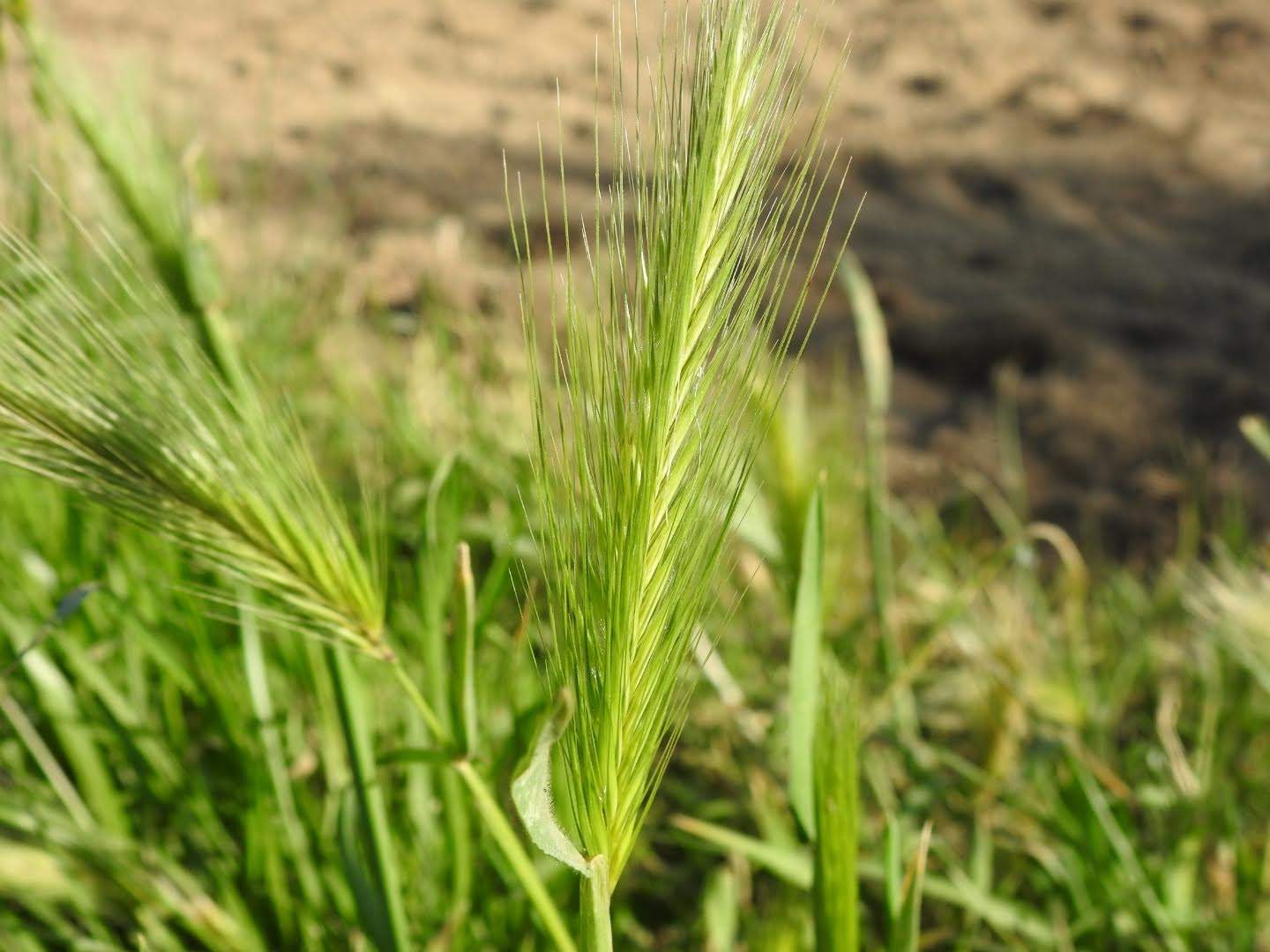
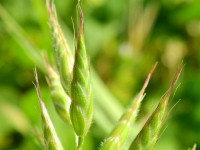
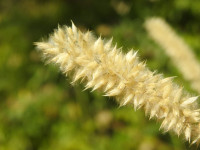
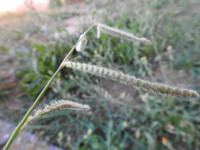
The inflorescence is a lanceolate spike, 8 to 10 cm long (up to 12 cm), green in color with shades that can turn purplish or brown with maturation. The spike is characterized by spikelets arranged in groups of three (ternate): the central spikelet is fertile, sessile or with a very short peduncle (0.6-1.5 mm), while the two lateral ones are sterile, shorter, and borne on peduncles about 2 mm long. The glumes of the spikelets are lanceolate, 25 to 35 mm long, with ciliate margins especially in the central spikelet.
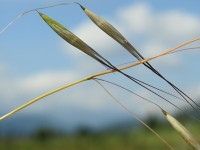
The lemmas are awned, with five nerves, 1.5-7 mm long and with an awn 18 to 50 mm long, generally longer than the glumes; in the lateral spikelets the awn can reach 40 mm. The anthers are whitish, varying in length from 0.2 to 3.2 mm and sometimes show purple spots. The flower is single-flowered and petal-less, with feathery stigmas at the apex of the ovary.
The fruit is an ellipsoid caryopsis, with the hilum as long as the seed itself, grooved in the hilar area and hairy at the apex. Seed dispersal occurs by breaking of the rachis or spikelets, which often fall together in groups of three. The root system is fasciculate, typical of annual species.
Habitat and distribution
This species is widely distributed in Italy and the Mediterranean basin, extending also into the temperate zones of Eurasia and introduced in other regions of the world such as North America, Africa, and Australia. It grows mainly on abandoned lands, uncultivated areas, edges of paths and roads, flowerbeds, sidewalks, and urban areas even in anthropized environments. It prefers loose, sandy or calcareous soils but adapts to a wide variety of substrates typical of disturbed habitats.
The growth altitude ranges from 0 up to about 1600 meters above sea level. Exposure is variable, but the species tends to colonize sunny or partially shaded environments, often in poor or degraded soil conditions.
Flowering period
Flowering generally extends from April to October, with peaks varying according to latitude and local climatic conditions. In warmer and Mediterranean regions, flowering can start as early as April and continue until autumn, while in northern or mountainous areas it is concentrated in the summer months.
Ecology and pollination
It is an anemophilous species, i.e., mainly wind-pollinated. The structure of the spike and the presence of pendulous anthers favor the dispersion of pollen in the air. Reproduction relies on a single fertile flower per central spikelet, while the lateral spikelets are sterile and contribute to the protection and mechanical dispersal of seeds.
Seeds are mainly dispersed through the falling of spikelets that detach easily from the rachis, but also through accidental transport by animals or humans, due to their ability to cling to fur or clothing thanks to the long sharp awns.
Curiosities and traditional uses
In the past, during periods of famine, the seeds of this species were collected and ground to produce emergency flours for bread, although of lower quality compared to cultivated cereals.
The common name "Wall Barley" refers to the long pointed awns (awns) that can adhere to the fur of domestic and wild animals, causing irritations and wounds, especially in dogs. These awns can penetrate various parts of the animals' bodies (paws, ears, nose, throat), causing infections and damage if not promptly removed.
No significant medicinal uses are known, but the species represents an important indicator of disturbed habitats and colonizers in anthropized areas.
Etymology
The generic name Hordeum derives from classical Latin and indicated barley; it is etymologically linked to the Greek phorbé (fodder) and Latin horreo (granary), probably referring to the long awns that resemble the bristly shape of spikes.
The specific epithet murinum means "related to the mouse" (from Latin mus, muris), probably alluding to the plant's spread in environments near human settlements and mice, or to the shape of the seed which can resemble a small rodent.
The common name "Wall Barley" refers to the pointed "tails" of the spikelets, while "wild barley" indicates its affinity with cultivated barley, but in a spontaneous and weedy form.
Sources
- Prof. S. Pignatti, Flora d'Italia
- Acta Plantarum - Flora delle regioni italiane
- Tela Botanica / H. Coste, Flore descriptive et illustrée de la France
- World Flora Online (WFO)
Characteristics
Scheda botanica
| Famiglia | Poaceae |
|---|---|
| Fioritura | aprile – ottobre |
| Forma biologica | Scapose |
| Habitat | flower without petals, annual plant, plant with a spreading bushy habit |
Domande frequenti
- Quando fiorisce Wall Barley?
- Wall Barley fiorisce aprile – ottobre.
- Che tipo di pianta è Wall Barley?
- Wall Barley è una Therophytes (Scapose) secondo la classificazione di Raunkiaer.
- A quale famiglia appartiene Wall Barley?
- Wall Barley appartiene alla famiglia botanica Poaceae.
Where I found it (4 sightings)
Classification
- Kingdom
- Plantae
- Family
- Poaceae
- Full name
- Hordeum murinum L.
- Life form
- Therophytes scapose
Similar species
Search for species with similar characteristicsFurther reading
Noticed an error in the identification? Write to me
Other species of the same family
Poaceae
Explore
Other species of Poaceae