Botanical species
Melica ciliata
L.
Ciliate melic
Description
Morphological description
Perennial plant belonging to the family Poaceae, characterized by an erect and bushy habit, with smooth, erect, and leafy stems up to the top, reaching a height between 20 and 80 cm. The culms have a diameter of 1–2 mm and are equipped with glabrous leaf sheaths, hairless, which wrap around the base of the leaves.
The leaves are alternately arranged along the stem, with a linear blade up to 3 mm wide, often channelled or more or less convolute towards the apex. The lower (abaxial) surface of the leaves can be smooth or slightly rough, while the sheaths are glabrous. The ligule, membranous and often laciniate, measures 1.5–5 mm in length and surrounds the base of the leaf, forming a membranous ring that tends to disappear in older leaves.
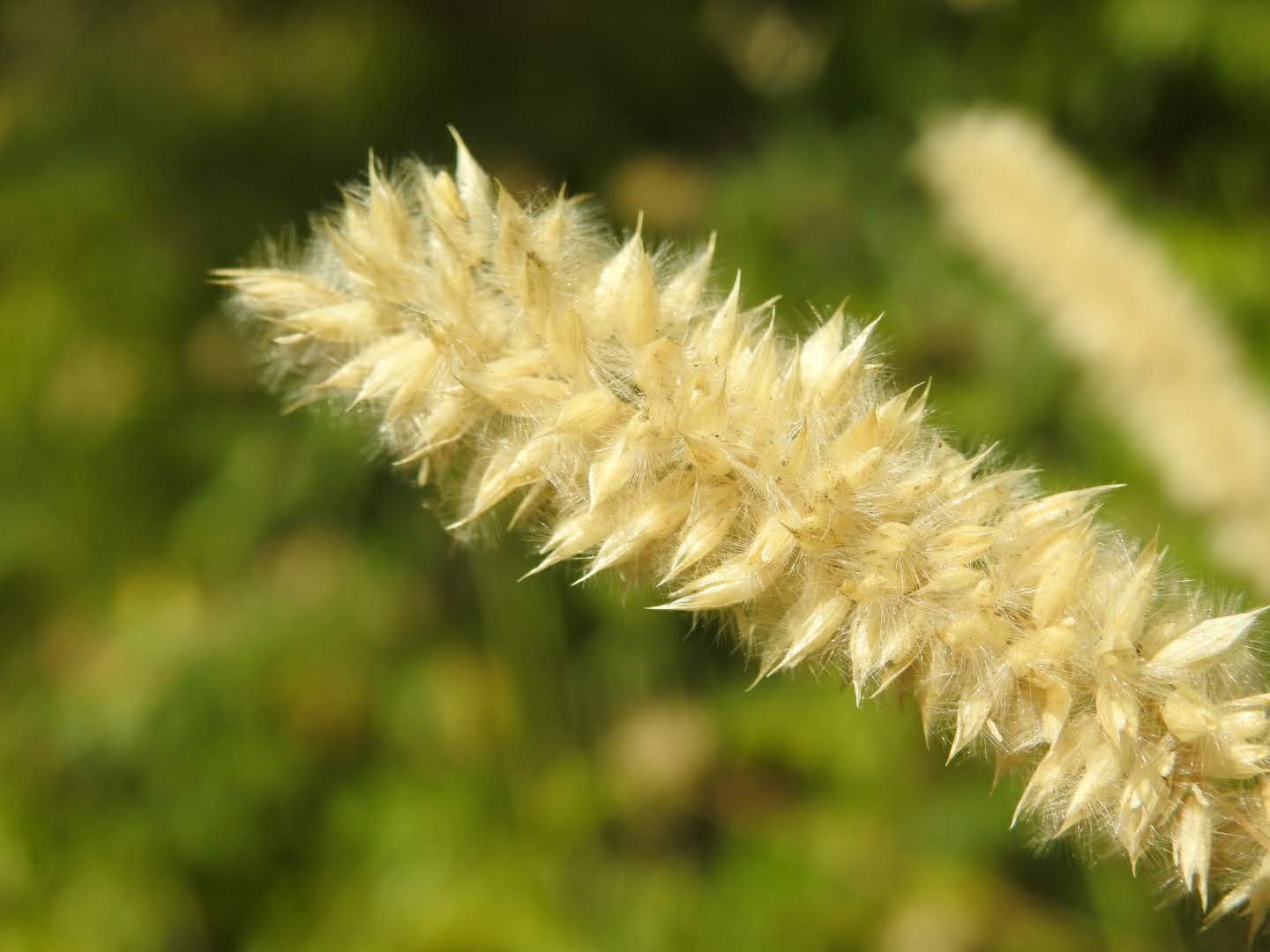
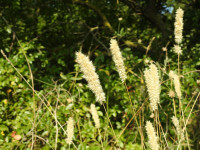
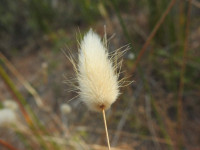
The inflorescence is compact, linear and spike-like in shape, 2.5 to 10 cm long, usually unilateral (bearing flowers on one side only), although it can be rather dense or looser and sometimes slightly lobed at the base. The lower branches of the inflorescence are short and bear 5 to 7 spikelets, each containing a single terminal fertile flower and an upper sterile flower reduced to a clavate body.
The spikelets, 4 to 8 mm long, are green or light purple in color. The glumes are ovate, with 5 nerves, both acute; the lower glume is about three quarters or four fifths the length of the upper one, which coincides with the length of the spikelet. The glumes are rough, sometimes with slight scattered pubescence. The lemma is lanceolate, 2.5–4 mm long, with 7–9 nerves, granulose and ciliate along the margins with hairs 2–3 mm long, giving the plant a "bearded" appearance. The palea has ciliate nerves. The anthers measure 0.8–1.5 mm.
The flowers lack petals and are characterized by a floral formula P 2, A (1-)3(-6), G (2–3) superior, with fruits as caryopses.
The root system is typical of perennial grasses, with short rhizomes that allow the formation of dense and compact tufts.
Habitat and distribution
It is a Euro-Mediterranean species distributed throughout the Italian territory, although it is considered rare or absent in the higher areas of the Alps and in some parts of the Po Plain. It prefers montane and submontane environments, typically on calcareous substrates, where it grows on rocks and rocky slopes, in sunny and warm exposures. It frequents xerothermic environments, such as garrigues and rocky areas, at altitudes ranging from hill to subalpine limit, generally between 500 and 1500 meters above sea level.
In Italy its presence appears more southern compared to other related species of the genus Melica, with some populations showing slight morphological and distributional differences. The ecology of the species is linked to calcareous habitats, preferring rocky substrates and well-drained soils.
Flowering period
Flowering occurs between May and July, corresponding to the warmest months of the spring and summer seasons. No significant variations in the flowering period are known at the geographic level in Italy, although flowering may be anticipated or delayed depending on local climatic conditions and altitude.
Ecology and pollination
Ciliate melic is a species predominantly wind-pollinated (anemophilous), as typical of Poaceae, exploiting the production of light and abundant pollen for cross-fertilization. The adaptation to anemophilous dispersal is evident from the structure of the flowers lacking showy petals and the presence of exposed anthers.
Seed dispersal occurs through caryopses, which can be transported by wind or potentially by small animals, although there are no specific data on secondary dispersal modes for this species.
Curiosities and traditional uses
Currently, there are no specific data available regarding ethnobotanical, medicinal, or traditional food uses of Ciliate melic in Italy or the Mediterranean basin. Its presence in garrigues and rocky environments makes it an important component of xerothermic ecosystems, but it is not known to have direct applications in popular culture or traditional medicine.
Etymology
The scientific name "Melica" derives from Latin and Greek "melike," which indicated a type of grass, probably referring to its sweet or honey-like consistency (from Greek "meli" = honey), although the plant does not produce honey. The specific epithet "ciliata" refers to the ciliate margins of the lemma, a morphological characteristic clearly evident in this species. The Italian common name "Ciliate melic" derives precisely from the presence of long hairs (beards) on the margins of the lemmas, which give a characteristic and easily recognizable appearance.
Sources
- Prof. S. Pignatti, "Flora d'Italia"
- World Flora Online (WFO)
Characteristics
Scheda botanica
| Famiglia | Poaceae |
|---|---|
| Fioritura | maggio – luglio |
| Forma biologica | Tufted |
| Habitat | flower without petals, Perennial plant, plant with a spreading bushy habit |
Domande frequenti
- Quando fiorisce Ciliate melic?
- Ciliate melic fiorisce maggio – luglio.
- Che tipo di pianta è Ciliate melic?
- Ciliate melic è una Hemicryptophytes (Tufted) secondo la classificazione di Raunkiaer.
- A quale famiglia appartiene Ciliate melic?
- Ciliate melic appartiene alla famiglia botanica Poaceae.
Where I found it (5 sightings)
Classification
- Kingdom
- Plantae
- Family
- Poaceae
- Full name
- Melica ciliata L.
- Synonyms
- Melica ciliata L. subsp. glauca (F.W.Schultz) K.Richt.; Melica ciliata L. subsp. magnolii (Godr. & Gren.) K.Richt.; Melica glauca F.W.Schultz; Melica magnolii Godr. & Gren.; Melica nebrodensis Parl.
- Life form
- Hemicryptophytes tufted
Similar species
Search for species with similar characteristicsFurther reading
Noticed an error in the identification? Write to me
Other species of the same family
Poaceae
Explore
Other species of Poaceae