Botanical species
Paspalum dilatatum
Poir.
Dallis-grass
Description
Morphological description
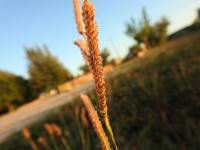
Dallis-grass is a perennial herbaceous plant belonging to the Poaceae family, characterized by a bushy and tufted habit, with a height generally ranging between 50 and 150 cm, but it can also reach up to 180 cm. It has a short and creeping rhizome, through which it propagates, giving it the ability to form tight and dense clumps.
The stem (culm) is erect or erect-ascending, compressed and laterally flattened, with glabrous nodes or sometimes with slight hairs, and glabrous internodes. The leaves are alternate, linear in shape and up to 40-45 cm long, with a blade width ranging from 3 to 14 mm. They are generally glabrous or nearly so, with both surfaces scattered with few trichomes especially towards the base; the lower surface is keeled. The leaf margin is entire, and the leaf sheath is green-violet and striated. The ligule is membranous, clearly visible, 1 to 5 mm long (up to 8 mm in some descriptions), acute and rounded at the top; often a pseudoligule is present, consisting of a hair arch about 5 mm long.
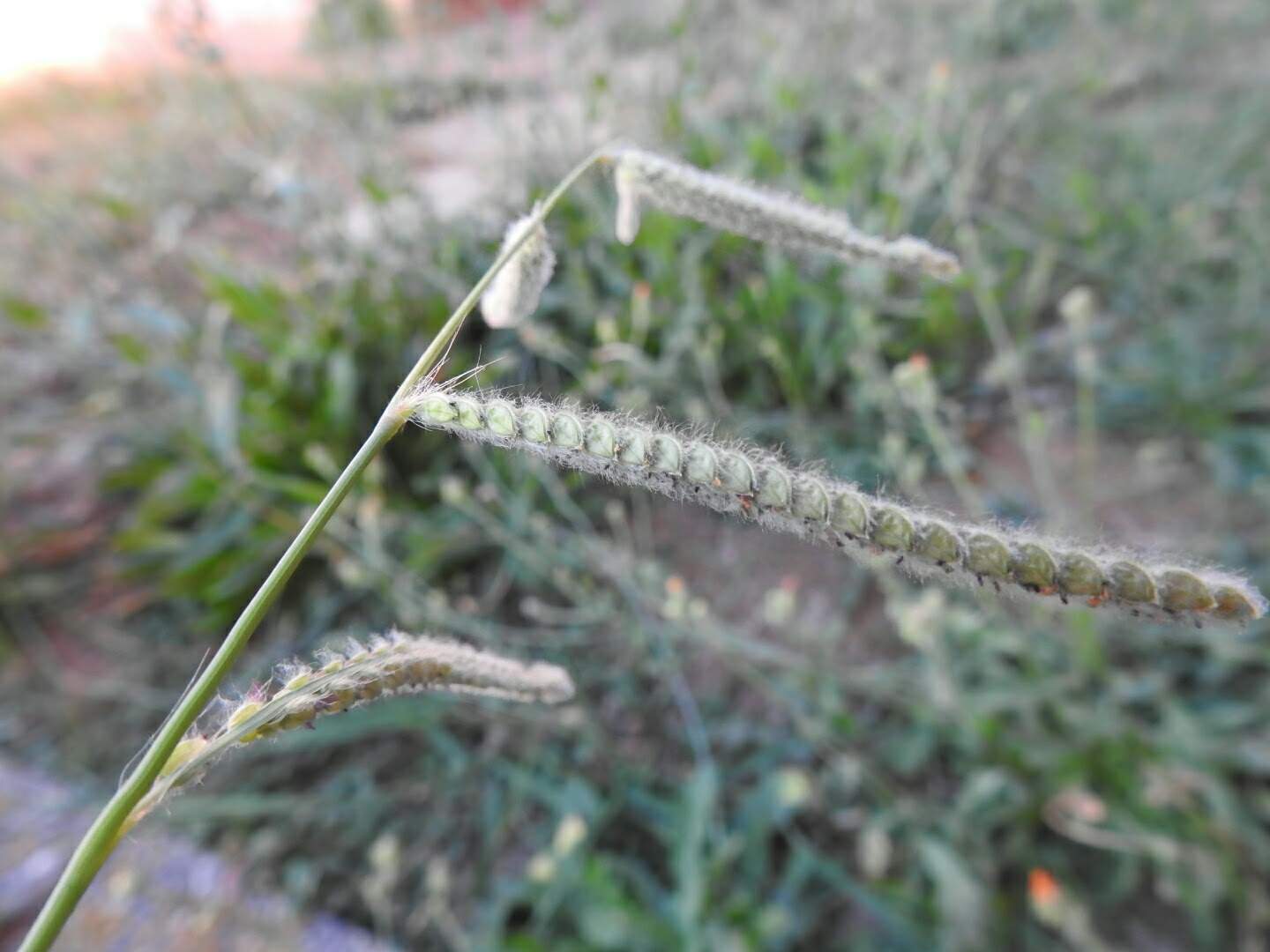
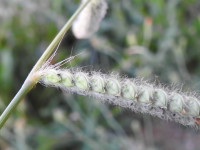
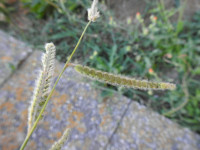
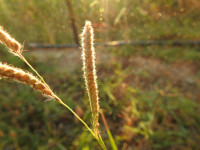
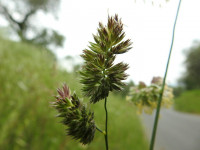
The inflorescence is a digitate panicle, formed by 3-9 racemes arranged sparsely or subdigitately along a central axis 3-20 cm long, with a muticous appearance, that is without awns, and generally pendulous or nodding. The racemes are unilateral and arranged on one side of the axis, green tending to yellow or purple in color, with a rough surface at the margins. The spikelets, arranged in four rows on the rachis, are ovate, about 3-4 mm long and 2-2.5 mm wide, with unequal glumes: the lower glume is often absent or reduced, while the upper one is longer than the lower lemma, hairy and ciliate along the edges with white hairs. Each spikelet is two-flowered, but only the upper flower is fertile; the lower is sterile and similar to the glume.
The lemmas are ovate-gibbous, 2.5-3 mm long, with the fertile upper lemma more coriaceous and papillose-striated, while the lower is sterile and softer. The fruit is an caryopsis of about 2-2.3 mm, white or brownish in color, which disarticulates at maturity inside the glumes.
The basal sheaths are glabrous or sometimes with few hairs; the culm nodes are generally glabrous. The plant presents a generally bushy appearance with ascending or slightly curved culms.
Habitat and distribution
Native to South America, particularly Brazil, Argentina and surrounding regions, this species was introduced to Italy in the 19th century, initially as forage, and later naturalized in various Italian regions. It mainly grows in alluvial plains rich in organic matter, up to about 600 meters altitude, but can adapt up to 2600 m a.s.l. in other areas of its native and naturalized range.
In Italy and the Mediterranean it is found mainly in open environments, disturbed areas, wet pastures, canal edges, and aquatic or semi-aquatic habitats, where it prefers fresh and nutrient-rich soils. Exposure is generally from full sun to partial shade. It can tolerate variable moisture conditions, but is not typically present in arid environments.
Flowering period
Flowering generally extends from July to September in Italy, with possible geographical variations that can extend the period from October to May in other warmer areas or with favorable climatic conditions. The long flowering duration is typical of perennial rhizomatous species that adapt to different environmental conditions.
Ecology and pollination
The species is predominantly wind-pollinated (anemophily), typical of Poaceae, which have flowers lacking petals and structured to facilitate pollen dispersal in the air. The flowers lack petals and have small anthers (about 0.9-1.5 mm), with little or no nectar and scent production, characteristics that discourage entomophilous pollination.
Seed dispersal occurs through disarticulation of the glumes containing the fruits (caryopsis), favoring mechanical dispersal as well as by water or animals. The presence of ciliate hairs on the glumes may contribute to adhesion to materials or animals, promoting secondary zoochorous dispersal.
Curiosities and traditional uses
Introduced to Europe as a forage plant, Dallis-grass is today also considered an invasive species in some areas, particularly in wet pastures and meadows. Historically, no widespread medicinal or food uses are known in Europe, while in its native areas it can be locally used as livestock forage due to its good biomass production.
No particular folkloric traditions related to this species are known in Italy or the Mediterranean basin. Its Italian common name, "panico brasiliano," reflects the geographic origin and its belonging to the genus Paspalum, known for species used as cereals or forage.
Etymology
The generic name Paspalum derives from the Greek "πασπαλος" (paspalos), synonym of "κεγχρος" (kenchros), meaning millet, recalling the similar appearance to some cultivated millets or panic grasses. The specific epithet dilatatum means "expanded," "widened," "spread out," referring to the sparse and expanded arrangement of the racemes in the inflorescence along the rachis.
The Italian common name "panico brasiliano" highlights the geographic origin of the species, native to Brazil and South America, and its belonging to the group of panic grasses, plants similar to Panicum and other forage Poaceae.
Sources
- Prof. P.V. Arrigoni, "Flora analitica della Toscana", "Flora dell'Isola di Sardegna"
- Acta Plantarum - Flora delle regioni italiane (scheda di Antonino Messina)
- World Flora Online (WFO)
Characteristics
Scheda botanica
| Famiglia | Poaceae |
|---|---|
| Fioritura | luglio – settembre |
| Forma biologica | Tufted |
| Habitat | flower without petals, Perennial plant, plant with a spreading bushy habit |
Domande frequenti
- Quando fiorisce Dallis-grass?
- Dallis-grass fiorisce luglio – settembre.
- Che tipo di pianta è Dallis-grass?
- Dallis-grass è una Hemicryptophytes (Tufted) secondo la classificazione di Raunkiaer.
- A quale famiglia appartiene Dallis-grass?
- Dallis-grass appartiene alla famiglia botanica Poaceae.
Where I found it (5 sightings)
Classification
- Kingdom
- Plantae
- Family
- Poaceae
- Full name
- Paspalum dilatatum Poir.
- Synonyms
- Digitaria dilatata (Poir.) H.J.Coste
- Life form
- Hemicryptophytes tufted
Similar species
Search for species with similar characteristicsFurther reading
Noticed an error in the identification? Write to me
Other species of the same family
Poaceae
Explore
Other species of Poaceae