Botanical species
Sporobolus pungens
(Schreb.) Kunth
Sand dropseed
Description
Morphological description
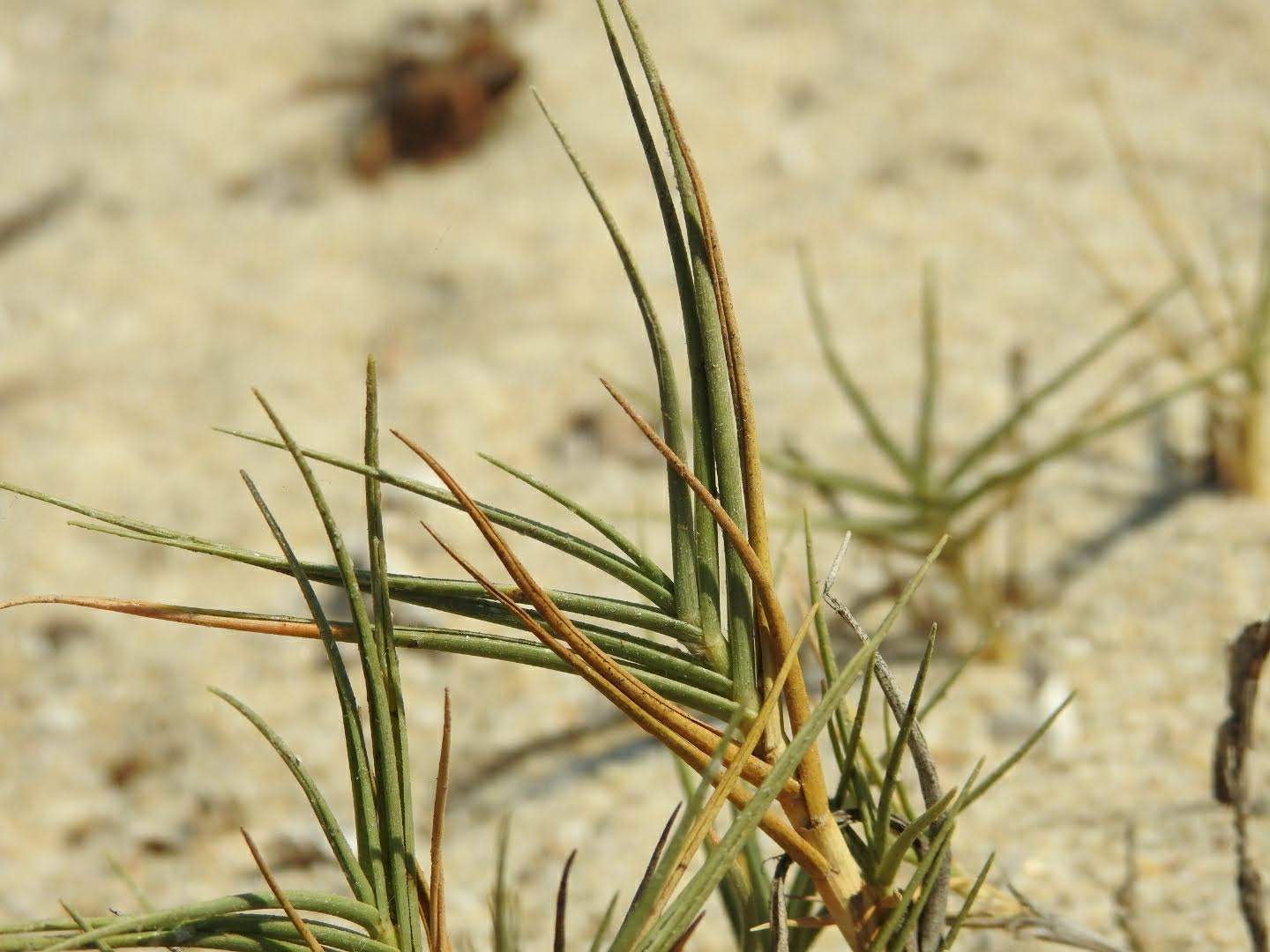
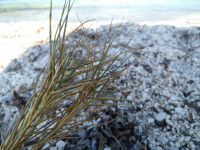
The plant is a perennial herbaceous species belonging to the family Poaceae, characterized by a psammophilous habit and rhizomatous growth. The rhizome is long and creeping, typically 20-40 cm, and develops beneath the sandy surface, contributing to substrate consolidation. Erect or ascending culms arise from the rhizome, glabrous and leafy, 10 to 30 cm tall, which can be simple or branched. Sterile lateral shoots are often observed at the lower nodes.
The leaves are distichous, stiff and sharp at the apex, with a narrow linear blade 2-5 mm wide and 2-8 cm long. The margin is entire, the blade is convolute and presents long hairs at the base of the upper surface; the ligule is replaced by a short fringe of laciniate hairs about 0.2 mm long. The leaves are often subopposite and equipped with sharp margins, a distinctive characteristic that inspired the specific epithet of the species.
The inflorescence is a dense, contracted panicle, pyramidal or oval in shape, with variable dimensions between 2-4 cm in length and 1-2.4 cm in width. It is often wrapped at the base by the upper leaf. The spikelets are uniflorous, hermaphroditic, white-yellowish in color and shortly pedicellate. The glumes are glabrous, membranous, acute and one-nerved, with the lower glume about 2 mm long and the upper about 3 mm; lemma and palea are awnless, glabrous and acute, about 3 mm. The stamens are 2-3 with violet-colored anthers.
The fruit is a subglobose caryopsis enclosed in a gelatinous pericarp; the rachilla disarticulates above the glumes facilitating dispersion. The plant lacks petals in the flowers, as typical of grasses.
Habitat and distribution
This is a species typical of coastal and sandy areas of the Mediterranean, particularly adapted to coastal dunes and psammophilous environments, where it contributes to the consolidation of sands thanks to its robust rhizome. In Italy it is widespread along the coasts, including those of Tuscany and Sardinia, preferring marine sandy substrates and xerophilous zones.
The species grows mainly at low altitude, in coastal dunes and marine environments, where it finds sunny exposure conditions and well-drained soils, poor in nutrients and often saline. Its presence is indicative of stable habitats or in the colonization phase of dunes.
Flowering period
Flowering occurs mainly in the summer months, from July to August. During this period the panicles fully develop and the plant's maximum reproductive activity is observed.
Ecology and pollination
The plant is anemophilous, meaning pollination occurs via wind, a common characteristic among Poaceae. It does not present colored petals or attractive structures for pollinating insects. The dispersion of caryopses occurs with the disarticulation of the rachilla above the glumes, facilitating seed detachment and transport. The robustness of the rhizome and the ability to produce stolons favor rapid colonization and stabilization of the sandy substrate, contributing to the formation and maintenance of dunes.
Curiosities and traditional uses
No particular ethnobotanical applications or traditional medicinal uses are known for this species. Its main role is ecological, as a colonizer of coastal dunes and stabilizer of sandy soils, making it important for the conservation of coastal habitats and erosion prevention.
Etymology
The genus name derives from the Greek "spora" (seed) and "bolos" (to throw), probably referring to the ease with which the caryopses detach from the glumes for dispersion. The specific epithet "pungens" indicates the characteristic sharp point of the leaves, which are prickly to the touch. The Italian common name "Sand dropseed" highlights its habit of growing in sandy and coastal environments, with an invasive habit similar to that of couch grasses in agricultural settings.
Sources
- Prof. P.V. Arrigoni, "Flora analitica della Toscana", "Flora dell'Isola di Sardegna"
- Acta Plantarum - Flora delle regioni italiane (scheda di Anja Michelucci)
- Tela Botanica / H. Coste, "Flore descriptive et illustrée de la France"
Characteristics
Scheda botanica
| Famiglia | Poaceae |
|---|---|
| Fioritura | luglio – agosto |
| Forma biologica | Rhizomatous |
| Habitat | psammophilous plant, flower without petals, Perennial plant |
Domande frequenti
- Quando fiorisce Sand dropseed?
- Sand dropseed fiorisce luglio – agosto.
- Che tipo di pianta è Sand dropseed?
- Sand dropseed è una Geophytes (Rhizomatous) secondo la classificazione di Raunkiaer.
- A quale famiglia appartiene Sand dropseed?
- Sand dropseed appartiene alla famiglia botanica Poaceae.
Where I found it (4 sightings)
Classification
- Kingdom
- Plantae
- Family
- Poaceae
- Full name
- Sporobolus pungens (Schreb.) Kunth
- Synonyms
- Sporobolus virginicus (L.) Kunth; Sporobolus pungens (Schreb.) Kunth; Agrostis pungens Schreb.; Podosemum pungens (Schreb.) Link; Sporobolus virginicus auct. Fl. Ital.; Vilfa pungens (Schreb.) P.Beauv.
- Life form
- Geophytes rhizomatous
Similar species
Search for species with similar characteristicsFurther reading
Noticed an error in the identification? Write to me
Other species of the same family
Poaceae
Explore
Other species of Poaceae