Botanical species
Dactylis glomerata
L.
Cock's-Foot
Description
Morphological description
Perennial herbaceous plant, tufted and robust, with an erect or slightly curved base, reaching a variable height from 30 up to 120-140 cm. The culms are characteristically compressed and rigid at the base, with a smooth and green-grayish surface, sometimes glaucous. The roots are fasciculate and well developed, giving the plant good stability in the soil.
The leaves have a linear blade, 4 to 8 (up to 10) mm wide, herbaceous green in color, often channelled or flat, with the upper surface slightly rough due to scattered hairs, while the lower surface is smoother and shiny. The ligule is a small oblong-truncate membrane, 2-10 mm long, without lateral auricles, often torn. The leaf sheaths are compressed and keeled (with a marked keel).
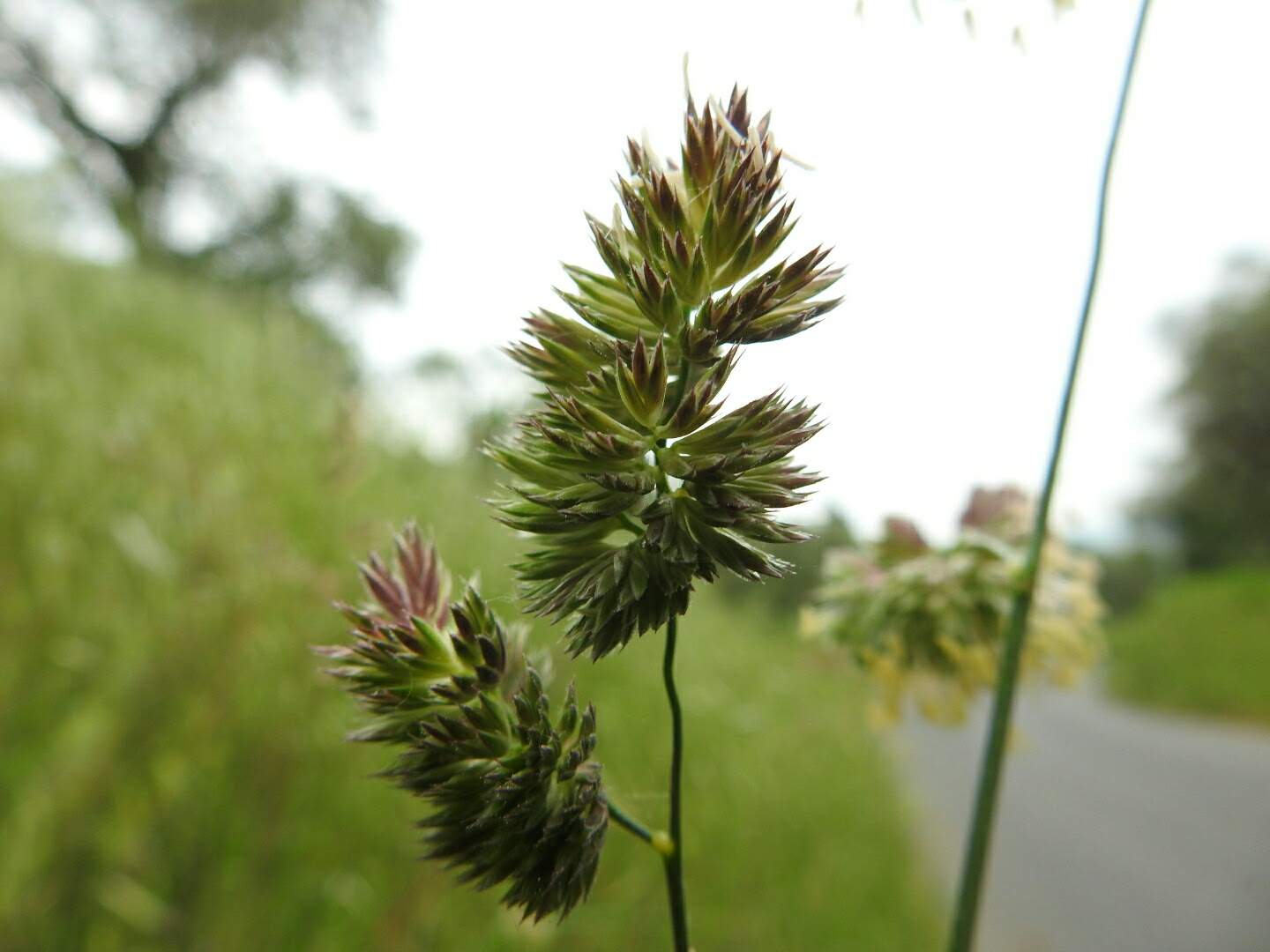
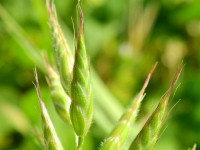
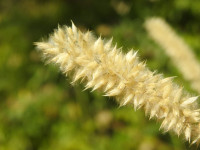
The inflorescence is an erect panicle, with a triangular or ovate outline, 3 to 15 cm long, composed of 1-2 spaced basal branches, rigid and flattened, which are bare in the lower part and bear dense unilateral clusters of spikelets at the top. The spikelets are 5-9 mm long, laterally compressed and formed by 3-7 flowers; the clusters are very dense and compact, giving an agglomerated and characteristic appearance to the panicle.
The glumes are coriaceous, subequal, 3-3.5 mm long, often green or purplish in color, with a ciliate or hirsute keel and a mucronate or acuminate apex; the lower one is one-nerved, while the upper one is three-nerved. The lemmas are membranous, with 5 evident veins and ciliate along the keel. The paleas are about as long as the lemmas. The anthers are yellow or purplish, 2 to 4 mm long.
The fruit is a small awned caryopsis, oblong-ovate with a channelled inner face.
The species shows high morphological variability, due to its polyploid complex, with prevalent tetraploid populations (2n=28), but also diploid and hexaploid. This variability is reflected in leaf size, hairiness, and the general appearance of the panicles.
Habitat and distribution
It is a mesophilous species, widely distributed in Italy and the Mediterranean area, present from the lowlands up to about 2000-2500 meters altitude. It prefers anthropized environments such as mown meadows, pastures, roadsides, uncultivated areas, forest edges, and hedges, on nitrogen-rich and well-drained soils.
In Italy it is common in mountainous and hilly regions, but also adapts to less natural habitats, being a synanthropic species closely linked to agricultural and grazing activities. In more intact natural contexts it is often replaced by related species such as Dactylis hispanica and Dactylis polygama, with which it can give rise to intermediate populations.
In the Mediterranean area it is also widespread in temperate Europe, Western Asia, and North Africa, where it colonizes meadows, pastures, and forest margins, showing remarkable ecological plasticity.
Flowering period
Flowering generally occurs between April and September, with a possible extension until October, depending on altitude and latitude. In more temperate and low-altitude areas flowering starts early in spring, while in mountainous environments it can extend until late summer.
Ecology and pollination
The species is anemophilous, with flowers lacking colored petals but with prominent anthers of purplish or yellowish color that facilitate pollen dispersal by wind. The dense and compact spikelets favor the protection of flowers and fruits. Seed dispersal occurs through awned caryopses that can be transported by wind or animals.
As a forage plant, it is highly appreciated by livestock for its high nutritional value and persistence over time, contributing to the ecological balance of cultivated pastures.
Curiosities and traditional uses
This species, commonly known as Cock's-Foot, is one of the most important forage grasses at the European and Mediterranean level. It is cultivated and managed for hay production and as quality pasture, thanks to its longevity and nutritional richness.
It is subject to parasitism by the fungus Claviceps purpurea, known as "ergot of rye", which can cause the formation of black sclerotia on the spikelets, a fungal disease with significant impacts on forage crop quality.
No notable ethnobotanical traditions or specific medicinal uses are known for this species, but its main value lies in agricultural use and the conservation of meadow ecosystems.
Etymology
The genus name "Dactylis" derives from the Greek "dáktylos", meaning "finger", referring to the shape of the panicles that resemble the phalanges of a finger. The specific epithet "glomerata" indicates the characteristic agglomerated and compact arrangement of the spikelets at the top of the panicle.
The Italian common name "erba mazzolina" precisely recalls this aspect of "bundles" or dense tufts of flowers, while "dattile" is an older toponym, probably linked to the shape or traditional use of the plant.
Sources
- Prof. S. Pignatti, "Flora d’Italia"
- Acta Plantarum - Flora delle regioni italiane (scheda di Anja Michelucci)
- Tela Botanica / H. Coste, "Flore descriptive et illustrée de la France"
- World Flora Online (WFO)
Characteristics
Scheda botanica
| Famiglia | Poaceae |
|---|---|
| Fioritura | aprile – agosto |
| Forma biologica | Tufted |
| Habitat | flower without petals, Perennial plant |
Domande frequenti
- Quando fiorisce Cock's-Foot?
- Cock's-Foot fiorisce aprile – agosto.
- Che tipo di pianta è Cock's-Foot?
- Cock's-Foot è una Hemicryptophytes (Tufted) secondo la classificazione di Raunkiaer.
- A quale famiglia appartiene Cock's-Foot?
- Cock's-Foot appartiene alla famiglia botanica Poaceae.
Where I found it (3 sightings)
Classification
- Kingdom
- Plantae
- Family
- Poaceae
- Full name
- Dactylis glomerata L.
- Life form
- Hemicryptophytes tufted
Similar species
Search for species with similar characteristicsFurther reading
Noticed an error in the identification? Write to me
Other species of the same family
Poaceae
Explore
Other species of Poaceae