Botanical species
Bromus hordeaceus
L.
Soft Brome
Description
Morphological description
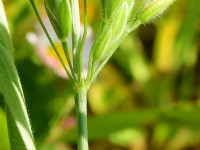
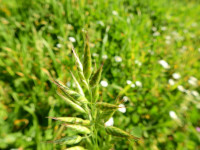
It is an annual herbaceous plant, belonging to the family Poaceae, reaching a height between 30 and 80 cm. The habit is erect but with culms (stems) that at the base are often bent or flexed, ascending and generally solitary. The surface of the stem is characterized by slight pubescence, especially below the inflorescence, while the nodes of the culm are finely hairy.
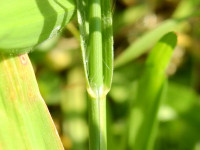
The leaves are alternate, with a linear and flat blade, 3 to 7 mm wide, equipped with a surface both on the upper and lower side covered by fine hairs. The texture is herbaceous and the leaf has entire margins. The leaf sheath is closed and pubescent, while the ligule is short (about 1 mm), acute and sometimes fringed.
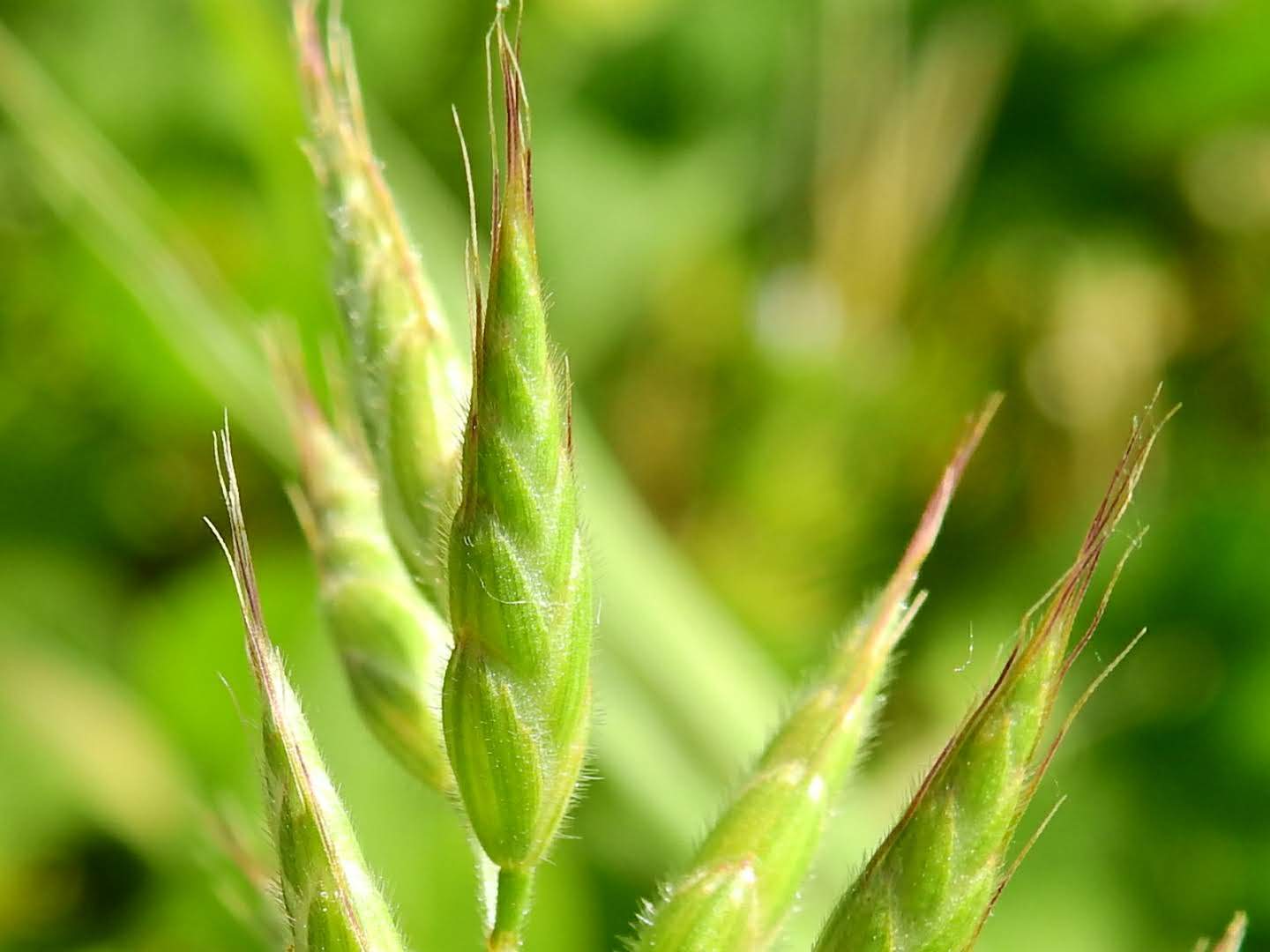
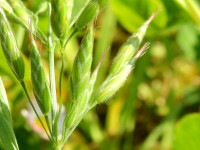
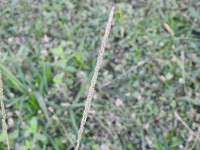
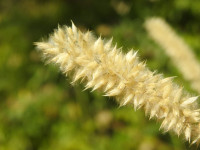
The inflorescence is a dense, contracted panicle of ovoid shape, 5 to 15 cm long. The branches of the panicle are short and rough, with pedicels shorter than the spikelets which are pubescent. The spikelets, 12 to 20 mm long and 4-6 mm wide, contain 4 to 16 flowers, with the more distal ones often sterile. The glumes are unequal, membranous with pubescent margins, the lower glume measures 4-6 mm and is grooved by 3-5 nerves, while the upper glume is longer (5-8 mm) with 5-7 nerves. The lemma, elliptic in shape and 8-11 mm long, is pubescent and has 7-9 well-defined nerves; the apex is obtuse, slightly bifid, with a robust awn inserted 1-2 mm below the tip and reaching a length of 5 to 10 mm, straight and rigid. The palea is shorter than the lemma, with two nerves and ciliate margins. The anthers are small, from 0.2 to 1 mm.
The fruit is a caryopsis, which can be shorter or the same length as the palea, typical of grasses.
Habitat and distribution
This species grows widely throughout the Italian territory, from the plains up to the mountain and subalpine belt, particularly in hilly and not too high mountainous environments. It prefers disturbed environments, such as cultivated lands, roadside edges, field margins, embankments and fertilized meadows. Its presence is common in areas with fresh, well-drained soils rich in organic matter, with predominantly sunny or semi-shaded exposure.
In the Mediterranean basin it is found with a similar distribution, adapting to anthropized and semi-natural habitats, where competition with other herbaceous species is reduced.
Flowering period
The Soft Brome typically flowers between May and July, with possible extension of flowering depending on altitude and local climatic conditions. In warmer and lowland areas flowering can begin as early as May, while in cooler mountainous environments it extends until July.
Ecology and pollination
The species is predominantly wind-pollinated, like many grasses, and does not have petals or conspicuous colors to attract pollinating insects. The structure of the spikelets, with robust and long awns, favors seed dispersal, which can adhere to the fur of animals or be carried by the wind, facilitating colonization of new habitats.
Adaptation to disturbed soils and anthropized ecosystems makes it an important component of secondary herbaceous communities, contributing to soil stabilization and local biodiversity.
Curiosities and traditional uses
No significant traditional medicinal or food uses are documented for this species. However, the common name "Soft Brome" recalls the characteristic of the achenes (seeds) equipped with a sharp and rigid awn, which can easily penetrate the skin or fur of animals, causing discomfort. This has led to some ethnobotanical interest in recognizing and managing infestations of this plant in pastures and cultivated lands.
Etymology
The scientific name of the genus, Bromus, derives from the Greek bromos, meaning “fodder”, indicating the importance of many species of this group as forage grasses. The specific epithet hordeaceus refers to the barley-like appearance (Hordeum), recalling the shape and structure of the inflorescences.
The Italian common name "forasacco peloso" highlights the presence of hairs on various parts of the plant and the characteristic sharp awn of the seeds ("forasacco" literally means “that pierces the sack” or penetrates the skin, metaphorically referring to the irritating potential of the seeds).
Sources
- Prof. S. Pignatti, "Flora d'Italia"
- World Flora Online (WFO)
Characteristics
Scheda botanica
| Famiglia | Poaceae |
|---|---|
| Fioritura | maggio – luglio |
| Forma biologica | Scapose |
| Habitat | flower without petals, Perennial plant |
Domande frequenti
- Quando fiorisce Soft Brome?
- Soft Brome fiorisce maggio – luglio.
- Che tipo di pianta è Soft Brome?
- Soft Brome è una Therophytes (Scapose) secondo la classificazione di Raunkiaer.
- A quale famiglia appartiene Soft Brome?
- Soft Brome appartiene alla famiglia botanica Poaceae.
Where I found it (11 sightings)
Classification
- Kingdom
- Plantae
- Family
- Poaceae
- Full name
- Bromus hordeaceus L.
- Life form
- Therophytes scapose
Similar species
Search for species with similar characteristicsFurther reading
Noticed an error in the identification? Write to me
Other species of the same family
Poaceae
Explore
Other species of Poaceae