Botanical species
Lagurus ovatus
L.
Hare's-Tail
Description
Morphological description
Annual herbaceous plant of the Poaceae family, characterized by a bushy habit with erect or ascending culms, smooth and glabrous. The height generally varies between 10 and 50 cm. The stems are fascicled, wrapped by villous or pubescent sheaths mainly in the lower half. The leaves are alternate, lanceolate and flat, with a blade width ranging from 2 to 10 mm, softly pubescent, with sheaths often slightly swollen in the upper leaves. The ligule is short, membranous in shape, with margins generally without fringes.
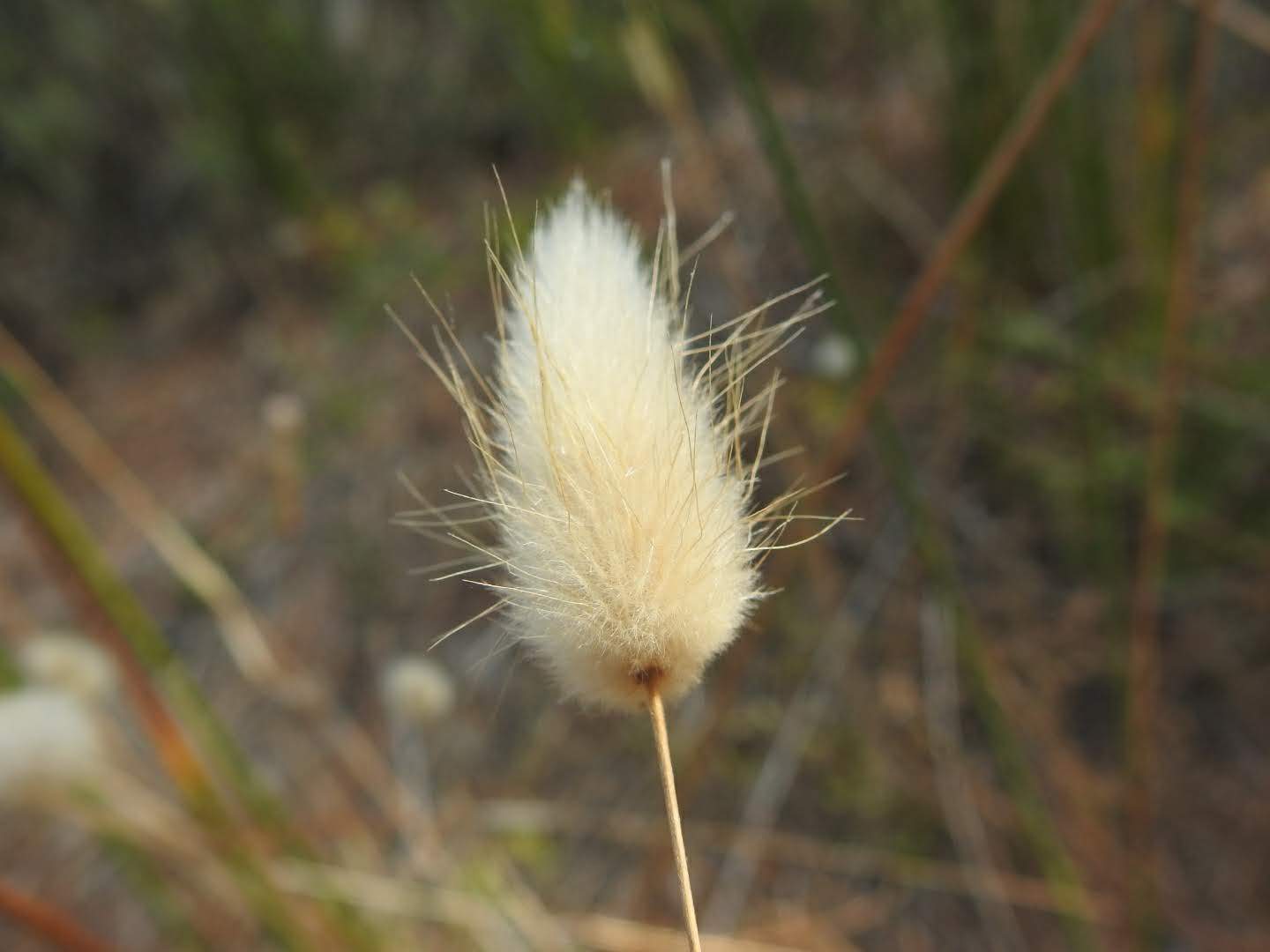
The inflorescence is a compact panicle of ovate or spike-like shape, 2 to 6 cm long and 0.5-2 cm wide, white-woolly or white-silky in color due to the presence of dense hairs and awns that give a soft and fluffy appearance, hence the common name “Hare's-Tail”. The spikelets are subsessile, narrow and closely arranged, with subequal, lanceolate and villous glumes, about 10 mm long, which extend into long feathery awns. The lemma is membranous, 3-5 mm long, glabrous or rarely slightly hairy at the base, with a dorsal awn about 2 cm long and two shorter subulate awns (2-6 mm) at the base of the central awn.
The fruits are oblong and glabrous caryopses, typical of grasses. The root system is fibrous and poorly developed, suitable for sandy and dry substrates.
Habitat and distribution
This species is typical of sandy coastal areas of the Mediterranean basin, mainly present on dunes and sandy, dry, well-drained soils. In Italy it is mainly widespread along the coasts, but can occasionally reach inland up to 1000 meters of altitude. Beyond the Mediterranean, its distribution extends to some areas of Western Europe, such as the Atlantic coasts and the English Channel, and also includes Corsica.
It prefers disturbed environments, often colonizing nutrient-poor sandy soils. It is a psammophilous plant, i.e., adapted to live in mobile and unstable substrates such as coastal dunes, where it helps stabilize the soil.
Flowering period
Flowering extends from March to May, with some local variations that can extend flowering until July in more southern regions or in milder years.
Ecology and pollination
Reproduction occurs mainly by anemophily, with pollen carried by the wind. The woolly and feathery structure of the inflorescence facilitates seed dispersal, which can be transported by wind, animals, or water in coastal environments. No particular relationships with pollinating insects are known, given the anemogamous nature of the species.
Curiosities and traditional uses
The “Hare's-Tail” is mainly known for its ornamental and decorative value: the panicles, properly collected and preserved, are used by the “dried flower” industry for floral arrangements and decorations. This practice exploits the particular soft texture and light color of the inflorescences.
No documented traditional medicinal or food uses are known for this species, nor particular references in Italian popular folklore.
Etymology
The genus name “Lagurus” derives from Greek and literally means “hare's tail,” referring to the characteristic soft shape of the inflorescence, which indeed resembles the tail of a small mammal. The specific name “ovatus” refers to the oval shape of the panicle.
In Italian, “piumino” is a direct reference to the soft and woolly morphology of the inflorescences, while “coda di lepre” is the more literal and poetic translation of the scientific name; both names are widely used and recognized.
Sources
- Prof. P.V. Arrigoni, "Flora analitica della Toscana", "Flora dell'Isola di Sardegna"
- Acta Plantarum - Flora delle regioni italiane (scheda di Marinella Zepigi)
- Tela Botanica / H. Coste, "Flore descriptive et illustrée de la France"
- World Flora Online (WFO)
Characteristics
Scheda botanica
| Famiglia | Poaceae |
|---|---|
| Fioritura | marzo – maggio |
| Forma biologica | Scapose |
| Habitat | psammophilous plant, flower without petals, annual plant |
Domande frequenti
- Quando fiorisce Hare's-Tail?
- Hare's-Tail fiorisce marzo – maggio.
- Che tipo di pianta è Hare's-Tail?
- Hare's-Tail è una Therophytes (Scapose) secondo la classificazione di Raunkiaer.
- A quale famiglia appartiene Hare's-Tail?
- Hare's-Tail appartiene alla famiglia botanica Poaceae.
Where I found it (2 sightings)
Classification
- Kingdom
- Plantae
- Family
- Poaceae
- Full name
- Lagurus ovatus L.
- Synonyms
- Lagurus ovatus L. subsp. nanus (Guss.) Messeri; Lagurus ovatus L. subsp. vestitus (Messeri) Brullo; Lagurus ovatus L. subsp. vestitus (Messeri) H.Scholz, isonym; Lagurus ovatus L. var. nanus Guss.; Lagurus ovatus L. var. vestitus Messeri
- Life form
- Therophytes scapose
Similar species
Search for species with similar characteristicsFurther reading
Noticed an error in the identification? Write to me
Other species of the same family
Poaceae
Explore
Other species of Poaceae