Botanical species
Smyrnium olusatrum
L.
Alexanders
Description
Morphological description
Biennial herbaceous plant, aromatic, 50 to 130 cm tall, with an erect habit and cylindrical or angular-grooved stems, glabrous and striated, reddish in color. The stem has an angular section with evident striations and a smooth surface. The root system consists of a thick, highly branched root of dark brown color.
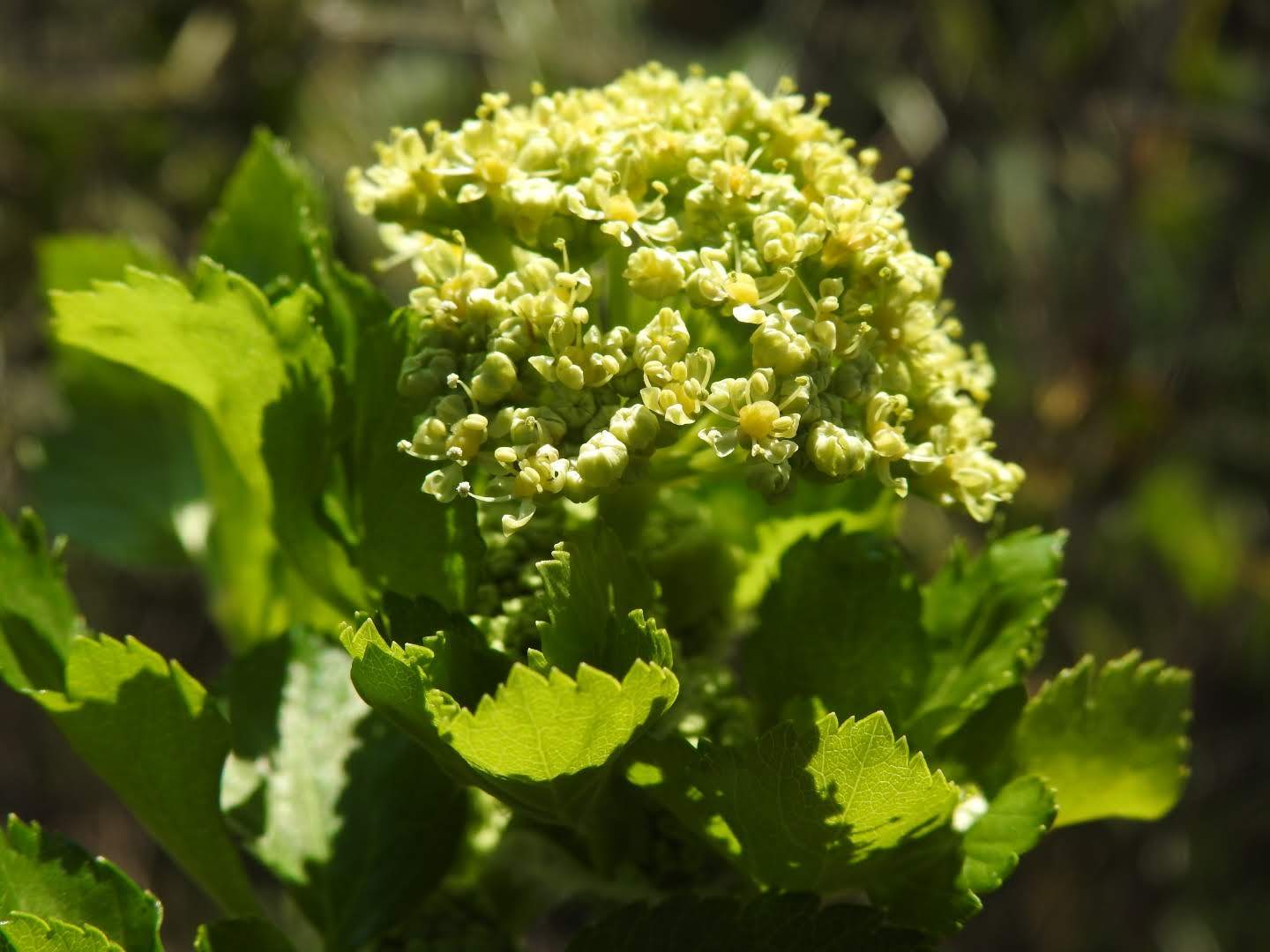
The leaves are arranged oppositely along the stem and are compound, glossy green in color, with toothed margins. The basal leaves are larger, with three distinct ovate segments about 10 cm long, while the upper leaves are smaller, composed of only three leaflets, borne on petioles sheathing the stem, also striated and reddish in color. The leaflets have serrated margins and an ovate-lanceolate shape.
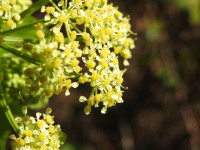
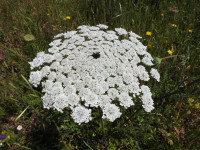
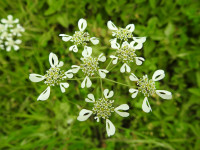
The inflorescence consists of umbels composed of 10-25 rays, borne on long peduncles. The umbels lack bracts and bracteoles and form dense whorls of tiny small flowers. The flowers are greenish with petals of a pale yellow.
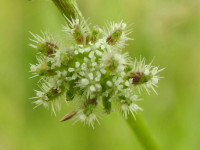
The fruit is a subglobose schizocarp, first green, then shiny black at maturity, with three ribs and well-marked furrows. At maturity it splits into two mericarps about 3 x 6-7 mm in size, each containing a black crescent-shaped seed.
Habitat and distribution
This species is typical of Mediterranean and Atlantic regions, with a widespread presence along the European Atlantic and Mediterranean coasts, but also penetrating inland up to about 800 meters altitude. In Italy it is mainly found in humid and shady environments, such as thickets, rocky places, uncultivated areas, ruins and rubble, where it prefers rich and well-drained soils but with good moisture.
The plant is stenomediterannean, with a range concentrated on Mediterranean coasts, but also extending to Atlantic zones and some inland areas.
Flowering period
Flowering generally occurs between December and May, with possible variations related to local climatic conditions. In the Mediterranean the plant can start flowering already in the milder winter months, while in cooler areas flowering shifts towards spring.
Ecology and pollination
The flowers, small and dense in umbels, are visited by pollinating insects, mainly bees and other hymenopterans, attracted both by the greenish-yellow color and the aromatic scent. The plant employs a reproductive strategy that combines attracting pollinating insects with a prolonged flowering period in the milder months, thus favoring cross-pollination.
The fruits, once mature, open into two mericarps containing crescent-shaped seeds, which can be dispersed mainly by falling near the mother plant and potentially through animals or water, in humid environments.
Curiosities and traditional uses
This species, which now grows wild, was once cultivated in gardens for food purposes thanks to the intense aromatic scent of its leaves and stems, reminiscent of celery. The Romans used the young leaves and shoots both raw and cooked in salads and dishes, appreciating their slightly bitter taste and stimulating and digestive properties.
The mature seeds, although having a resinous taste, were ground and used to flavor mainly meats, replacing pepper, an expensive spice for the rural classes of the time. The seeds possess antispasmodic properties, while the plant's juice was used as a disinfectant for wounds.
During the 16th and 17th centuries, Alexanders was largely replaced by celery, which was easier to cultivate and selected for horticultural traits. However, in some eastern regions it is still cultivated for food purposes, using young steamed stems, boiled or candied roots, and fried flowers.
The popular name "Macerone" may derive from the typical habitat of the plant, which often grows among rubble.
Etymology
The genus name "Smyrnium" derives from the Greek "smurna" or "smyrna," meaning myrrh, referring to the aroma of the seeds. The specific epithet "olusatrum" is formed from the Latin "olus" (herb) and "atrum" (dark, black), probably referring to the dark color of the fruits at maturity.
The Italian common name "Smirnio" reflects the Greek and Latin root, while "Macerone" is a popular term linked to the bare and rocky places (rubble) where the plant often grows spontaneously.
Sources
- Acta Plantarum - Flora delle regioni italiane (actaplantarum.org)
- Acta Plantarum - Flora delle regioni italiane (scheda di Mirna Medri)
Characteristics
Scheda botanica
| Famiglia | Apiaceae |
|---|---|
| Fioritura | gennaio, febbraio, marzo, aprile, maggio, dicembre |
| Forma biologica | Biennials |
| Habitat | edible plant, with yellow flowers, with green flowers |
| Uso alimentare | Commestibile |
| Uso officinale | Pianta officinale |
Domande frequenti
- Quando fiorisce Alexanders?
- Alexanders fiorisce gennaio, febbraio, marzo, aprile, maggio, dicembre.
- È commestibile Alexanders?
- Alexanders è considerata commestibile. Verifica sempre le parti eduli e la preparazione corretta prima del consumo.
- Che tipo di pianta è Alexanders?
- Alexanders è una Hemicryptophytes (Biennials) secondo la classificazione di Raunkiaer.
- A quale famiglia appartiene Alexanders?
- Alexanders appartiene alla famiglia botanica Apiaceae.
Where I found it (15 sightings)
Classification
- Kingdom
- Plantae
- Family
- Apiaceae
- Full name
- Smyrnium olusatrum L.
- Life form
- Hemicryptophytes biennials
Similar species
Search for species with similar characteristicsFurther reading
Noticed an error in the identification? Write to me
Other species of the same family
Apiaceae
Explore
Other species of Apiaceae