Botanical species
Echinophora spinosa
L.
Prickly Samphire
Description
Morphological description
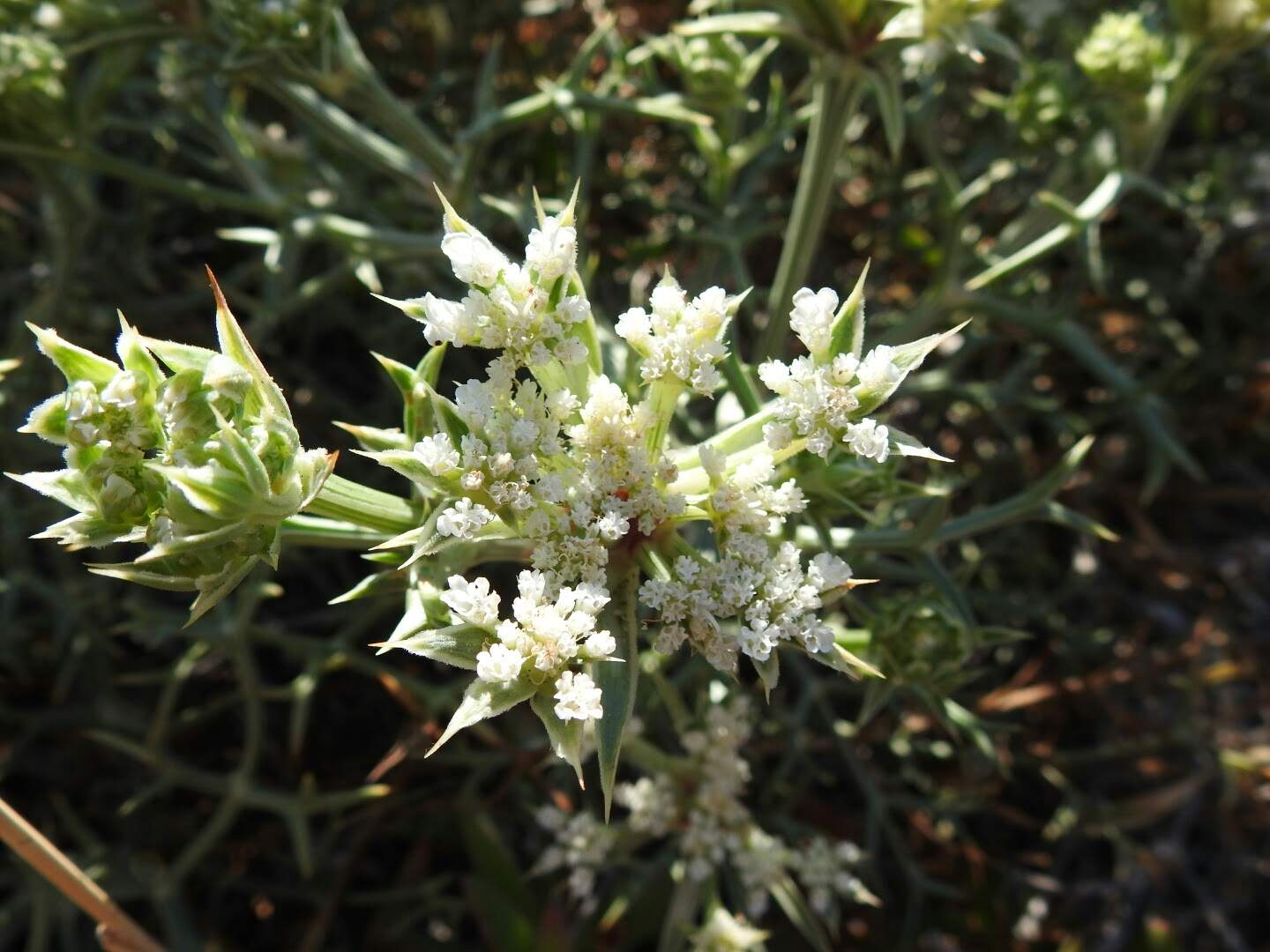
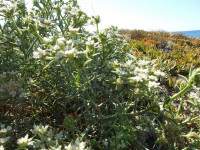
Perennial herbaceous plant, Echinophora spinosa has a bushy habit with height varying between 20 and 70 cm, depending on environmental conditions. The stem is robust, erect, grooved and jointed, often very branched, greenish-gray in color and slightly pubescent. The plant has an underground rhizome up to one meter long, which develops horizontally in the sand, with characteristic transverse rings and terminal grayish scales. This root system contributes to its anchoring ability in coastal sandy substrates.
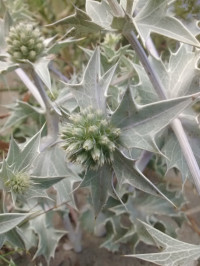
The leaves are sparse, rigid, herbaceous, and semi-succulent in texture. They are deeply divided, bipinnatisect or simple, with linear or oblong-triangular segments, keeled underneath and channeled above. The tips of the leaves end with stiff and sharp spines that give the plant a prickly appearance and protect it from adverse environmental conditions such as wind and salt spray.
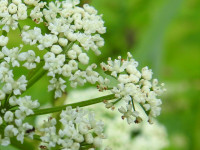
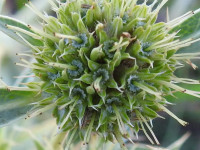
The inflorescence is an umbel composed of 5-10 short, thick, and pubescent rays, bearing small white or slightly pink flowers. The central flower of the umbel is hermaphrodite and sessile, while the peripheral ones are generally male. The calyx consists of 5 spiny and rigid teeth, which further contribute to the protection of the plant. The petals are obovate, slightly notched and with an arched tip.
The fruit is an ovoid schizocarp, with erect and persistent styles, enclosed in the receptacle, characterized by five equal, wavy and depressed ribs. The bracts surrounding the umbel are linear-lanceolate, spiny and veined on the back, with scarious margins, and almost as long as the inflorescence itself.
Habitat and distribution
This species is typical of marine and coastal environments, especially on sandy shores and in the zone of the first dunes, where it forms an integral part of the psammophilous vegetation, i.e. that adapted to sandy soils. It is widespread along the Mediterranean coasts, with a range extending from Mediterranean Europe to North Africa and the Bithynia region. In Italy it is present along many coasts, including Sardinia and Tuscany, where it is often associated with other species typical of fixed dunes such as Ammophila arenaria, Eryngium maritimum, Medicago marina, Calystegia soldanella and Euphorbia paralias.
The plant grows on well-drained sandy substrates, exposed to the sun and subject to salty winds. Its ability to tolerate salt spray and adapt to strong coastal winds makes it essential for dune stabilization.
Flowering period
Flowering occurs in summer and early autumn, generally from July to October. No significant geographic variations in the flowering period are known within the Mediterranean range.
Ecology and pollination
Echinophora spinosa has a reproductive strategy typical of Apiaceae with polygamous flowers: the central flower of the umbel is hermaphrodite and fertile, while the peripheral ones are male. Pollination is mainly mediated by pollinating insects attracted by the small white flowers, often generalist pollinators such as bees, flies and other common pollinating insects in coastal environments.
Seed dispersal occurs through the schizocarps, which remain anchored to the receptacle and can be transported by wind or, more rarely, by seawater, contributing to the colonization of new sandy areas. The presence of extensive root systems also contributes to substrate stabilization and promotes the formation of stable vegetation on coastal dunes.
Curiosities and traditional uses
The species is edible and has a pleasant taste. Young leaves, free of spines, are used in mixed spring salads as an aromatic ingredient. The root, in the past, was collected and consumed during periods of famine, especially at the end of winter, and used as a substitute for carrot. This use is documented in various popular traditions of Mediterranean coastal regions.
Besides its food use, the plant has medicinal properties and is considered a traditional medicinal species, although today its use is limited and poorly documented in modern pharmacopoeias.
From an ecological point of view, Echinophora spinosa plays a fundamental role in the formation and stabilization of coastal dunes, contributing to biodiversity and the protection of coastal ecosystems.
Etymology
The genus name "Echinophora" derives from ancient Greek, where "echino" means "spine" or "hedgehog" and "phora" means "bearing", indicating the characteristic presence of rigid spines on the leaves and bracts of the plant. The specific epithet "spinosa" comes from Latin and means "spiny", emphasizing the prickly and defensive nature of its leaves and bracts.
The Italian common names "Carota spinosa" and "Finocchio litorale spinoso" reflect both the spiny appearance of the plant and its coastal habitat and the resemblance to other aromatic plants of the Apiaceae family. The English common name is "Prickly Samphire".
Sources
- Prof. P.V. Arrigoni, "Flora analitica della Toscana", "Flora dell'Isola di Sardegna"
- Acta Plantarum - Flora delle regioni italiane (scheda di Mirna Medri)
- Tela Botanica / H. Coste, "Flore descriptive et illustrée de la France"
Characteristics
Scheda botanica
| Famiglia | Apiaceae |
|---|---|
| Fioritura | luglio – ottobre |
| Forma biologica | Scapose |
| Habitat | with white flowers, edible plant, spiny plant |
| Uso alimentare | Commestibile |
Domande frequenti
- Quando fiorisce Prickly Samphire?
- Prickly Samphire fiorisce luglio – ottobre.
- È commestibile Prickly Samphire?
- Prickly Samphire è considerata commestibile. Verifica sempre le parti eduli e la preparazione corretta prima del consumo.
- Che tipo di pianta è Prickly Samphire?
- Prickly Samphire è una Chamaephyte (Scapose) secondo la classificazione di Raunkiaer.
- A quale famiglia appartiene Prickly Samphire?
- Prickly Samphire appartiene alla famiglia botanica Apiaceae.
Where I found it (3 sightings)
Classification
- Kingdom
- Plantae
- Family
- Apiaceae
- Full name
- Echinophora spinosa L.
- Life form
- Chamaephyte scapose
Similar species
Search for species with similar characteristicsFurther reading
Noticed an error in the identification? Write to me
Other species of the same family
Apiaceae
Explore
Other species of Apiaceae