Botanical species
Tordylium apulum
L.
Mediterranean Hartwort
Description
Morphological description
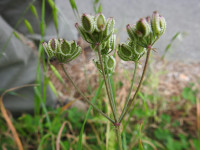
Annual herbaceous plant, with an erect habit and height ranging between 20 and over 60 cm. The stem is rigid, striated and ribbed, branched and covered by a dense pubescence of soft hairs; at the base the hairs are denser while on the upper part they are longer and sparse. The basal leaves are imparipinnate, with a petiole about 4-5 cm long; the blade is composed of 5-9 oval, pentlobed and crenate segments, each about 1.5 cm in size. The upper leaves are smaller, subsessile and divided into linear dentate-lobed segments, progressively shorter as they approach the inflorescence.
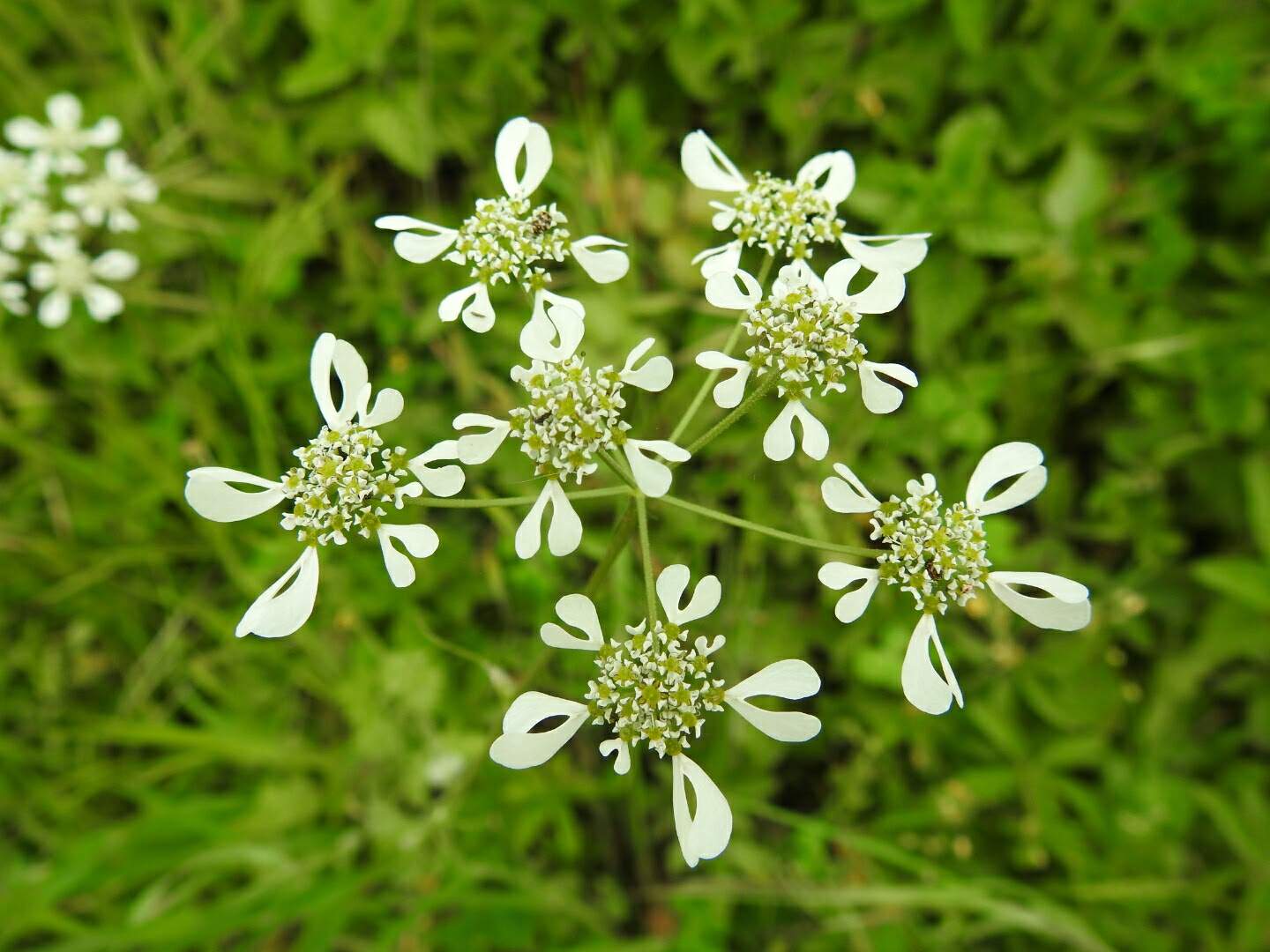
The inflorescence is a compound umbel, located at the apex of the stem on a long enveloping petiole; it has from 3 to 8 thin and pubescent rays internally. The bracts and bracteoles are linear, subulate, denticulate and rough, initially open and then reflexed during fruiting. The flowers are hermaphroditic, white, with a corolla of many petals; the peripheral ones are distinguished by having a single large outer petal (4-9 mm), deeply bifid into two equal lobes that take a shape similar to a heart or a small wing (vexillary).
The fruit is a schizocarp with two compressed and fused mericarps, disc-shaped or oval, measuring 5-8 mm. The surface is brown, covered with vesicular hairs, with a thickened and crenellated margin, smooth and glabrous internally. The fruit structure is characteristic, with three strips in the valleculae, and the moniliform margin gives a sculpted appearance to these “medallions”.
The root system is not specifically described in the sources, but being an annual plant with an erect stem, a taproot or fasciculate root system is presumed, sufficient to support the plant in arid environments.
Habitat and distribution
Typically Mediterranean species, with a stenomediterranean distribution affecting the coasts of the Mediterranean basin, from the Apulian region (from which it takes its name) to various coastal areas of southern France, Corsica and North Africa, including western Asia. In Italy it is mainly present in southern and insular regions, with reports up to 1,200 meters altitude.
It prefers open and sunny habitats such as dry pastures, cultivated lands, uncultivated areas, meadows, road margins, slopes and hills. It grows on well-drained soils, often calcareous or clayey, preferably exposed to full sun, in Mediterranean environments characterized by mild temperatures and dry seasons.
Flowering period
Flowering mainly extends from April to July, with a higher concentration in May and June. In some warmer areas or at lower altitudes flowering can start as early as April, while at higher altitudes or cooler climates it can continue until July. The duration and intensity of flowering are influenced by local climatic conditions.
Ecology and pollination
The plant produces hermaphroditic flowers, adapted to favor entomogamous pollination. The white flowers, with showy and bifid peripheral petals, attract pollinating insects such as bees, bumblebees and other flies that feed on nectar and pollen. The umbrella-shaped inflorescence structure facilitates simultaneous access to multiple flowers, increasing reproductive efficiency.
The fruits, equipped with thickened and hairy margins, are adapted mainly for barochory dispersal, i.e. falling near the mother plant, but their shape and robustness can also favor some secondary mechanical or animal dispersal, especially due to the hairy surface that can adhere to fur.
Curiosities and traditional uses
In folk medicine, this species has traditionally been used for various purposes: as a remedy against hair loss, for nervous disorders, to stimulate menstrual flow and as an expectorant. The young leaves, with a scent similar to parsley, have been used in some regions to flavor pies, soups and salads, although the food use should be considered cautious due to the presence of toxic substances typical of Apiaceae.
Recent studies have highlighted a high content of natural vitamin E (alpha-tocopherol) in the plant, with values around 2,426 mg per 100 g, confirming a potential antioxidant use related to the fight against free radicals.
A curious popular use concerns the fruits, which were colored and used by children as decorative elements for bracelets and necklaces in their games, exploiting the characteristic and robust shape of the mericarps.
Etymology
The genus name derives from the Greek “tornos” (chisel) and “illein” (to turn), referring to the rounded and sculpted shape of the fruits, which resemble a medallion with decorated edges. The specific epithet “apulum” is Latin and indicates the Apulia region, the area where Linnaeus first identified and described the species.
The Italian common name “Mediterranean Hartwort” refers to the characteristic umbrella inflorescence and its main area of origin and natural presence, Apulia.
Sources
- Prof. P.V. Arrigoni, "Flora analitica della Toscana", "Flora dell'Isola di Sardegna"
- Acta Plantarum - Flora delle regioni italiane (scheda di Giuliano Salvai)
- Tela Botanica / H. Coste, "Flore descriptive et illustrée de la France"
Characteristics
Scheda botanica
| Famiglia | Apiaceae |
|---|---|
| Fioritura | maggio – luglio |
| Forma biologica | Scapose |
| Habitat | with white flowers, fragrant plant, annual plant |
Domande frequenti
- Quando fiorisce Mediterranean Hartwort?
- Mediterranean Hartwort fiorisce maggio – luglio.
- Che tipo di pianta è Mediterranean Hartwort?
- Mediterranean Hartwort è una Hemicryptophytes (Scapose) secondo la classificazione di Raunkiaer.
- A quale famiglia appartiene Mediterranean Hartwort?
- Mediterranean Hartwort appartiene alla famiglia botanica Apiaceae.
Where I found it (6 sightings)
Classification
- Kingdom
- Plantae
- Family
- Apiaceae
- Full name
- Tordylium apulum L.
- Life form
- Hemicryptophytes scapose
Similar species
Search for species with similar characteristicsFurther reading
Noticed an error in the identification? Write to me
Other species of the same family
Apiaceae
Explore
Other species of Apiaceae