Botanical species
Eryngium maritimum
L.
Sea-holly
Description
Morphological description
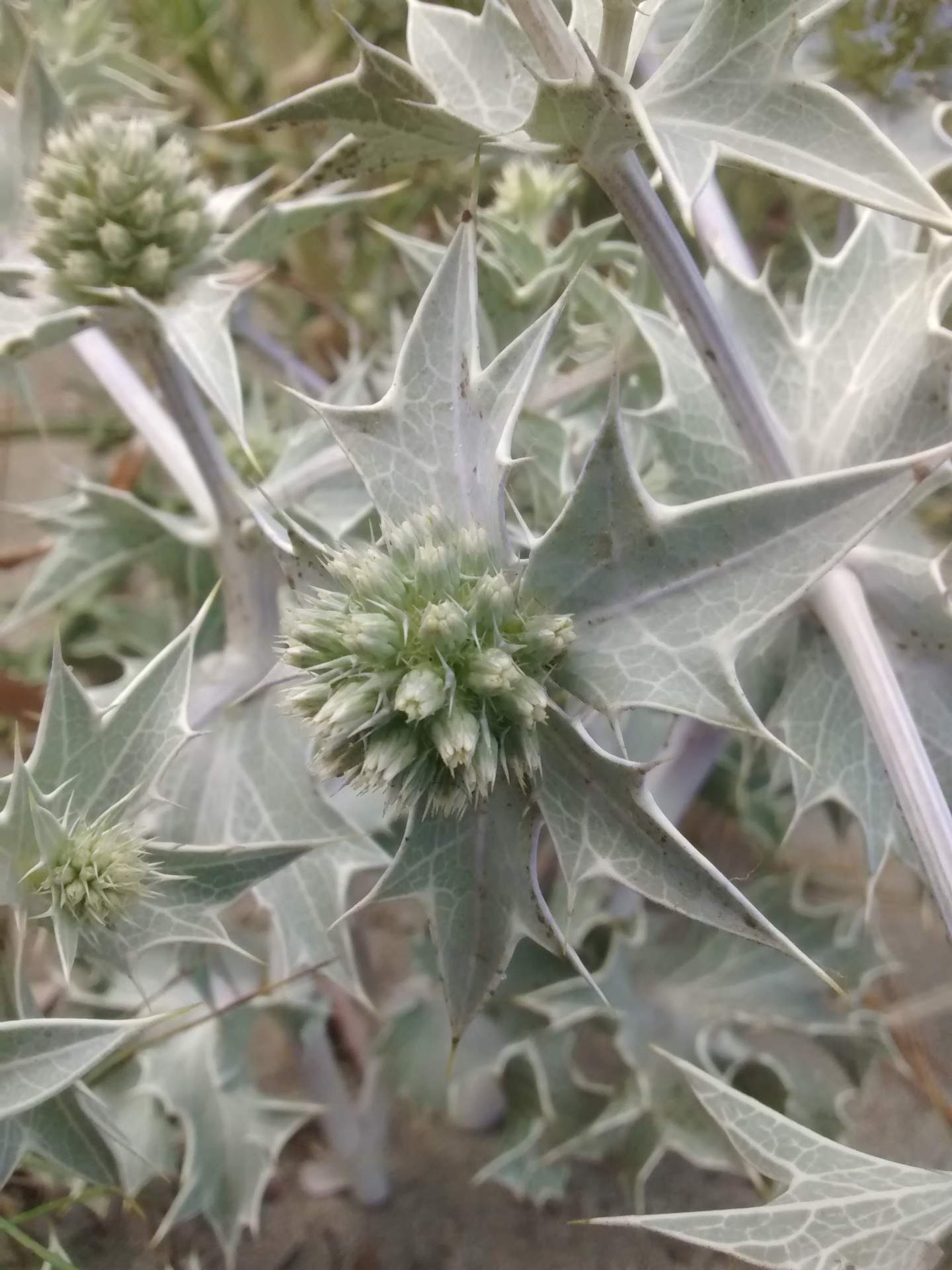
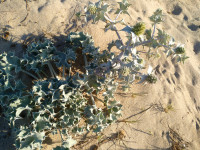
Perennial herbaceous plant, generally 20 to 60 cm tall, with an erect habit and a woody stem at the base, branched in the upper part. The stem is robust, striated and pithy inside, bluish grey-green in the upper part, and has a spiny surface that also extends to the leaves and bracts.
The leaves are leathery, glabrous, spiny and bluish-green or bluish in color, sometimes with violet tones. The basal leaves are petiolate, with a cordate, suborbicular or reniform base, divided into 3-5 deep and toothed lobes with central segments smaller than the lateral ones. The upper leaves are sessile, clasping and have a wide sheath at the base; they are palmately lobed with well-defined veins ending in rigid spines, while the margins are cartilaginous and spiny. The entire plant is adapted to limit water loss thanks to the thick and waxy cuticle and the presence of spines.
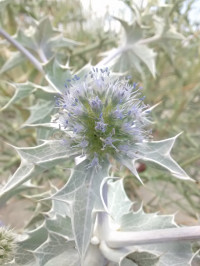
The inflorescences are numerous and grouped into subglobose heads, varying in size from 1 to 3 cm in diameter, distributed at the apex of the stem and in the leaf axils. Each head is protected by an involucre formed by 4-6 ovate-lanceolate, leathery and spiny bracts, which exceed the length of the heads themselves. The flowers are hermaphroditic, amethyst or blue-violet, with five rigid, aristate sepals and five petals shorter than the calyx. They also have five stamens and a bicarpellary inferior ovary. The scent of the flowers attracts various pollinating insects.
The fruit is an oblong polyachene, formed by two united monocarps, with longitudinal striations and equipped with hooked scales that facilitate dispersal by wind or transport on animals. The root is a robust woody rhizome that emits underground stolons, allowing the plant to survive in dynamic environments such as mobile dunes.
Habitat and distribution
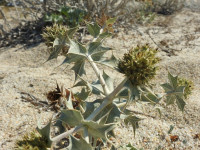
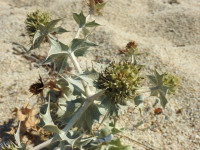
Sea-holly is a typical plant of sandy coastal environments, mainly of mobile dunes and sea beaches, where it plays a pioneering role in substrate consolidation. It is widespread along all Italian and Mediterranean coasts, as well as on European Atlantic coasts, extending to Western Asia and North Africa.
It prefers very well-drained sandy substrates, with sunny exposure and conditions of high salinity and wind. Its particular adaptability makes it capable of withstanding extreme conditions of aridity and sand movement, thanks to a deep root system that can extend over a meter into the soil.
The growth altitude is generally limited to coastal areas, from the shore to the first dunes, not exceeding a few tens of meters above sea level.
Flowering period
Flowering occurs from June to September, varying slightly depending on latitude and local climatic conditions. In Italy and the Mediterranean, the plant is mainly visible in flower during the summer, when its blue-blue coloration stands out in the coastal environment.
Ecology and pollination
Sea-holly is mainly pollinated by pollinating insects attracted by the color and amethyst scent of the flowers, including bees and other hymenopterans. The structure of the head, with numerous hermaphroditic flowers, facilitates cross-fertilization, improving the genetic variability of the species.
Seed dispersal mainly occurs thanks to the hooked scales of the fruit, which can adhere to feathers or animal fur or be transported by the wind. This mechanism allows the plant to colonize new areas of mobile dunes, contributing to the stabilization of the sandy soil.
The plant plays a fundamental ecological role in coastal dunes, helping to block sand movement and thus promoting the formation of a more stable habitat, also useful for other plant species.
Curiosities and traditional uses
Sea-holly has long been known for its medicinal and food properties. Traditionally it has been used as an aphrodisiac, diaphoretic, expectorant, stimulant, diuretic and tonic plant. The roots, slightly sweet, can be eaten raw in salads, while the young leaves are edible if cooked.
Although no known toxicity is present, excessive consumption can cause blood pressure drops, so caution is advised. Medicinal and food uses are for informational purposes only and do not replace medical advice.
From an ecological and conservation point of view, sea-holly is a species sensitive to urbanization and coastal tourism, so collection is strongly discouraged to allow the conservation of natural habitats.
Etymology
The genus name Eryngium derives from the ancient Greek term used to indicate similar plants, probably referring to the spiny shape and marine habitat. The specific name maritimum indeed emphasizes its close association with the coastal environment.
The Italian common name "calcatreppola" recalls the spiny nature of the plant, "calca-" referring to trampling and "treppola" (from "trappola") indicating the prickly sensation experienced when touching it, typical of many spiny and stinging plants.
Sources
- Prof. P.V. Arrigoni, "Flora analitica della Toscana", "Flora dell'Isola di Sardegna"
- Acta Plantarum - Flora delle regioni italiane (scheda di Giuliano Salvai)
- Tela Botanica / H. Coste, "Flore descriptive et illustrée de la France"
Characteristics
Scheda botanica
| Famiglia | Apiaceae |
|---|---|
| Fioritura | giugno – settembre |
| Forma biologica | Rhizomatous |
| Habitat | spiny plant, with blue flowers, psammophilous plant |
Domande frequenti
- Quando fiorisce Sea-holly?
- Sea-holly fiorisce giugno – settembre.
- Che tipo di pianta è Sea-holly?
- Sea-holly è una Geophytes (Rhizomatous) secondo la classificazione di Raunkiaer.
- A quale famiglia appartiene Sea-holly?
- Sea-holly appartiene alla famiglia botanica Apiaceae.
Where I found it (2 sightings)
Classification
- Kingdom
- Plantae
- Family
- Apiaceae
- Full name
- Eryngium maritimum L.
- Life form
- Geophytes rhizomatous
Similar species
Search for species with similar characteristicsFurther reading
Noticed an error in the identification? Write to me
Other species of the same family
Apiaceae
Explore
Other species of Apiaceae