Botanical species
Daucus carota
L.
Queen Anne's Lace
Description
Morphological description
Biennial plant, sometimes annual, with an erect habit and variable height generally between 30 and 100 cm. The stem is usually single, erect, more or less hairy (hirsute) or sometimes glabrescent in the upper part, with a rough or striated surface. The base of the stem can be woody.
The root system consists of a long and fleshy taproot, yellow-golden in color, fusiform and branched, a characteristic that gave rise to the cultivated carrot.
The leaves are arranged alternately along the stem and have a complex structure, bipinnatisect or bi-tripinnatisect. The basal leaves are sheathing at the base and have a triangular blade with lanceolate-acuminate or oval incised-dentate segments and lobes, while the upper leaves are divided into thinner, linear and pointed lobes. The appearance of the leaves is very variable, from compact to slender and expanded, with terminal segments ranging from linear to lanceolate, sometimes mucronate.
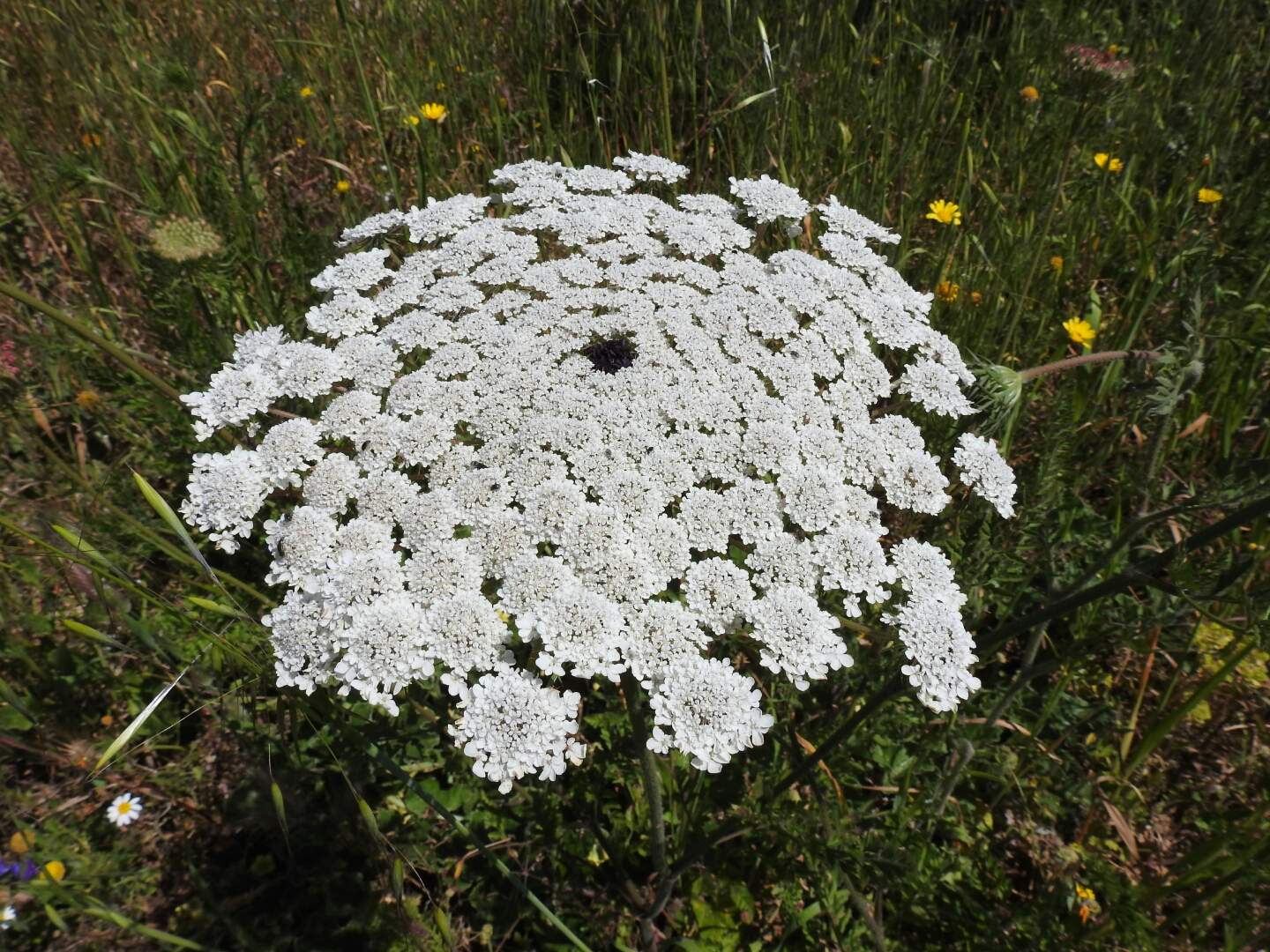
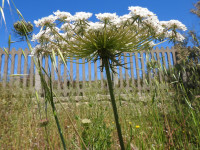
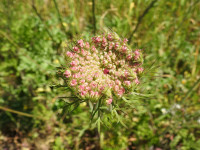
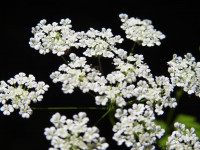
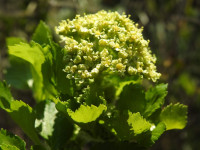
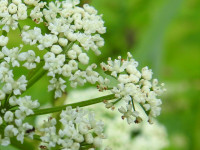
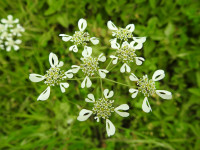
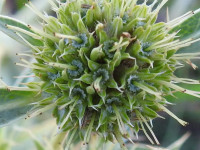
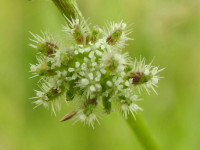
The inflorescence is an umbel (umbellet) 5-10 cm in diameter, generally composed of 20-40 thin rays, initially flat and then slightly convex during fruiting. The bracts of the involucre are numerous, long, trifid or pinnatisect with linear segments; the bracts of the secondary involucre (bracteoles) are linear, often longer than the pedicels and with membranous margins. During flowering the bracts are spread out, while at fruiting they fold inward forming a sort of ball.
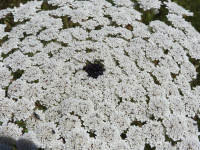
The flowers are small, generally white, with larger and showier outer petals (vexillary). Sometimes they can take pale pink shades, while the central flower of the umbel is often sterile and purplish-black or dark purple in color, a distinctive characteristic.
The fruits are elliptic or ovoid achenes, about 2-3 mm long, with main ribs covered by stiff bristles and secondary ribs equipped with sharp spines, generally simple or sometimes hooked. At maturity, the umbels close into a dome, facilitating seed dispersal.
Habitat and distribution
Wild carrot is widely distributed throughout the Italian territory and the Mediterranean basin, with a presence extending in Europe, Western and Central Asia, Siberia and North Africa. It grows mainly in anthropized environments such as uncultivated lands, meadows, roadsides and dry or semi-arid soils, from the plains up to mountain altitudes, generally between 0 and 1400 meters above sea level, with reports up to 1700 meters.
It prefers well-drained soils, often calcareous or sandy, and adapts well to sunny exposures. It is frequent in hilly and mountainous environments, sometimes also in subalpine zones, showing good hardiness and adaptability.
Flowering period
Flowering extends from April to October, with a peak in the summer months. The long flowering duration allows prolonged reproductive activity and considerable phenological variability depending on climatic and geographic conditions.
Ecology and pollination
Wild carrot is mainly pollinated by pollinating insects such as bees, bumblebees, butterflies and other pollinators attracted by the umbel of small white flowers and the purplish central flower, which serves a visual attractant function.
The reproductive strategy is based on a polymorphic umbel, with fertile and sterile flowers, which facilitates cross-pollination and increases genetic variability. The fruits, once mature, close into a dome, favoring mechanical seed dispersal by wind or transport by animals.
Curiosities and traditional uses
Wild carrot is the ancestor of the cultivated carrot and has an important history of ethnobotanical use. Traditionally, the whole plant emits a characteristic aromatic odor similar to carrot when crushed.
It is considered a medicinal plant with diuretic, digestive and stimulating properties, used in infusions based on seeds to promote digestion and relieve urinary tract problems such as cystitis and kidney stones. Furthermore, it is used for its vermifuge properties, thanks to the high content of essential oils.
The essential oil extracted from the seeds is used in cosmetics for its emollient, protective and anti-aging properties, promoting tanning and improving dry or cracked skin. In the food sector, the roots of wild carrot are edible, although less sweet and more fibrous than the cultivated carrot.
Historically, wild carrot was known since ancient times and appreciated by Greeks, Romans and other populations for its aroma and healing properties. It was depicted in frescoes such as those of Pompeii and mentioned by Pliny the Elder. However, ancient carrots were very different from modern ones, often knobby, thin and with a sharp taste.
Etymology
The genus name Daucus derives from the ancient Greek "daíō" meaning "to burn" or "to heat", probably referring to the stimulating properties attributed to the plant. The specific name carota also comes from the Greek "karotón", indicating the edible root.
The common Italian name "carota selvatica" clearly recalls the close relationship with the cultivated carrot, emphasizing the natural and uncultivated state of the plant.
Sources
- Prof. P.V. Arrigoni, "Flora analitica della Toscana", "Flora dell'Isola di Sardegna"
- Acta Plantarum - Flora delle regioni italiane (sheet by Marinella Zepigi)
- Tela Botanica / H. Coste, "Flore descriptive et illustrée de la France"
- World Flora Online (WFO)
Characteristics
Where I found it (4 sightings)
Classification
- Kingdom
- Plantae
- Family
- Apiaceae
- Full name
- Daucus carota L.
- Life form
- Emicriptofite bienni
Similar species
Search for species with similar characteristicsFurther reading
Noticed an error in the identification? Write to me
Other species of the same family
Apiaceae
Explore
Other species of Apiaceae