Botanical family
Apiaceae
Description
Botanical characteristics
Apiaceae are predominantly herbaceous plants, with growth habits that can be annual, biennial, or perennial; shrubs or trees are rarely encountered. The stem is generally hollow, often longitudinally grooved, and in herbaceous species it has leaf petioles often sheathing the stem at the base. The leaves are alternate, without stipules, and usually composed of numerous finely divided leaflets, although some species such as Bupleurum rotundifolium have entire leaves. The petioles are frequently widened and sheathing.
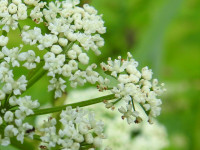
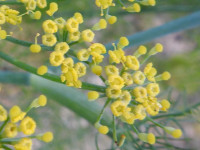
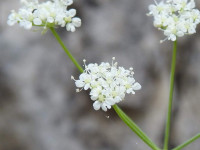
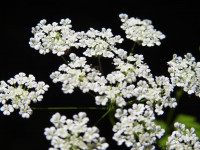
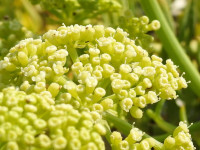
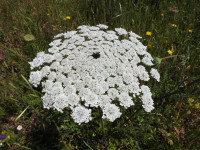
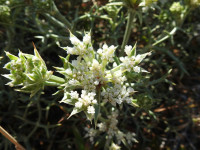
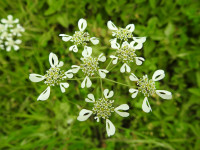
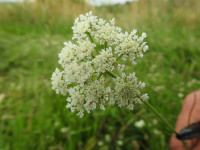
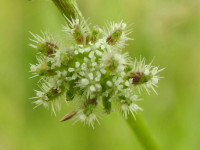
The typical inflorescence, which characterizes the family, is the umbel, from which the common name "umbellifers" also derives. The umbel can be simple or composed of several umbels, often accompanied by bracts at the base. The flowers are small, pentamerous, with radial symmetry, generally hermaphroditic but sometimes unisexual. They have 5 reduced sepals, 5 petals (often white or yellowish, rarely reddish as in the central flowers of the carrot), 5 stamens, and an inferior ovary formed by two carpels. The two styles widen at the base forming a nectar disc. In some species, the peripheral flowers of the umbel are irregular with larger outer petals, giving the inflorescence the appearance of a single flower.
The fruit is a schizocarp, dry and indehiscent, which at maturity splits into two one-seeded mericarps. The morphology of the fruit is highly variable, with possible spines, hooks, hairs, or wings, features often useful for species identification.
Distribution and diversity
The family has a cosmopolitan distribution, present on all continents except Antarctica, with greater concentration in temperate regions, especially in the Old World. It includes about 3000 species grouped into over 400 genera, divided into four main subfamilies: Apioideae, Azorelloideae, Mackinlayoideae, and Saniculoideae.
Main genera and representative species
Among the best-known and most important genera are:
- Daucus, with the species Daucus carota (carrot), widely distributed and cultivated
- Pastinaca, with Pastinaca sativa (parsnip)
- Apium, with Apium graveolens (celery)
- Foeniculum, with Foeniculum vulgare (fennel)
- Petroselinum, with Petroselinum crispum (parsley)
- Anthriscus, with Anthriscus cerefolium (chervil)
- Cuminum, with Cuminum cyminum (cumin)
- Ferula, with Ferula assa-foetida (asafoetida) and Ferula communis (giant fennel)
- Conium, with Conium maculatum (hemlock)
- Cicuta, with Cicuta virosa (water hemlock)
Many of these species are found wild or cultivated in Italy and the Mediterranean basin.
Etymology
The family name derives from the Latin apium, a term used to indicate celery, one of the most well-known and widespread species of the group.
Curiosities and uses
Apiaceae have significant ecological importance as many species are forage plants for pollinating insects. From a human perspective, the family is very relevant for food and medicinal uses.
Among the best-known edible species are carrot, celery, parsnip, and fennel. Some Apiaceae are used as condiments or spices, such as chervil, parsley, cumin, and asafoetida.
Numerous species are employed in phytotherapy: fennel, dill (Anethum graveolens), bisnaga, and meum (Meum athamanticum). However, some species are toxic, such as hemlock (Conium maculatum) and water hemlock (Cicuta virosa), requiring caution in harvesting and use.
An interesting historical and therapeutic aspect concerns the use of some Apiaceae rich in furanocoumarins for photochemotherapy of dermatological diseases such as psoriasis and vitiligo. This practice, known as PUVA therapy, consists of the intake of these photosensitizing substances followed by controlled exposure to ultraviolet rays. Despite its effectiveness, the use involves risks of carcinogenesis related to photosensitization.
Sources
- Wikipedia, entry "Apiaceae"
Species of the family
13 species catalogued
Explore
Other botanical families