Botanical species
Crithmum maritimum
L.
Rock Samphire
Description
Morphological description
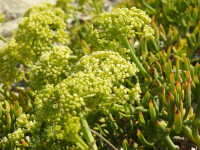
Perennial suffrutescent plant, Rock Samphire presents a bushy habit and a height ranging from 20 to 60 cm. The base is lignified, while the upper herbaceous stems are ascending or erect, glaucous green with longitudinal stripes and a zigzag pattern. These stems are glabrous and flexible, sometimes prostrate, giving the plant a compact and robust appearance.
The leaves are one of its most distinctive features: persistent, fleshy, glabrous, with a succulent texture, generally lanceolate in shape. They are bipinnatisect or bi-tripinnatisect, with linear or acute lanceolate segments, fleshy and keeled, giving a fleshy and often glossy appearance. The basal leaves are more complex and finely divided, while the cauline leaves, especially the upper ones, tend to be simpler and inserted directly on a widely enveloping sheath around the stem. This sheath is often highlighted by an enlargement of the petiole. The leaf structure, combined with the presence of a protective veil, effectively limits water loss through evaporation, adapting to the conditions of strong sunlight, wind, and salinity typical of the coastal environment.
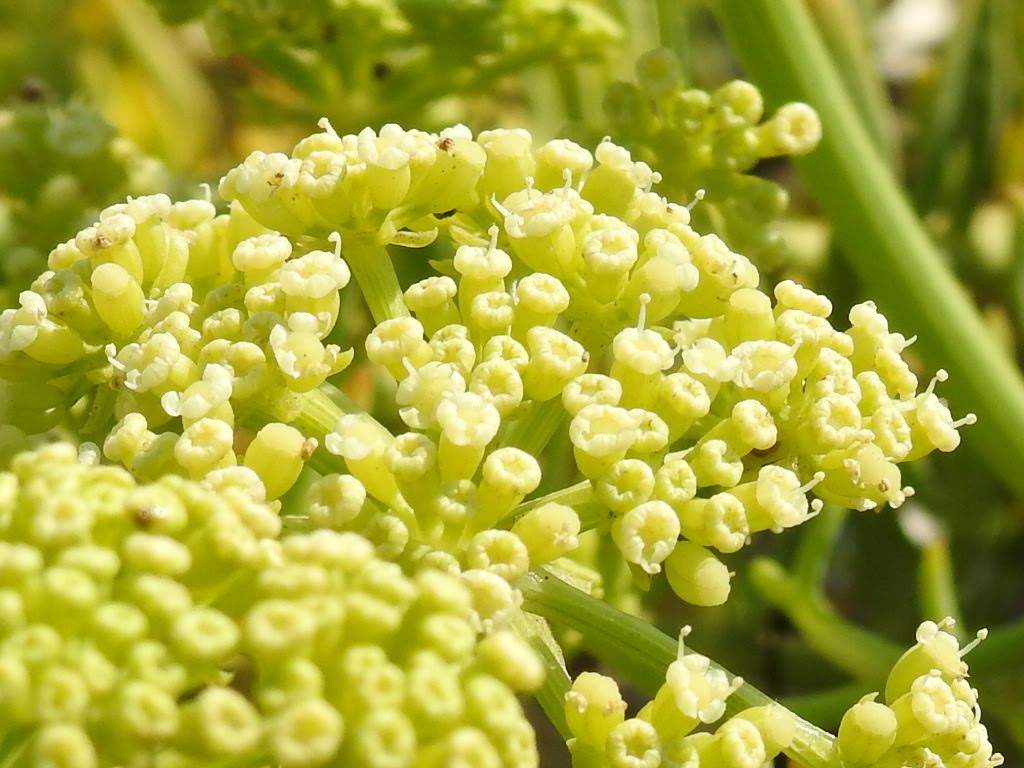
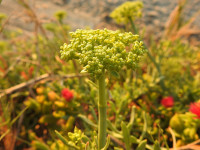
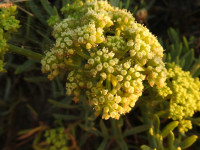
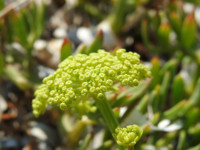
The inflorescence consists of relatively large terminal umbels, composed of 8 to 36 robust rays, each equipped with lanceolate, acuminate, and pendulous bracts. The flowers are small, white-greenish (greenish), with a calyx reduced to a minimum, suborbicular entire petals slightly folded inward. The styles are erect but shorter than the nectariferous gland (stylopodium). Flowering extends from June to September-October, with slight variation depending on latitude.
The fruit is a polachenar schizocarp, 4-6 mm long, ovoid in shape and yellowish or brown-reddish in color. It has a glabrous surface covered with well-marked longitudinal ribs, some of which are wider and keeled, giving the achene a resemblance to a barley grain, from which the species name derives. The spongy part of the pericarp allows the seeds to float for a long time in water, facilitating their dispersal along the coasts.
The root system consists of an underground rhizomatous base, from which woody and herbaceous stems arise, allowing the plant both good anchorage in sandy or rocky substrates and the ability to regenerate.
Habitat and distribution
Rock Samphire is a typical species of Mediterranean coastal environments, but with a distribution extending along the coasts of the Black Sea, the Mediterranean, and the Atlantic up to northern Scotland. In Italy, it is very common on all coasts, from sandy beaches to cliffs and piers, preferring substrates influenced by salinity such as sand, gravel, limestone or volcanic rocks. It grows at sea level and low altitude, usually up to a few tens of meters above sea level.
The species is psammophilous, i.e., adapted to live on sandy and brackish soils, and is also found in rocky environments exposed to the sea, where it withstands the action of wind and salt spray. Its presence is significant in coastal ecosystems, where it contributes to substrate stabilization and environmental balance.
Flowering period
Rock Samphire’s flowering mainly extends from June to September, with flowering peaks that can last until October in more southern regions or favorable microclimates. In more northern areas or with less mild climatic conditions, the flowering period is generally concentrated between July and September.
Ecology and pollination
The flowers of Crithmum maritimum, although small and of inconspicuous color (white-greenish), attract specialized and generalist pollinating insects, including bees, flies, and other coastal pollinators. The umbrella-shaped inflorescence facilitates access to nectar and pollen by these insects.
Reproduction occurs both sexually, through seed production, and vegetatively through the rhizome. Seed dispersal is facilitated by the fruit’s adaptation to float on seawater thanks to the spongy tissue of the pericarp, which acts as a “life buoy.” Seeds transported in this way can reach other coastal areas, promoting colonization of new suitable habitats.
Curiosities and traditional uses
Rock Samphire has been known since antiquity for its aromatic and medicinal properties. The fleshy and aromatic leaves, with a flavor reminiscent of a combination of fennel and celery with a marked salty note, are edible and used in cooking especially in Mediterranean coastal regions. They are consumed fresh, preserved in vinegar as pickles, or used to flavor soups, sauces, and seasonings.
From a medicinal point of view, the plant is rich in essential oils, iodine, beta-carotene, vitamin C, proteins, and minerals, which confer aromatic, aperitive, digestive, carminative, diuretic, and antiscorbutic properties. Traditionally, the fresh plant has been used as a diuretic and depurative. The seeds and fruits stimulate appetite and digestion, helping to reduce fermentations and intestinal spasms.
The essential oil extracted from Rock Samphire is used in the cosmetic industry for the production of perfumes, soaps, and creams thanks to its characteristic aroma.
It is important to emphasize that, due to the similarity with other potentially toxic Umbelliferae, precise botanical identification is necessary before consuming the plant.
Etymology
The scientific name Crithmum maritimum derives from the Greek krithe, meaning “barley,” referring to the resemblance between its fruits and a barley grain, while maritimum indicates its typically marine and coastal habitat.
The Italian common name “cretamo” or “finocchio marino” recalls the aromatic and slightly fennel-like flavor of the leaves, similar to that of common fennel, and its affinity for coastal environments.
Sources
- Prof. P.V. Arrigoni, "Flora analitica della Toscana", "Flora dell'Isola di Sardegna"
- Acta Plantarum - Flora delle regioni italiane (scheda di Giuliano Salvai)
- Tela Botanica / H. Coste, "Flore descriptive et illustrée de la France"
Characteristics
Scheda botanica
| Famiglia | Apiaceae |
|---|---|
| Fioritura | giugno – settembre |
| Forma biologica | Suffruticose |
| Habitat | edible plant, succulent plant, with green flowers |
| Uso alimentare | Commestibile |
Domande frequenti
- Quando fiorisce Rock Samphire?
- Rock Samphire fiorisce giugno – settembre.
- È commestibile Rock Samphire?
- Rock Samphire è considerata commestibile. Verifica sempre le parti eduli e la preparazione corretta prima del consumo.
- Che tipo di pianta è Rock Samphire?
- Rock Samphire è una Chamaephyte (Suffruticose) secondo la classificazione di Raunkiaer.
- A quale famiglia appartiene Rock Samphire?
- Rock Samphire appartiene alla famiglia botanica Apiaceae.
Where I found it (6 sightings)
Classification
- Kingdom
- Plantae
- Family
- Apiaceae
- Full name
- Crithmum maritimum L.
- Life form
- Chamaephyte suffruticose
Similar species
Search for species with similar characteristicsFurther reading
Noticed an error in the identification? Write to me
Other species of the same family
Apiaceae
Explore
Other species of Apiaceae