Botanical species
Macrobriza maxima
(L.) Tzvelev
Sonaglini maggiori
Description
Morphological description
The plant is an annual herb with a generally erect habit, although the culms can be bent especially at the base. The height ranges from 20 to 50 cm, with specimens that can reach up to 80 cm under favorable conditions. The stems are slender, solitary or sometimes in small groups, glabrous or slightly pubescent. The stem surface is smooth and hairless.
The leaves are alternate, with an elongated, linear blade and a rather rough texture to the touch. Their length varies between 4 and 7 cm with a width between 2 and 8 mm. The leaf margins are finely dentate and the ligule is well developed, oblong, 3-5 mm long, with an irregularly dentate edge. The leaf sheaths are slightly swollen in the upper part.
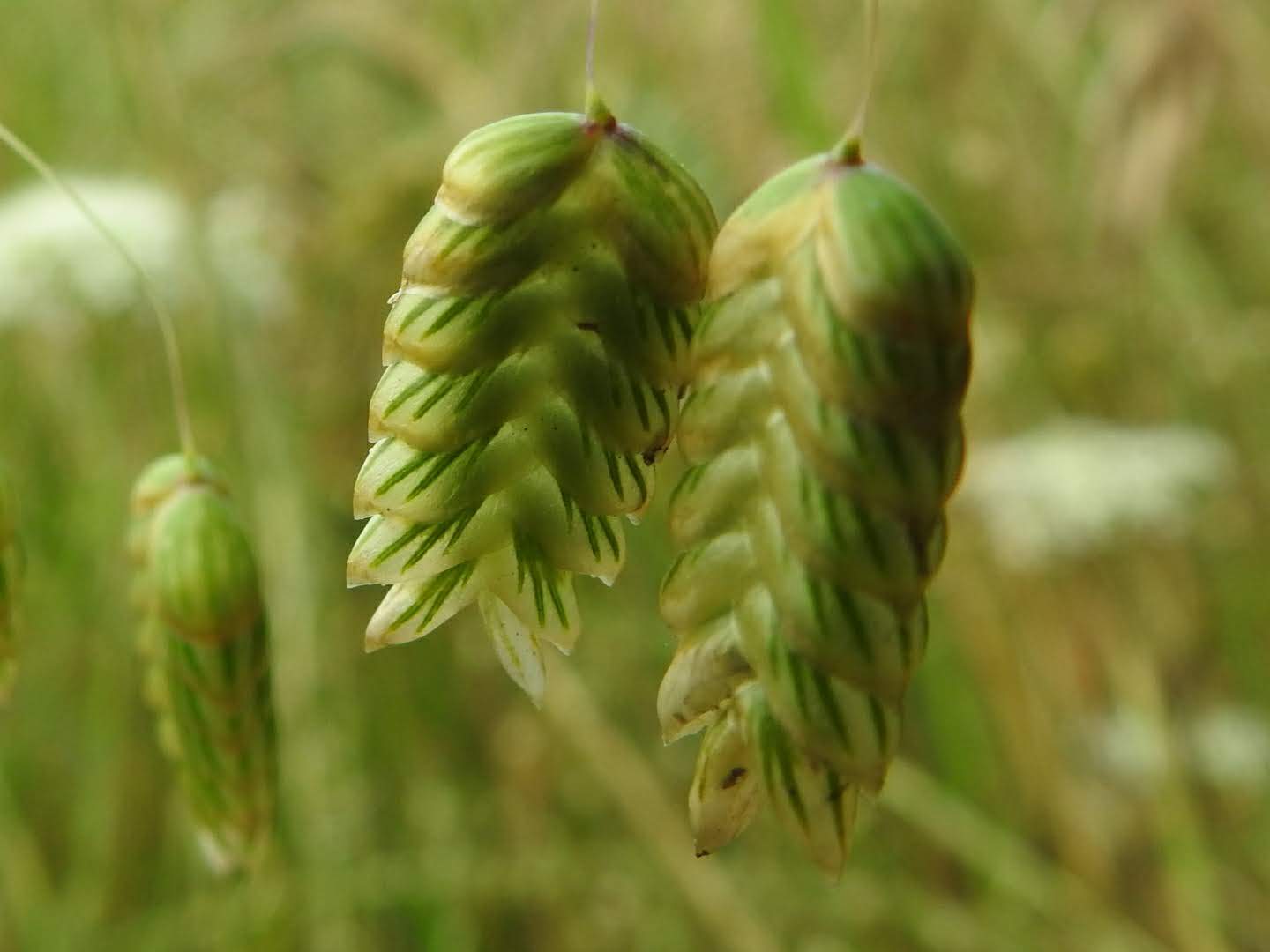
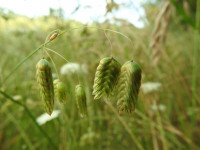
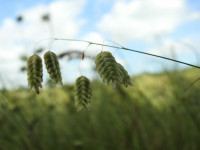
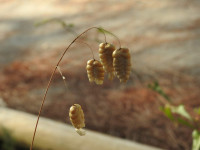
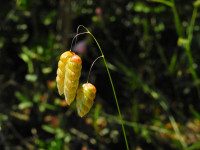
The inflorescence is a simple, unilateral panicle, often pendulous and characterized by flexible branches bearing single or double spikelets. The spikelets are ovate-oblong, 12-25 mm long, pendulous and trembling at the slightest breeze, giving the plant a very decorative appearance. Each spikelet hosts from 5 to 20 flowers, which lack conspicuous petals, typically green-silvery when fresh, turning rust-red when dried. The glumes and lemmas are subequal, ovate-rounded in shape and 5-6 mm long. The lemmas of the lower flowers measure about 4 mm, while those of the upper flowers are progressively smaller.
The root system is fibrous, suitable for dry and well-drained soils, and contributes to the plant's stability in arid or rocky environments.
Habitat and distribution
The species is typical of Mediterranean and sub-Mediterranean environments, mainly distributed in regions with warm and dry climates. In Italy it is commonly found in mountainous and hilly areas, preferring dry and sunny places with poor soils, often calcareous or stony. It is also present in Corsica and extends throughout the Mediterranean basin to the southern regions of France, such as Drôme and Ardèche, as well as being reported in arid areas of southern Europe.
It generally grows on well-drained soils, exposed to full sun, and can withstand summer drought conditions typical of Mediterranean habitats. The altitude range varies from low elevations up to about 1000 meters, with a preference for mountainous and hilly environments.
Flowering period
Flowering mainly occurs between April and June. In some Mediterranean areas, especially the warmer ones, flowering can begin as early as April, while in cooler regions it extends until June. This period coincides with the spring season, when climatic conditions are favorable for the growth and reproduction of the plant.
Ecology and pollination
The species has flowers lacking showy petals, typical of Poaceae, and therefore does not rely on visual attraction for pollinating insects as many other plants do. Pollination is predominantly anemophilous (pollen transport by wind), facilitated by the pendulous and lightweight structure of the spikelets which favors pollen release and dispersal.
Seed dispersal mainly occurs by falling near the mother plant, but can be aided by the wind due to the lightness of the dry spikelets, allowing limited spread in the surrounding environment. No particular adaptations for animal-mediated dispersal are known.
Curiosities and traditional uses
The species is known for its decorative appearance thanks to the pendulous and trembling spikelets, which is why it is sometimes cultivated as an ornamental plant in gardens and floral arrangements. The common name “sonaglini maggiori” derives precisely from the characteristic movement of the spikelets in the wind, reminiscent of the tinkling of small bells.
No significant medicinal or food uses are documented for this species, nor are particular traditional or folkloric applications known. However, its presence is indicative of well-preserved natural environments less subject to intensive cultivation.
Etymology
The scientific name “Macrobriza” derives from the Greek “macro-” (large) and “briza” (name of a genus of grasses), highlighting the relatively large size of the spikelets compared to related species. The specific epithet “maxima” further emphasizes the size of the spikelets and the panicle compared to other species of the genus.
The Italian common name “sonaglini maggiori” refers to the oscillatory movement and the sound produced by the wind shaking the spikelets, similar to small bells, distinguishing it from “briza minore” or other similar species.
Sources
- Prof. P.V. Arrigoni, "Flora analitica della Toscana"; Prof. S. Pignatti, "Flora d'Italia"
- Tela Botanica / H. Coste, "Flore descriptive et illustrée de la France"
Characteristics
Scheda botanica
| Famiglia | Poaceae |
|---|---|
| Fioritura | aprile – giugno |
| Forma biologica | Scapose |
| Habitat | flower without petals, annual plant |
Domande frequenti
- Quando fiorisce Sonaglini maggiori?
- Sonaglini maggiori fiorisce aprile – giugno.
- Che tipo di pianta è Sonaglini maggiori?
- Sonaglini maggiori è una Therophytes (Scapose) secondo la classificazione di Raunkiaer.
- A quale famiglia appartiene Sonaglini maggiori?
- Sonaglini maggiori appartiene alla famiglia botanica Poaceae.
Where I found it (5 sightings)
Classification
- Kingdom
- Plantae
- Family
- Poaceae
- Full name
- Macrobriza maxima (L.) Tzvelev
- Synonyms
- Briza maxima L.
- Life form
- Therophytes scapose
Similar species
Search for species with similar characteristicsNoticed an error in the identification? Write to me
Other species of the same family
Poaceae
Explore
Other species of Poaceae