Botanical species
Cynodon dactylon
(L.) Pers.
Bermuda Grass

Description
Morphological description
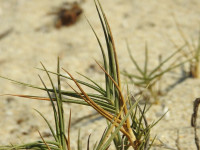
Perennial herbaceous plant, Bermuda Grass has a creeping and bushy habit, with intertwined epigeal stolons and tenacious, creeping, and branched underground rhizomes that easily root at the nodes, allowing rapid colonization of the soil. The culms are prostrate-ascending and reach a variable height between 10 and 40 centimeters.
The leaves are linear, distichous, mainly basal, with a blade 3-5 cm long and 3-3.5 mm wide, lanceolate in shape and rigid herbaceous texture. The leaf surface is channelled and covered with patent hairs, especially near the sheath; the ligule is replaced by a fringe of hairs about 1.5 mm long. The leaves of sterile shoots are shorter and more lanceolate.
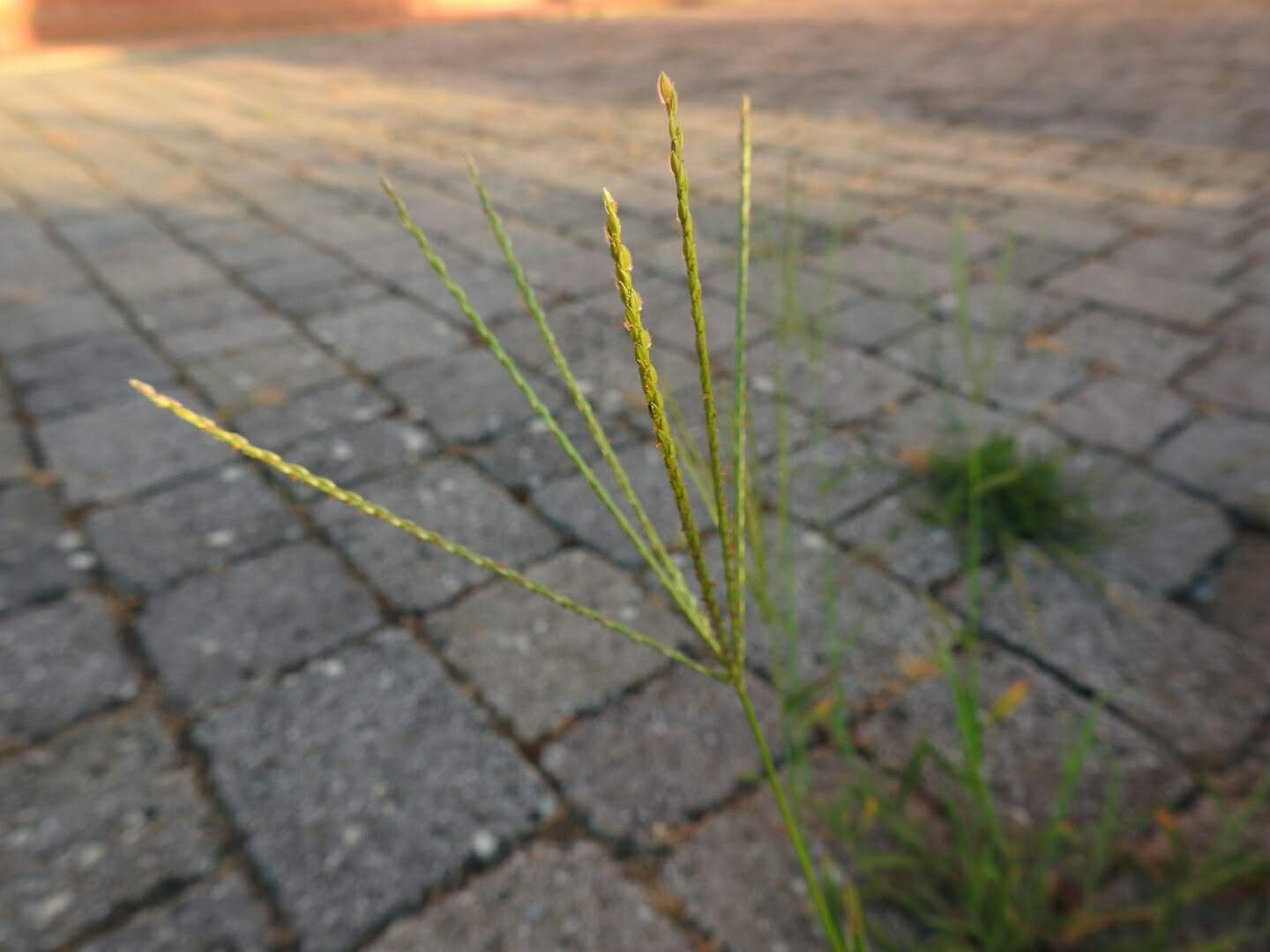
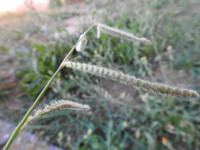
The inflorescence is terminal, composed of 3-7 digitated or subdigitated spikes, arranged in a whorl on a flattened rachis, and 3-4 cm long. The spikes are thin, from green to violet, with unifloral spikelets about 2-2.5 mm long, laterally compressible. Each spikelet has a fertile flower and an abortive rudiment of an upper flower. The glumes, subequal and lanceolate, measure respectively 0.7-1.7 mm and are acuminate, membranous, and one-nerved. The lemma, about 2.3 mm long, is concave, trilobed, awnless, and hairy along the keel. The fruit is a caryopsis with an adherent pericarp.
The root system consists of very extensive superficial rhizomes and stolons that promote wide expansion and a strong invasive capacity.
Habitat and distribution
Bermuda Grass is a thermophilic species, widespread throughout Italy and the Mediterranean basin, typical of arid or semi-arid environments but highly adaptable. It commonly grows in uncultivated areas, hedges, roadside edges, dry grassy places, sandy and trampled soils, up to 800 meters altitude. It is also frequent in anthropized environments and as a weed in crops.
It prefers well-drained soils, often sandy or poor, and easily adapts to compact and disturbed soils. Its distribution is subcosmopolitan, being native to the Old World but widely naturalized in warm climates worldwide.
Flowering period
Flowering occurs from June to September in Italy, with possible variations linked to altitude and local climatic conditions. In warmer or Mediterranean climates, flowering can extend until May or September, showing some phenological plasticity.
Ecology and pollination
Bermuda Grass is a perennial rhizomatous and stoloniferous plant that forms dense and wear-resistant turf. Reproduction occurs mainly vegetatively through rhizomes and stolons, allowing rapid spread and colonization of new spaces. Pollination is anemophilous, typical of Poaceae, and does not rely on pollinating insects. Seed dispersal is limited and secondary compared to vegetative clonal propagation.
Curiosities and traditional uses
Bermuda Grass is known for its medicinal properties: the rhizomes contain mucilages, sugars, starches, saponin substances, a vanillin glucoside, and potassium salts. Traditionally it has been used as a popular remedy for its diuretic, purifying, anti-inflammatory, and refreshing actions, particularly for diseases such as gout, arthritis, and rheumatism.
The rhizome decoction is an ancient remedy for spring body purification. In the past, dried and roasted rhizomes were used as an economical coffee substitute, free of the contraindications of the latter. An interesting application is the production of a refreshing and low-cost beer.
Besides medicinal use, the species is widely used as lawn grass in English-style gardens in warm and dry climate regions, thanks to its resistance and ability to quickly cover the ground. It also provides important forage in many areas.
Etymology
The genus name Cynodon derives from the Greek “kynodon,” composed of “kyon” (dog) and “odon” (tooth), probably referring to the pointed and toothed shape of the spikelets. The specific epithet “dactylon” means “finger” and alludes to the digitated inflorescence, characterized by spikes arranged in a radiating pattern like the fingers of a hand.
The Italian common name “gramigna rossa” refers to the violet-reddish color of the spikes, which distinguishes it from other greener or yellowish Bermuda Grasses.
Sources
- Prof. S. Pignatti, "Flora d'Italia"
- Acta Plantarum - Flora delle regioni italiane (scheda di Anja Michelucci)
- World Flora Online (WFO)
Characteristics
Scheda botanica
| Famiglia | Poaceae |
|---|---|
| Fioritura | giugno – settembre |
| Forma biologica | Rhizomatous |
| Habitat | creeping plant, flower without petals, plant with a prostrate-ascending habit |
Domande frequenti
- Quando fiorisce Bermuda Grass?
- Bermuda Grass fiorisce giugno – settembre.
- Che tipo di pianta è Bermuda Grass?
- Bermuda Grass è una Geophytes (Rhizomatous) secondo la classificazione di Raunkiaer.
- A quale famiglia appartiene Bermuda Grass?
- Bermuda Grass appartiene alla famiglia botanica Poaceae.
Where I found it (4 sightings)
Classification
- Kingdom
- Plantae
- Family
- Poaceae
- Full name
- Cynodon dactylon (L.) Pers.
- Life form
- Geophytes rhizomatous
Similar species
Search for species with similar characteristicsFurther reading
Noticed an error in the identification? Write to me
Other species of the same family
Poaceae
Explore
Other species of Poaceae