Botanical species
Agrostis stolonifera
L.
Creeping Bent
Description
Morphological description
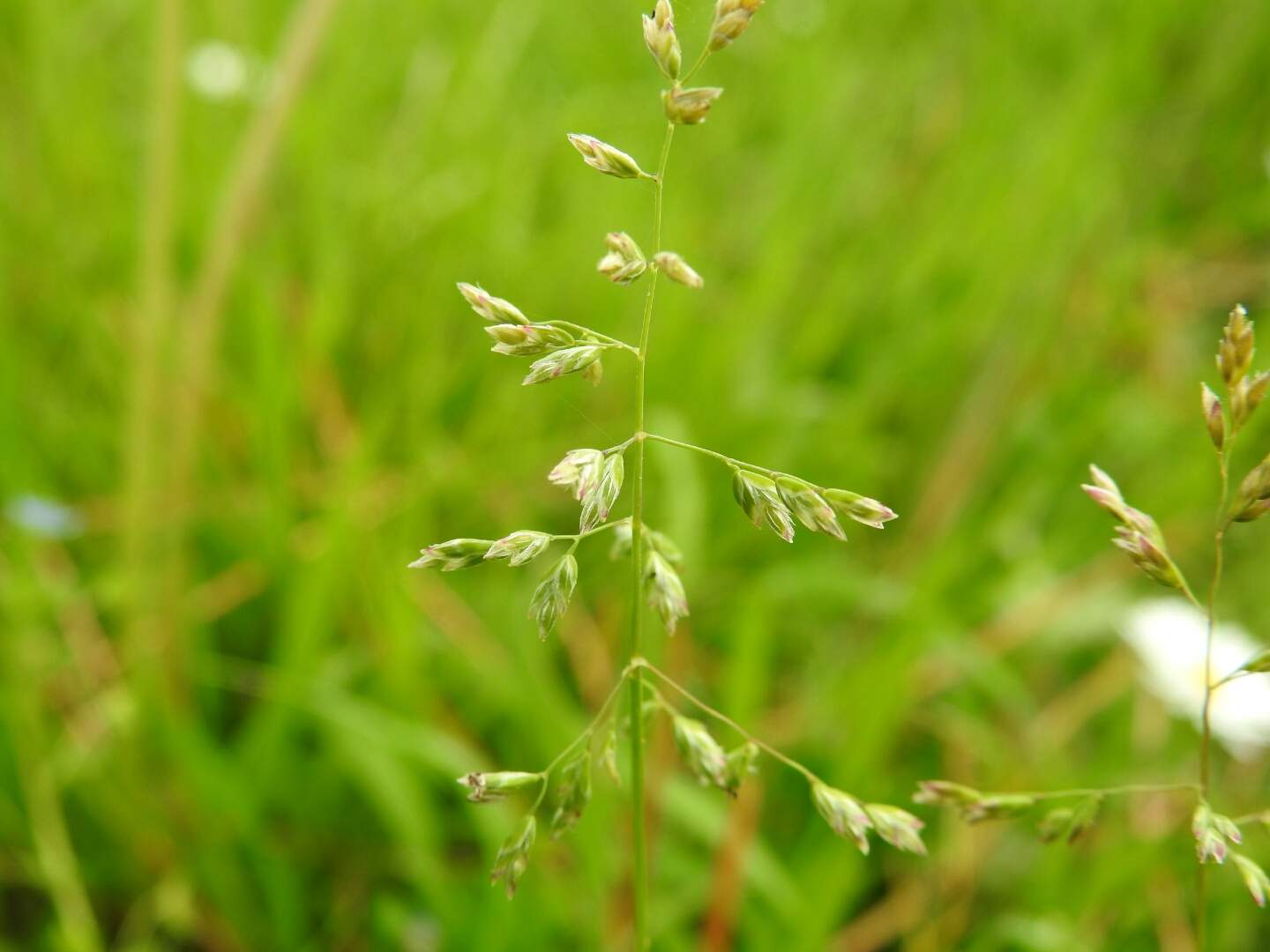
Perennial plant belonging to the Poaceae family, it has a predominantly creeping and branched-ascending habit thanks to thin stems and leafy epigeal stolons that extend widely. These stolons, rooting at the nodes, allow the plant to rapidly expand horizontally, giving a lawn-like appearance. The height of the culms can vary from 30 to 100 cm, generally erect or geniculate with roots at the lower nodes.
The leaves are alternately arranged along the stem, with a linear, herbaceous blade, light green in color that can take on glaucous tones. The leaf width varies between 2 and 7 mm, while the length can reach 4–10 cm. The leaves have slightly rough margins and an acute or pointed apex. The ligule, membranous and 2–7 mm long, is typically acute and often fringed or laciniate.
The panicle is generally contracted, linear or lanceolate in shape, 5 to 20 cm long, open only during flowering and otherwise compact and dense. The panicle branches are erect-patent, rough, with several branches per node, often accompanied by shorter branches bearing the spikelets down to the base. The glumes are lanceolate, subequal or with the lower glume slightly longer, with an acute apex; the lower glume can be rough along the keel. The lemma, about 1.5 mm long, is truncate-denticulate with 5 nerves, usually awnless and with a rounded apex. The palea is about half to three-quarters the length of the lemma. The spikelets are unifloral, about 2–3 mm long, yellow-green or whitish in color. The anthers measure between 0.8 and 1.5 mm.
The root system consists of superficial rhizomes, which together with the stolons enhance the ability to colonize moist soil and the aquatic nature of this species.
Habitat and distribution
Circumboreal species, it is widespread throughout the Italian territory and the Mediterranean basin, with particular presence in wet areas, edges of watercourses, wet meadows, and marshy zones. It frequently lives in aquatic or semi-aquatic environments, such as muddy or gravelly banks, and in wet meadows at low and hilly altitudes, up to subalpine elevations.
In Italy it is found in almost all regions, with well-defined ecogeographical variants, such as the subspecies maritima, typical of low brackish areas along the Adriatic and Tyrrhenian coasts, and the subspecies scabriglumis more typical of southern regions such as Sicily and Calabria. These forms are distinguished by morphological characteristics such as leaf rigidity and panicle color.
It prefers moist soils, often with high salinity in coastal areas, and adapts to variable exposures provided there is sufficient moisture. Its broad ecological tolerance makes it a common species in wet meadows and areas subject to periodic flooding.
Flowering period
Flowering mainly occurs between May and August, with peak activity in summer. In some more temperate regions or at higher altitudes, flowering may extend until September. During this period the panicles open to allow pollination, while subsequently they tend to contract and become more compact.
Ecology and pollination
Adapted to wet meadows and marshy areas, the species reproduces mainly vegetatively through stolons and rhizomes, allowing rapid local expansion and colonization of new sites. Sexual reproduction occurs through unisexual flowers lacking petals, primarily wind-pollinated (anemophily), which carries the pollen from the open panicles.
Seed dispersal occurs through the detachment of spikelets, facilitated by their light structure and proximity to watercourses that can transport them downstream. The absence of petals and the presence of relatively small anthers are typical adaptations of grasses to wind pollination.
Curiosities and traditional uses
Although widespread and common, this species has few references in ethnobotany or documented medicinal uses. Its ability to form dense turf makes it useful in agronomic and environmental contexts for soil erosion control in wet areas and as a component of hay meadows in marginal zones.
It is sometimes also used for forage, although it is not one of the most valued species. No particular folkloric traditions or direct food uses related to this grass are known.
Etymology
The generic name "Agrostis" derives from the Greek ἀγρός (agrós), meaning "field" or "cultivated land," probably referring to the common habitat of many species of the genus, typically meadows and open fields. The specific epithet "stolonifera" indicates the main characteristic of this species of producing stolons, i.e., creeping stems that emit roots at the nodes, from which a new plant develops.
The Italian common name "cappellini comuni" refers to the shape of the glumes and spikelets which resemble small "hats" or headgear, an affectionate and descriptive term of their morphology.
Sources
- Prof. S. Pignatti, "Flora d'Italia"
- Tela Botanica / H. Coste, "Flore descriptive et illustrée de la France"
- World Flora Online (WFO)
Characteristics
Scheda botanica
| Famiglia | Poaceae |
|---|---|
| Fioritura | maggio – agosto |
| Forma biologica | Creeping plants |
| Habitat | creeping plant, flower without petals, Perennial plant |
Domande frequenti
- Quando fiorisce Creeping Bent?
- Creeping Bent fiorisce maggio – agosto.
- Che tipo di pianta è Creeping Bent?
- Creeping Bent è una Hemicryptophytes (Creeping plants) secondo la classificazione di Raunkiaer.
- A quale famiglia appartiene Creeping Bent?
- Creeping Bent appartiene alla famiglia botanica Poaceae.
Where I found it (2 sightings)
Classification
- Kingdom
- Plantae
- Family
- Poaceae
- Full name
- Agrostis stolonifera L.
- Life form
- Hemicryptophytes creeping plants
Similar species
Search for species with similar characteristicsNoticed an error in the identification? Write to me
Other species of the same family
Poaceae
Explore
Other species of Poaceae