Botanical species
Sorghum halepense
(L.) Pers.
Johnson-Grass
Description
Morphological description
Perennial herbaceous plant, Johnson-Grass has an erect habit that can reach a variable height between 30 and 180 (up to 250) cm. The stem is robust, cylindrical but slightly compressed, solid, and develops from a very extensive, fleshy, and creeping rhizomatous system located underground. This rhizome, whitish or pinkish, allows the plant to spread rapidly and is one of the causes of its invasive nature.
The leaves are alternate, linear, with a blade 1-2 cm wide and up to 60 cm long, green with sometimes purplish shades, glossy but not particularly bright. The leaf margins are rough and scabrous, often equipped with small upward-pointing spines, while the surface is glabrous, with a well-visible white central nerve. The ligule, located at the base of the leaf, is membranous and ciliate, with a variable length of about 2-6 mm and may present a tuft of white hairs.
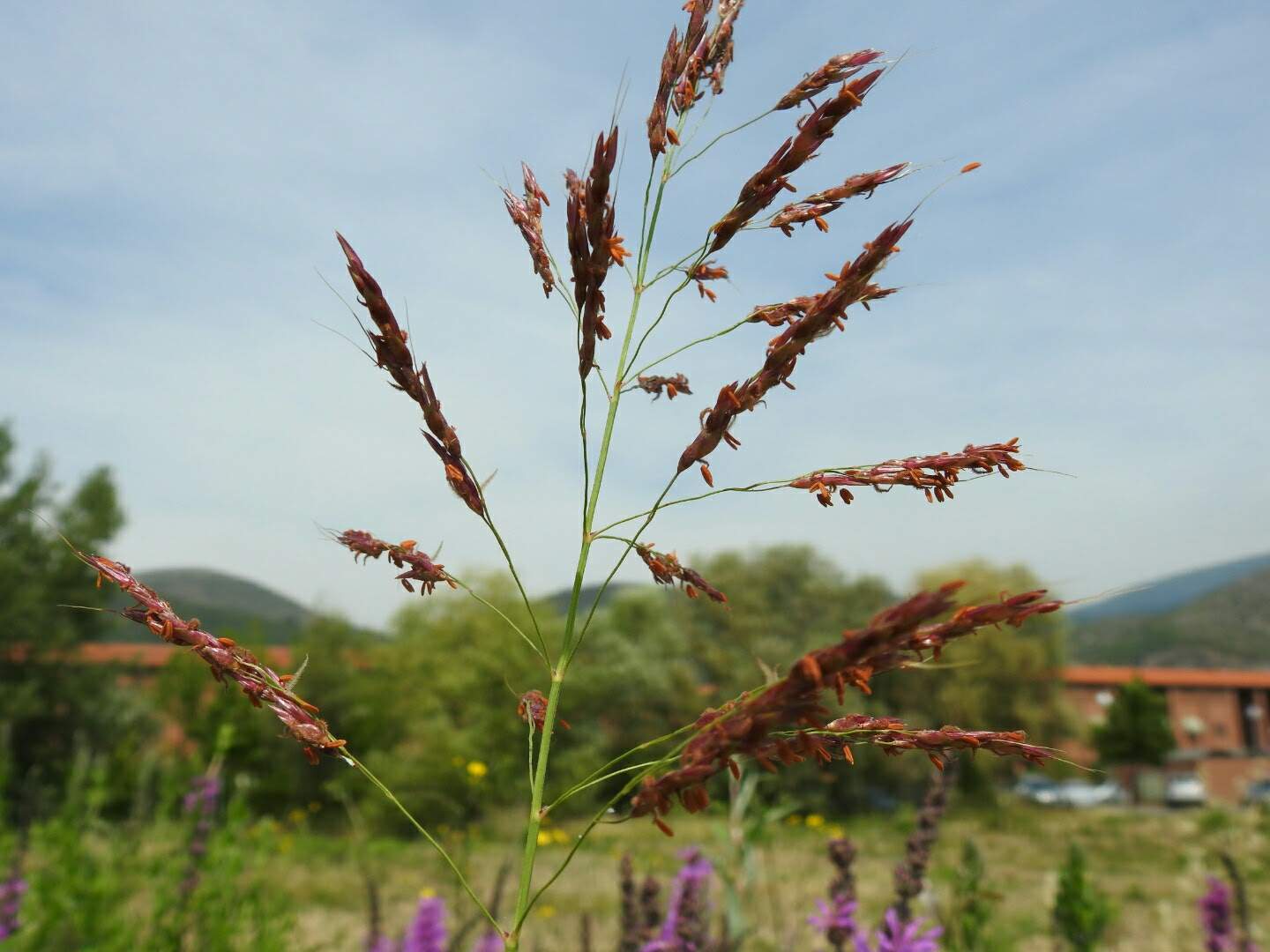
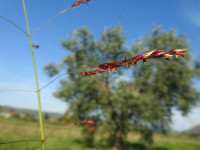
The inflorescence is a broad, pyramidal panicle, with patent and thin branches, sometimes slightly pendulous. The spikelets, 4-6 mm long, are arranged in paired couples along the branches and in groups of three at the branch tips; in the triad the central spikelet is sessile, fertile, and hermaphrodite with a generally awned lemma (with an awn 5-15 mm long, often twisted at the base), while the lateral ones are respectively pedunculate and male, and sessile and sterile. The glumes are leathery, glossy, with a pubescent surface on the lower part, brown-reddish in the pedunculate spikelets and protect the underlying paleas, which are instead transparent. The fruit is an oval-oblong caryopsis, partially enveloped by the glumes, with a typical "turtle shell" shape.
The culm is glabrous or slightly pubescent, with nodes free of widespread white hairs and a rough or tomentose surface. The root system is rhizomatous, with long creeping rhizomes that emit roots and adventitious stems, giving the plant a great capacity for colonization and resistance.
Habitat and distribution
Johnson-Grass is native to the eastern Mediterranean, with the specific name referring to the city of Aleppo in Syria, but it is now widely naturalized throughout the Mediterranean basin, southern Europe, and many other temperate and tropical regions of the world. In Italy it is present as a casual in all regions and islands, from sea level up to about 600 meters altitude, sometimes up to 1200 m, especially in hilly and flat areas.
It prefers disturbed habitats such as cultivated fields (especially maize), fallows, roadsides, ruderal areas, and sandy or loose soils. It is frequent in sandy, well-drained soils but also adapts to more clayey or mixed soils, showing good environmental tolerance. Its presence is often considered invasive due to its aggressiveness and ability to compete with herbaceous crops.
Flowering period
Flowering occurs mainly from July to October, with geographical variations that can slightly influence the duration and start of the flowering period. In warmer and temperate climates, flowering can extend until late autumn. In some Mediterranean areas, especially in the southernmost regions, flowering can start as early as June and continue until September.
Ecology and pollination
Perennial plant with rhizomatous capacity, Johnson-Grass reproduces both vegetatively through rhizomes and sexually via caryopses. Pollination is anemophilous, i.e., wind-mediated, typical of Poaceae, and does not require the intervention of pollinating insects. The uniflorous spikelets are structured to favor pollen dispersion in the air.
Seed dispersal occurs mainly by falling near the mother plant, but also through accidental transport by humans, animals, or water. The rhizomatous system also allows rapid local expansion, making the species very competitive and often invasive in cultivated soils.
Curiosities and traditional uses
Johnson-Grass is considered an invasive plant in many crops, particularly maize, due to its ability to spread rapidly and compete for resources. However, the genus Sorghum also includes cultivated species of great food and forage importance, such as Sorghum bicolor, used in Africa and Asia as a drought-resistant cereal.
In Italy and the Mediterranean, Johnson-Grass is not commonly used for food or medicinal purposes, but its presence is monitored due to its impact on crops. Historically, cultivated sorghum varieties have been used for forage and human food in other parts of the world.
Etymology
The genus name "Sorghum" probably derives from an Indian word "sorghi," referring to a related species of the genus. The specific name "halepense" indicates the geographical origin of the species, i.e., Aleppo, Syria, from which the Italian common name "sorgo selvatico" or "sorgo d’Aleppo" derives. This geographical reference highlights the eastern Mediterranean origin of the plant, from which it then spread throughout the Mediterranean basin and beyond.
Sources
- Prof. S. Pignatti, "Flora d'Italia"
- Acta Plantarum - Flora delle regioni italiane (scheda di Mirna Medri)
- Tela Botanica / H. Coste, "Flore descriptive et illustrée de la France"
- World Flora Online (WFO)
Characteristics
Scheda botanica
| Famiglia | Poaceae |
|---|---|
| Fioritura | luglio – ottobre |
| Forma biologica | Rhizomatous |
| Habitat | flower without petals, Perennial plant |
Domande frequenti
- Quando fiorisce Johnson-Grass?
- Johnson-Grass fiorisce luglio – ottobre.
- Che tipo di pianta è Johnson-Grass?
- Johnson-Grass è una Geophytes (Rhizomatous) secondo la classificazione di Raunkiaer.
- A quale famiglia appartiene Johnson-Grass?
- Johnson-Grass appartiene alla famiglia botanica Poaceae.
Where I found it (6 sightings)
Classification
- Kingdom
- Plantae
- Family
- Poaceae
- Full name
- Sorghum halepense (L.) Pers.
- Synonyms
- Andropogon halepensis (L.) Brot.; Andropogon sorghum (L.) Brot. subsp. halepensis (L.) Hack.; Blumenbachia halepensis (L.) Koeler; Holcus halepensis L.; Milium halepense (L.) Cav.; Rhaphis halepensis (L.) Roberty; Sorghum saccharatum (L.) Moench
- Life form
- Geophytes rhizomatous
Similar species
Search for species with similar characteristicsFurther reading
Noticed an error in the identification? Write to me
Other species of the same family
Poaceae
Explore
Other species of Poaceae