Botanical species
Lathyrus cicera
L.
Red Vetchling
Description
Morphological description
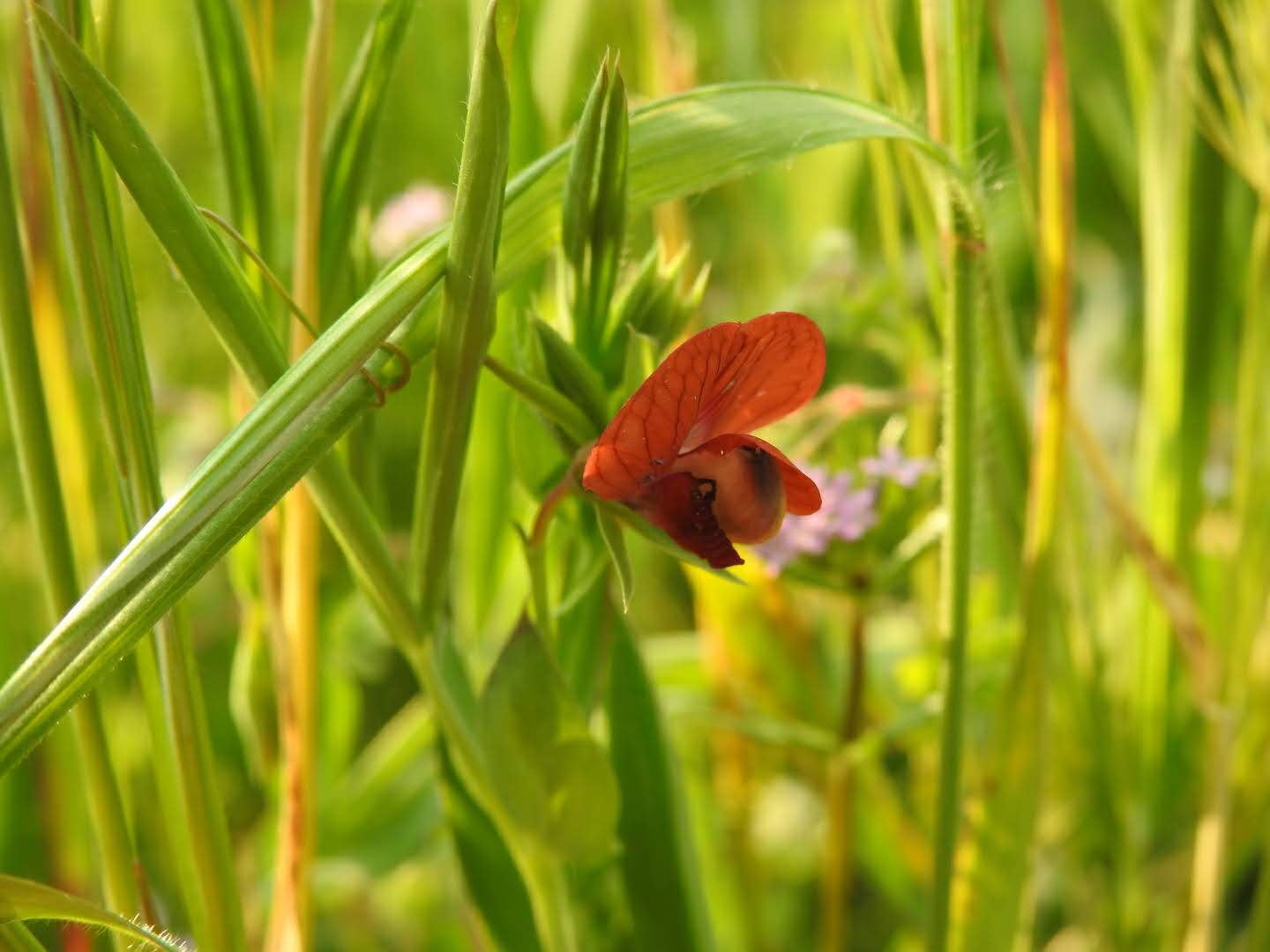
Annual herbaceous plant, the Red Vetchling develops with a scapose habit, reaching a variable height between 10 and 60 (up to 100) cm. The stem is erect or ascending and can exhibit a climbing character thanks to the presence of narrow wings (0.3-1.3 mm wide) that characterize its angular section. It is glabrous and branched especially at the base.
The leaves are compound, paripinnate, with one or two pairs of narrowly lanceolate or linear-lanceolate segments, varying in size between 2-8 mm wide and 20-60 mm long. The arrangement is opposite and the texture herbaceous. The lower leaves generally end with a simple tendril, while the upper ones have a branched tendril, which helps the plant to support itself during growth. The rachis is winged, acting as a phyllodium, and measures from 4 to 28 mm. The stipules are lanceolate, acute, semi-sagittate, about as wide as the leaf segments (3-5 x 8-20 mm), often with a small tooth at the base, and can reach up to one third of the length of the corresponding leaf segment.
The inflorescence consists of solitary flowers, rarely in pairs, borne on axillary peduncles 1 to 3 (up to 4.5) cm long, generally shorter than the subtending leaf. The peduncle is articulated, usually with a short mucro of about 5 mm at half its length.
The flowers are papilionaceous, carmine red or brick red with a reticulated and emarginate standard. The corolla measures between 13 and 15 mm. The calyx is campanulate, 6.5-12.5 mm long, with subequal, acute teeth at least twice as long as the calyx tube (3-5 mm in the tube and 5 mm teeth). The stamens are diadelphous and the ovary glabrous with a twisted style.
The fruit is a glabrous, dehiscent legume, elliptical, 20-40 mm long and 5-10 mm wide, characterized by a grooved dorsal suture and two narrow lateral wings. It contains 2 to 6 smooth, angular or spherical seeds, about 4-6 mm, with a relatively small hilum (about 1/13 of the seed circumference).
The root system is typical of legumes, with secondary roots and rhizobial nodules for nitrogen fixation, although it has not been described in detail in the consulted sources.
Habitat and distribution
The Red Vetchling is a eurymediterranean species, predominantly distributed along the Mediterranean coasts but extending northwards and eastwards, following the vine area. In Italy it is present throughout the territory, more frequently in the north where it is often found as a relic of ancient crops. It grows on dry soils, uncultivated land, abandoned fields, often on well-drained and sunny substrates. The growth altitude ranges from 0 up to about 1000 meters above sea level.
The preferred exposure is sunny or with direct light, in open and dry environments, where it adapts to poor or stony soil conditions.
Flowering period
Flowering extends from March to June, with possible geographical variations linked to the local climate: in the southern or milder regions flowering can begin as early as March, while in the northern areas it can last until June. Flowers appear singly in the leaf axils during this period.
Ecology and pollination
The species is mainly pollinated by pollinating insects attracted by the bright color of the flowers, particularly bees and bumblebees, which facilitate cross-fertilization. The presence of scapose and pedunculated flowers favors access by pollinating insects.
Seed dispersal occurs through the dehiscence of the legume which opens longitudinally along the dorsal suture, allowing the seeds to fall to the ground. No particularly developed long-distance dispersal strategies are known; the species tends to remain localized or expand slowly in the surrounding soil.
Curiosities and traditional uses
The Red Vetchling is a species historically used as food especially in times of famine. The seeds are edible but contain a toxic amino acid which, if consumed in large quantities or over long periods, can cause a severe neurological syndrome known as "lathyrism". For this reason, its use as food is now uncommon and considered risky.
Legumes harvested while still green are instead edible and were used as fodder for animals, harvested before seed maturation precisely to avoid toxicity. The plant is therefore cultivated in some areas as quality forage, although it is important to prevent animals from ingesting mature seeds.
No established medicinal uses or pharmaceutical applications have been reported, and any indication in this regard should be considered purely informative and non-binding.
Etymology
The genus name, Lathyrus, derives from the Greek "lathyros" (λαθύρος), latinized as "lathyrus", an ancient term for Red Vetchling or a similar legume. The specific epithet cicera comes from the Latin "cicer", meaning "chickpea", referring to the small seeds of the plant.
The Italian common name "cicerchia cicerchiella" directly recalls the scientific name and the resemblance to the common vetchling, emphasizing the smaller size of the seeds and the plant compared to related species.
Sources
- Prof. P.V. Arrigoni, "Flora analitica della Toscana", "Flora dell'Isola di Sardegna"
- Acta Plantarum - Flora delle regioni italiane (scheda di Anja Michelucci)
- World Flora Online (WFO)
Characteristics
Scheda botanica
| Famiglia | Fabaceae |
|---|---|
| Fioritura | marzo – giugno |
| Forma biologica | Scapose |
| Habitat | with red flowers, toxic plant, annual plant |
| Tossicità | Tossica — non consumare |
Domande frequenti
- Quando fiorisce Red Vetchling?
- Red Vetchling fiorisce marzo – giugno.
- È tossica Red Vetchling?
- Red Vetchling è una pianta tossica o velenosa. Non consumare nessuna sua parte senza aver consultato un esperto.
- Che tipo di pianta è Red Vetchling?
- Red Vetchling è una Therophytes (Scapose) secondo la classificazione di Raunkiaer.
- A quale famiglia appartiene Red Vetchling?
- Red Vetchling appartiene alla famiglia botanica Fabaceae.
Where I found it (2 sightings)
Classification
- Kingdom
- Plantae
- Family
- Fabaceae
- Full name
- Lathyrus cicera L.
- Life form
- Therophytes scapose
Similar species
Search for species with similar characteristicsNoticed an error in the identification? Write to me
Other species of the same family
Fabaceae
Explore
Other species of Fabaceae