Botanical species
Sulla coronaria
(L.) Medik.
French Honeysuckle
Description
Morphological description
It is a perennial herbaceous plant belonging to the Fabaceae family, characterized by a scapose habit and prostrate-ascending stems, generally 20 to 100 cm long. The stem is hollow, fistulous, striated, very branched, with a glabrous surface or rarely slightly hairy. The plant has a particularly developed taproot system, equipped with nodules that host symbiotic bacteria capable of fixing atmospheric nitrogen, a characteristic that allows the plant to enrich poor soils.
The leaves are opposite, imparipinnate, 4-10 cm long, composed of 5 to 9 elliptical segments generally measuring 6-15 mm in length by 10-20 mm in width. The margins of the segments are subrounded and the lower surfaces appear woolly, that is covered by fine and soft hairs. The stipules are triangular and acute, measuring between 1-2 mm by 4-6 mm.
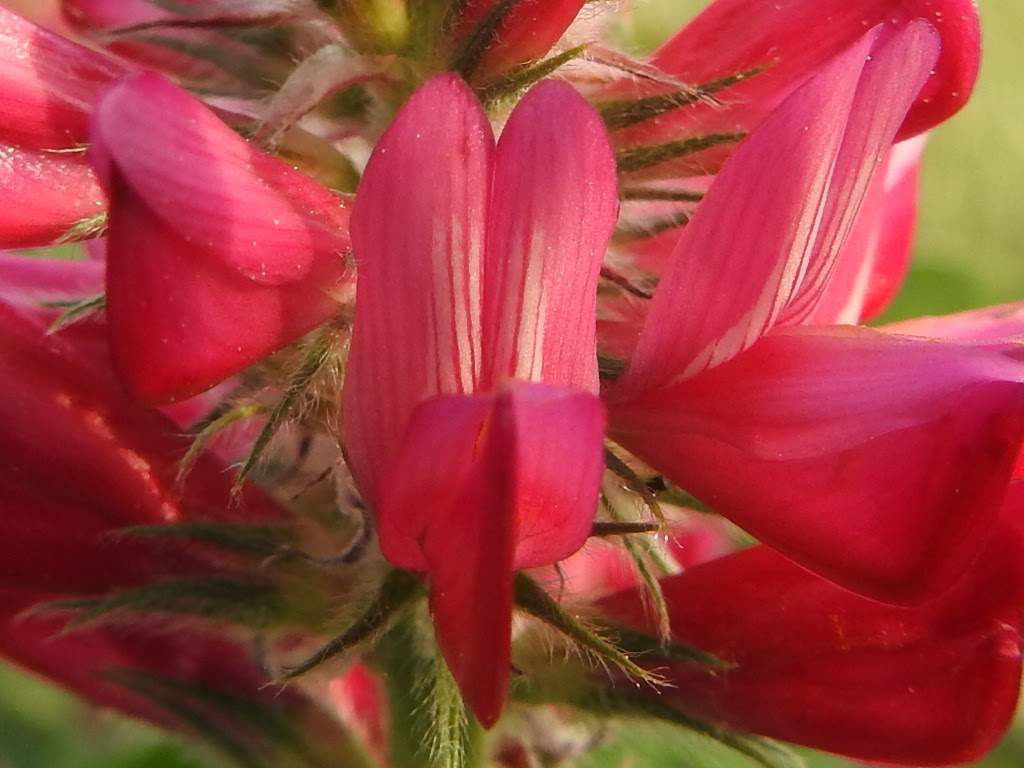
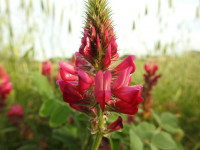
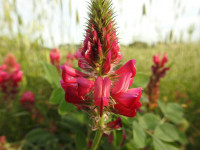
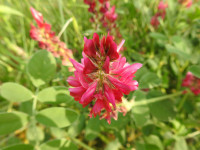
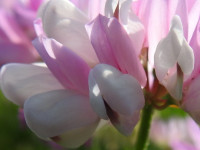
The inflorescence consists of ovoid axillary racemes, about 3 cm wide by 3-8 cm long, with erect-patent flowers, i.e., arranged erect and slightly open, borne on peduncles 0.7 to 1.3 times the length of the axillary leaf. The flowers have a corolla of ruby red color, which can tend to ochre or violet; the banner, the most conspicuous and large part of the leguminous flower, measures between 15 and 20 mm. The calyx is 7-8 mm long with teeth subequal to the calyx tube.
The fruit is a loment segmented into 3-5 discoid articles, bristly with spines along the edge and with flat faces; each segment disarticulates at maturity and contains a single lenticular, shiny, yellowish seed.
Habitat and distribution
The species is native to the western regions of the Mediterranean basin, widely present in Italy, Spain, Tunisia, and Portugal, and also cultivated in North America, Australia, and New Zealand. In Italy, it grows spontaneously mainly in mountainous and hilly environments up to 1200 meters of altitude.
It prefers clayey soils, also subsaline, often uncultivated grassy areas, where it manages to colonize difficult and unstable soils thanks to its tuberous root which contributes to reclamation and improvement of soil fertility through biological nitrogen fixation. It is a species that adapts well to sunny exposures and temperate Mediterranean climates.
Flowering period
Flowering mainly occurs between April and June, with a window that can vary slightly depending on latitude and local climatic conditions. During these months the plant produces abundant floral racemes that attract numerous pollinating insects.
Ecology and pollination
The flowers of the plant are fragrant and rich in soluble sugars, characteristics that make them particularly appealing to bees and other pollinating insects. The species is indeed considered a melliferous plant of great value, appreciated for the production of high-quality honey, especially in Italian hilly areas such as Abruzzo, Molise, Calabria, and Sicily.
Pollinating insects, attracted by the ruby red color and delicate scent, facilitate fertilization and fruit production. Seed dispersal occurs through the disarticulation of the loments into segments containing a single seed, which then fall to the ground to germinate.
Curiosities and traditional uses
The plant is highly valued as forage throughout the Mediterranean basin, where it represents one of the main legumes used for grazing and silage production. The high protein content and the presence of tannins in the forage improve the gastrointestinal health of sheep, reducing infections, as evidenced by agronomic studies.
In herbal medicine, the dried flowers are used for astringent preparations and as hypocholesterolemic agents, while in cooking the young shoots are used in mixed salads, appreciated for their nourishing and vitaminizing properties.
Historically the plant was also known by names such as "Guardarubio", referring to the color of the inflorescences, and "Hedysarum", from Greek meaning "sweet" and "fragrant", recalling the delicate aroma of the flowers. The presence of this plant is documented since 1619, when it was cultivated for ornamental purposes in Europe, but it was of Spanish origin.
The monofloral honey of this species, produced especially in some Italian regions, is known for its delicate and pleasant flavor, particularly suitable for children and infants.
Etymology
The scientific name of the genus derives from the Castilian term "Zulla", traditionally used to indicate this plant. The specific epithet "coronaria" refers to the crown-like arrangement of the flowers. The Italian common name, "sulla", derives directly from the Latin scientific name and from popular tradition linked to the forage and food use of the plant.
Sources
- Prof. S. Pignatti, "Flora d'Italia"
- Acta Plantarum - Flora delle regioni italiane (scheda di Mirna Medri)
- Tela Botanica / H. Coste, "Flore descriptive et illustrée de la France"
Characteristics
Scheda botanica
| Famiglia | Fabaceae |
|---|---|
| Fioritura | aprile – giugno |
| Forma biologica | Scapose |
| Habitat | with red flowers, Perennial plant, plant with a prostrate-ascending habit |
Domande frequenti
- Quando fiorisce French Honeysuckle?
- French Honeysuckle fiorisce aprile – giugno.
- Che tipo di pianta è French Honeysuckle?
- French Honeysuckle è una Hemicryptophytes (Scapose) secondo la classificazione di Raunkiaer.
- A quale famiglia appartiene French Honeysuckle?
- French Honeysuckle appartiene alla famiglia botanica Fabaceae.
Where I found it (7 sightings)
Classification
- Kingdom
- Plantae
- Family
- Fabaceae
- Full name
- Sulla coronaria (L.) Medik.
- Synonyms
- Hedysarum coronarium L.
- Life form
- Hemicryptophytes scapose
Similar species
Search for species with similar characteristicsFurther reading
Noticed an error in the identification? Write to me
Other species of the same family
Fabaceae
Explore
Other species of Fabaceae