Botanical species
Trifolium campestre
Schreb.
Field Clover
Description
Morphological description
Annual herbaceous plant, Field Clover presents slender stems, generally erect or ascending, sometimes branched at the base, and of variable height between 5 and 20 cm, although in some descriptions it can reach 50 cm. The stem surface is pubescent, with fine hairs that make the plant slightly velvety to the touch.
The leaves are characterized by the typical trifoliate arrangement, with three obovate or elliptical leaflets, measuring between 6 and 16 mm in length and 4-8 mm in width. The lateral leaflets are shortly petiolate or sessile, while the median one has a longer petiole (3-7 mm). The leaflet margin is entire at the base and presents denticulations or crenations towards the apex. The leaf surface is generally herbaceous, with the midrib slightly pubescent on the underside. The leaves are accompanied by lanceolate, ovate, or oblanceolate stipules, 5-8 mm long, lacking auricles at the base and adnate for about half their length to the petiole.
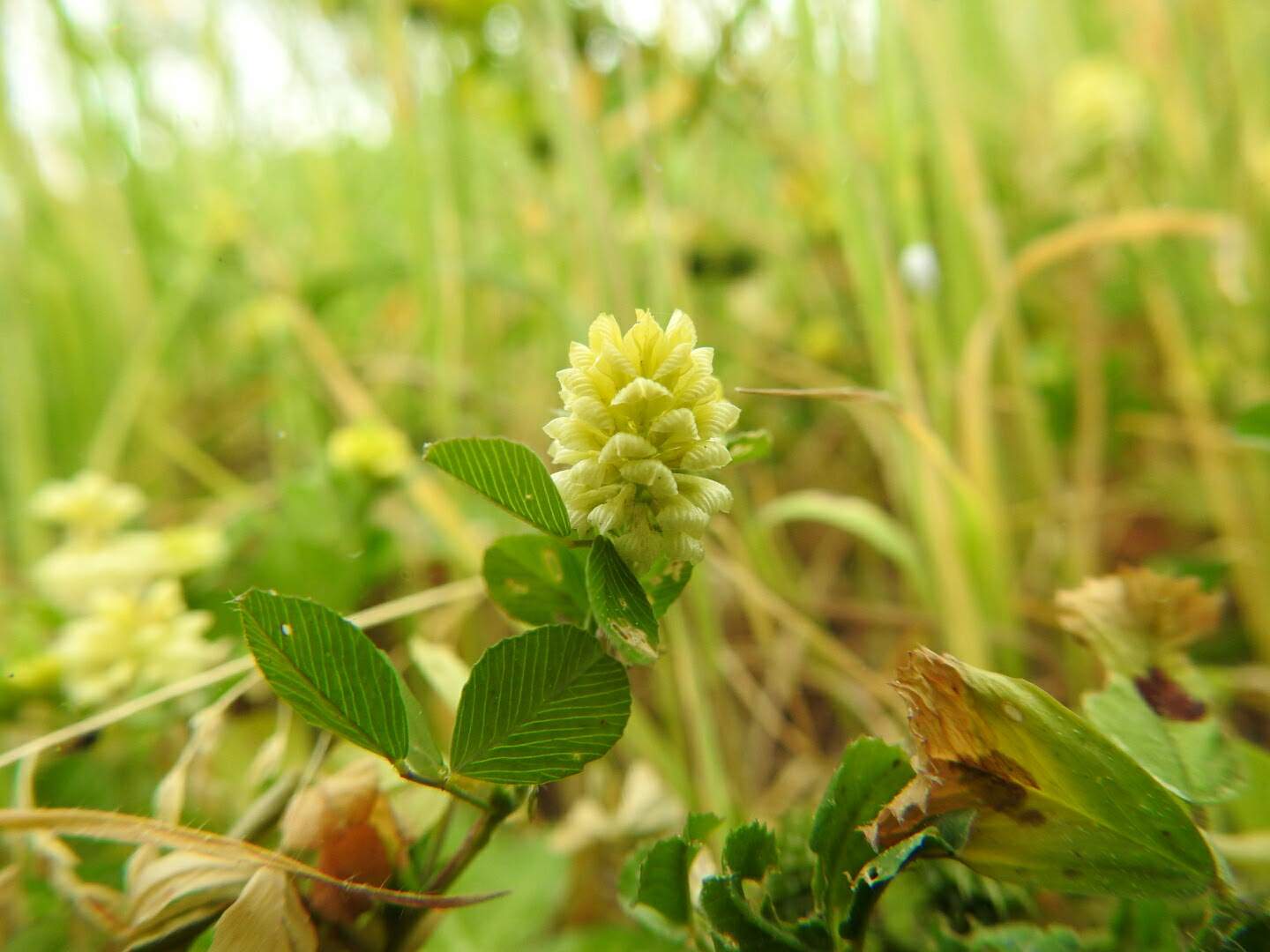
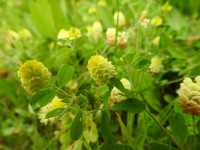
The inflorescence consists of small ovate or globose heads, of variable size (about 8-13 mm in length and 7-10 mm in width), composed of 20 to 40 tightly imbricated flowers. The heads are borne on axillary peduncles, erect and rigid, which exceed the length of the underlying leaves (peduncles 1 to 3 cm long). The calyx, membranous and white, measures between 2 and 2.8 mm, is glabrous or with slight pubescence, with five unequal teeth: the two upper ones shorter and triangular, while the other three are longer and thinner, often longer than the tubular part of the calyx.
The flowers have a yellow corolla, with the standard (the largest petal) spatulate in shape, elongated, with a slightly emarginate apex and finely denticulate margin. The corolla tends to turn towards brown-reddish or brown-brownish tones after anthesis. The wings and keel are elongated in shape, with dimensions twice those of the corolla stalk.
The fruit is a small indehiscent legume (camara), ovoid in shape and about 3 mm long, with a single smooth seed, light brown or yellowish in color, about 1 mm long. The fruit remains enclosed in the persistent calyx.
The root system is not described in detail in the provided sources, but being an annual herbaceous plant typical of arid and field environments, a fibrous and superficial root system is presumed.
Habitat and distribution
Field Clover is widely distributed throughout the Italian territory, being common and easily found in many regions. It preferably grows in mountainous and hilly environments, generally between 0 and 800 meters of altitude, but can also reach up to 2,000 meters above sea level under favorable conditions.
It favors open habitats such as field edges, dry uncultivated lands, dry meadows, path margins, and abandoned cultivations. It is a species typical of sunny and well-drained environments, often on poor or rocky soils, with predominantly sunny or semi-shaded exposure.
Its presence is attested not only in Italy but also in much of Europe, Western Asia, and North Africa, in environments with temperate and Mediterranean climates.
Flowering period
The flowering of Field Clover generally extends from April to July or August, with possible variations depending on latitude and altitude. In milder climates and lowland areas, it can start as early as late winter or early spring (February-April), while in higher mountainous areas it lasts until the end of summer.
During flowering, the yellow heads are very visible and contribute to characterizing rural landscapes in spring and early summer.
Ecology and pollination
Field Clover is a significant melliferous plant, appreciated by bees and other pollinating insects that facilitate its pollination. The flower structure, with the spatulate standard and bright yellow corollas, attracts bees, bumblebees, and butterflies, which feed on nectar and pollen.
The species adopts an entomogamous reproductive strategy, meaning it depends on insects for cross-fertilization and seed production. After flowering, seeds are produced inside the indehiscent legume, which remains well protected by the persistent calyx.
Seed dispersal occurs mainly by falling near the mother plant but can also be aided by animals or meteorological events such as rain and wind.
Curiosities and traditional uses
Field Clover has a long history of use as a medicinal and melliferous plant. Traditionally it has been used for its diuretic properties, contributing to the regulation of renal function. The plant is also known to be a good source of nectar for bees, which is why it is often considered important for beekeeping.
In agricultural and natural contexts, Field Clover is valued for its role in improving soil fertility thanks to its ability to fix atmospheric nitrogen, typical of Fabaceae.
No significant direct food uses or particular folkloric references are documented for this species, but the name itself and its distribution indicate a historical link with the rural and field environment.
Etymology
The genus name Trifolium derives from Latin, composed of “tri” (three) and “folium” (leaf), referring to the characteristic ternate leaf typical of all species of this genus. The specific name campestre indicates the plant’s preferred habitat, namely open fields and rural places.
In Italian it is commonly known as “trifoglio campestre,” a descriptive name that highlights both the shape of the leaves and the growth environment.
Sources
- Acta Plantarum - Flora delle regioni italiane (actaplantarum.org)
- Acta Plantarum - scheda di Marinella Zepigi
- Tela Botanica / H. Coste, Flore descriptive et illustrée de la France
- World Flora Online (WFO)
Characteristics
Scheda botanica
| Famiglia | Fabaceae |
|---|---|
| Fioritura | aprile – luglio |
| Forma biologica | Scapose |
| Habitat | with yellow flowers, annual plant |
| Uso officinale | Pianta officinale |
Domande frequenti
- Quando fiorisce Field Clover?
- Field Clover fiorisce aprile – luglio.
- Che tipo di pianta è Field Clover?
- Field Clover è una Therophytes (Scapose) secondo la classificazione di Raunkiaer.
- A quale famiglia appartiene Field Clover?
- Field Clover appartiene alla famiglia botanica Fabaceae.
Where I found it (2 sightings)
Classification
- Kingdom
- Plantae
- Family
- Fabaceae
- Full name
- Trifolium campestre Schreb.
- Life form
- Therophytes scapose
Similar species
Search for species with similar characteristicsFurther reading
Noticed an error in the identification? Write to me
Other species of the same family
Fabaceae
Explore
Other species of Fabaceae