Botanical species
Trifolium pratense
L.
Red Clover
Description
Morphological description
Red Clover is a perennial herbaceous plant, although its longevity often does not exceed two years. It has a scapose habit with erect or arcuate-erect stems, sometimes briefly creeping at the base, reaching a height ranging from 10 to 70 cm. The stems are robust, striated, and can be simple or branched. The root system includes a superficial woody rhizome wrapped in dark sheaths, on which microscopic nodules develop responsible for fixing atmospheric nitrogen thanks to the symbiosis with Rhizobium trifali bacteria.
The leaves are arranged alternately, generally trifoliate, with oval, elliptical, or obovate segments, varying in size from 1.5 to 4 cm in length and 1-2 cm in width. The leaflets have a herbaceous texture, with slightly serrated margins and an obtuse or sometimes bilobed apex. The upper surface of the leaves is characterized by a whitish mark in the shape of a “V” or crescent, very evident. The stipules are elongated and end with a short awn (thin and pointed appendage).
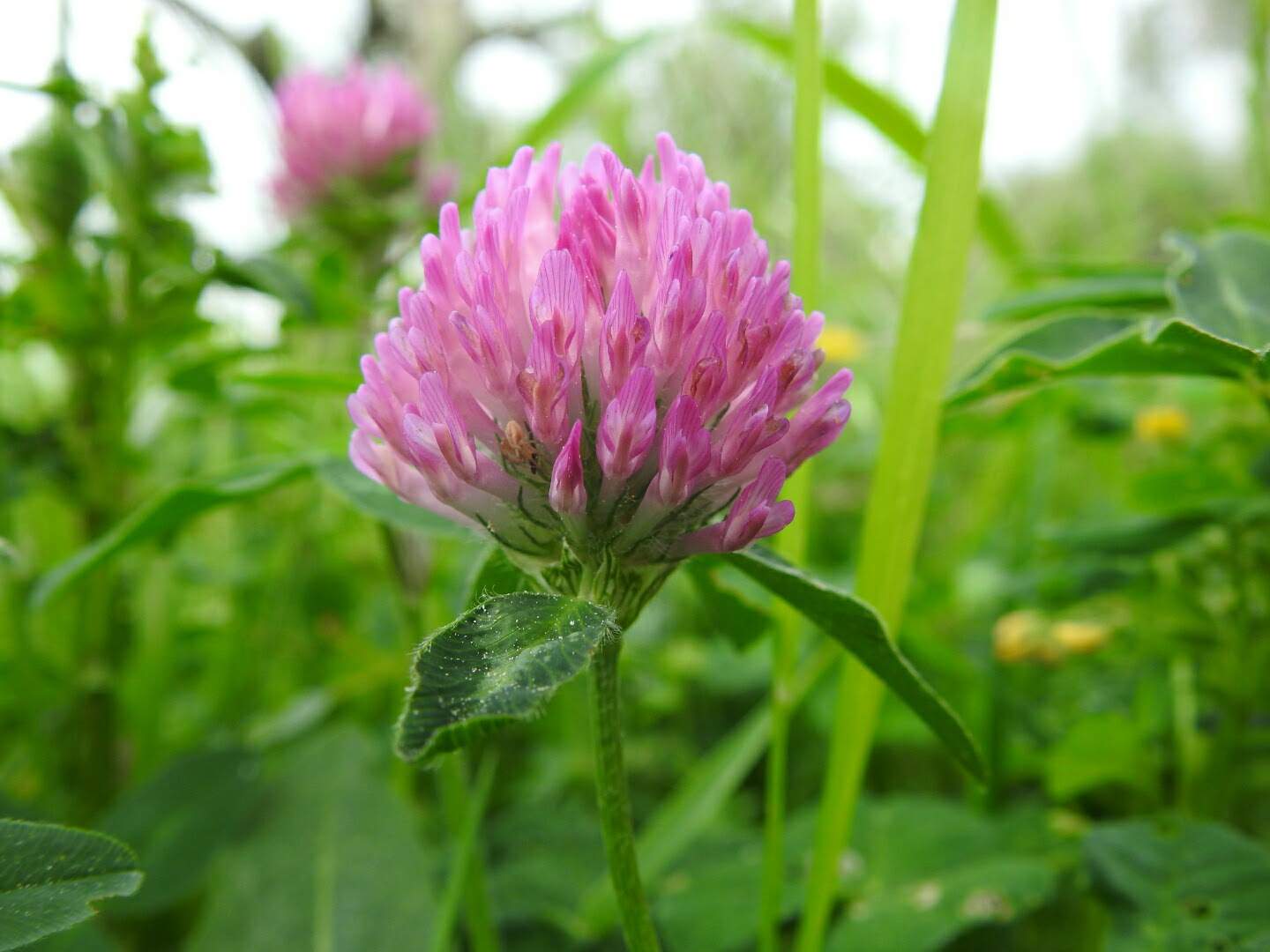
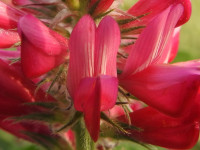
The flowers are gathered in globose or subglobose heads, generally pedunculated or subsessile, located at the axils of the upper leaves or terminal on the branches. Each head can include between 30 and 70 flowers of color varying from fuchsia, carmine pink to violet (rarely white or milky). The corolla measures about 12-16 mm, with the upper part (standard) spatulate and rounded, often retuse at the apex. The calyx has a tube 3.5-4 mm long with 10 veins, is slightly pubescent outside, and presents unequal teeth with the lower one longer and ciliate with hairs.
The fruits are indehiscent legumes called loments, membranous, containing a single ovoid seed, smooth and yellowish or brown in color, enclosed in the persistent calyx.
Habitat and distribution
Red Clover is a species of Euro-Mediterranean origin with a subcosmopolitan distribution, present in almost all temperate zones of the world. In Italy it is common in meadows, pastures, uncultivated lands, and field edges, from the plains up to about 2600 meters in elevation, adapting to a wide range of environmental conditions. It prefers clayey soils, well-drained but moist, tolerating even harsh temperatures and cold conditions. It can grow in sunny or partially shaded exposures and adapts to both calcareous soils and slightly acidic or volcanic soils.
In the Mediterranean basin, besides Italy, it is widespread in various countries of southern Europe, western Asia, and North Africa. In Italy it shows particular morphological variability especially in mountainous regions and coastal wet areas, with different subspecies and varieties adapted to specific ecological conditions.
Flowering period
The flowering of Red Clover generally extends from May to September, with possible variations depending on altitude and latitude. In the plains and milder climate areas, flowering can begin as early as late spring and continue until early autumn, while in the mountains it tends to be more concentrated in the summer months. In some high-altitude populations, flowering may be shorter and earlier.
Ecology and pollination
Red Clover is an entomogamous plant, mainly pollinated by pollinating insects. The relatively long corollas are frequented especially by bumblebees and butterflies, which can reach the nectar thanks to their long tongues, while honeybees, equipped with shorter tongues, visit them less frequently, especially when the flowers are large and vigorous. In late summer, when the plants are smaller and the flowers smaller, honeybees can also visit the heads more regularly.
The species produces seeds contained in indehiscent legumes (loments), which are generally dispersed locally or by animals and external agents. The presence of root nodules that fix atmospheric nitrogen makes Red Clover an important species in crop rotations for improving soil fertility.
Curiosities and traditional uses
Red Clover is historically known as a forage plant of great value, cultivated since Roman times for livestock feeding, which appreciates its sweet taste and digestibility, earning it the nickname “milk bread.” It is mainly used as green forage and less frequently as hay, since during drying the leaves tend to crumble.
Besides forage use, Red Clover has a long tradition of medicinal uses: it was considered antispasmodic, expectorant, diuretic, tonic, and febrifuge. It was used to treat cough, bronchitis, infections, and as a blood purifier. In India it has been employed to promote lactation in nursing mothers and as a uterine stimulant. In antiquity, Dioscorides and Galen also recommended it for treating wounds caused by venomous snake bites.
It is also an important melliferous plant, often the only source of nectar and pollen for bees and bumblebees in the summer months, thus contributing to the biodiversity of pollinating insects.
From an ornamental point of view, it is used for colorful turf in association with other species.
In folklore and art, the clover has always been a symbol of the trinity and good luck, a decorative motif in Gothic works and traditionally associated with positive meanings.
Etymology
The genus name "Trifolium" derives from the Latin "tri" (three) and "folium" (leaf), referring to the characteristic ternate arrangement of the leaves. The specific epithet "pratense" indicates the typical habitat of the species, that is meadows and grassy places. The Italian common name "trifoglio rosso dei prati" recalls both the shape of the leaves and the bright color of the flowers, which stand out in summer meadows.
Sources
- Prof. S. Pignatti, "Flora d'Italia"
- Acta Plantarum - Flora delle regioni italiane (scheda di Marinella Zepigi)
- Tela Botanica / H. Coste, "Flore descriptive et illustrée de la France"
- World Flora Online (WFO)
Characteristics
Scheda botanica
| Famiglia | Fabaceae |
|---|---|
| Fioritura | tutto l'anno |
| Forma biologica | Scapose |
| Habitat | with fuchsia flowers, plant with a scapose habit |
Domande frequenti
- Quando fiorisce Red Clover?
- Red Clover fiorisce tutto l'anno.
- Che tipo di pianta è Red Clover?
- Red Clover è una Therophytes (Scapose) secondo la classificazione di Raunkiaer.
- A quale famiglia appartiene Red Clover?
- Red Clover appartiene alla famiglia botanica Fabaceae.
Where I found it (3 sightings)
Classification
- Kingdom
- Plantae
- Family
- Fabaceae
- Full name
- Trifolium pratense L.
- Life form
- Therophytes scapose
Similar species
Search for species with similar characteristicsFurther reading
Noticed an error in the identification? Write to me
Other species of the same family
Fabaceae
Explore
Other species of Fabaceae