Botanical species
Trifolium incarnatum
L.
Crimson Clover
Description
Morphological description
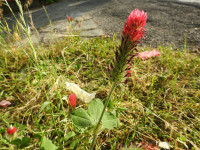
Annual herbaceous plant, robust and scapose, with erect stems generally reaching a height between 15 and 50 cm, but sometimes exceeding 50 cm. The stem is striated, green in color, and has a pubescent surface: the lower part is covered with patent hairs, while the upper part has appressed hairs. The plant therefore appears slightly velvety.
The leaves are alternate and trifoliate, with broadly obcordate leaflets (inverted heart-shaped), varying in size between 1.5 and 3.5 cm. The surface of the leaflets is herbaceous and pubescent on both sides, and the margins are irregularly crenate-dentate or denticulate especially in the apical half. The leaf apex is obtuse or slightly retuse. The leaves are borne on a petiole 2-4 cm long, also hairy. At the base of the petiole are ovate, membranous, hairy, and dentate stipules, which wrap the stem with two small ears, giving a characteristic biauriculate appearance visible also from the side.
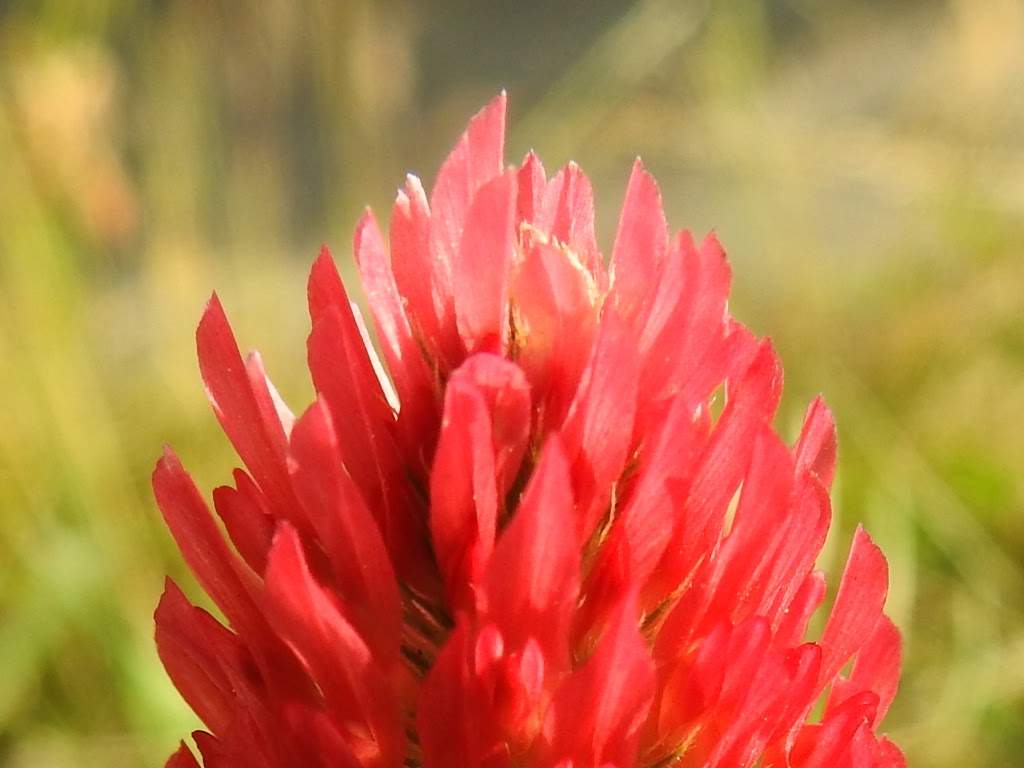
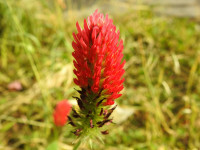
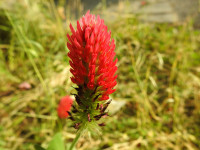
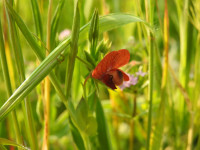
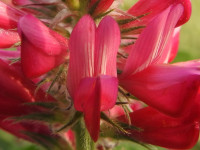
The inflorescence consists of a single terminal head, dense, ovate or ellipsoid in shape during flowering (about 1-2 cm wide by 3-6 cm long), becoming more cylindrical during fruiting. The head is supported by a long, hairy peduncle, lacking bracteoles or involucre. The flowers, numerous (between 50 and 120) and hermaphroditic, are bright red, sometimes tending to pink or white in the subspecies, with a corolla typical of the Fabaceae family (standard, wings, and keel). The petals are glabrous, about 10-15 mm long, and slightly exceed the calyx teeth, which is campanulate, hairy, and urn-shaped at fruiting. The calyx teeth are 5, herbaceous, triangular, subequal, as long as or slightly longer than the tube, with a hairy outer surface.
The androecium is composed of ten diadelphous stamens, nine of which are fused to form a tube and one free. The gynoecium has an ovary with a style that internally passes through the stamen tube.
The fruit is a legume called camara, ovoid, enclosed in the persistent calyx, with a membranous pericarp and containing a single seed of yellowish or green-brown color. The root system is not described in detail in the sources, but as with other Fabaceae, the presence of taproots with rhizobial nodules for nitrogen fixation is presumed.
Habitat and distribution
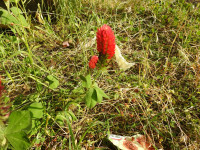
Crimson Clover is widespread throughout the Mediterranean area, with a range extending from western and southern Europe to the Mediterranean coasts, with extensions towards the north and east. In Italy, it grows spontaneously from the plains up to about 2,200 meters altitude, mainly frequenting meadows, arable fields, fallows, and crop margins, preferring siliceous and well-drained soils.
It is a eurymediterranean species, often cultivated as forage, but also naturalized in many areas. It prefers sunny or partially sunny exposures and open environments, not excessively humid.
Flowering period
Flowering typically extends from May to July. No significant geographic variations in the period are reported, but flowering may slightly advance or delay depending on altitude and local climate.
Ecology and pollination
Crimson Clover is pollinated by pollinating insects, particularly bees and other hymenopterans, which are attracted by the bright red color of the flowers and their typical structure. Cleistogamy (self-pollination without flower opening) is not present.
The plant produces numerous seeds, whose dispersal mainly occurs by falling near the mother plant, favored by the persistent calyx that protects the fruit. No mechanisms for long-distance dispersal such as wind or animals are highlighted.
Curiosities and traditional uses
Crimson Clover is a species of great agronomic and forage importance, thanks to the high protein and lipid content of its biomass, making it an excellent food for livestock. It is often cultivated as a green manure crop to improve soil fertility, due to its ability to fix atmospheric nitrogen through rhizobial symbionts.
In herbal medicine, it is considered a medicinal species, although specific traditional uses are not detailed in the sources examined here.
The Italian name “trifoglio incarnato” derives from the bright red color, similar to the color of flesh (from the Latin “incarnatus,” meaning “flesh-colored”), referring to the flowers.
Etymology
The genus name, Trifolium, derives from Latin and means “three leaves,” referring to the characteristic trifoliate leaf typical of many species in the genus. The specific name incarnatum refers to the bright red color of the flowers, reminiscent of flesh or incarnate color. The Italian common name “trifoglio incarnato” reflects this distinctive chromatic characteristic.
Sources
- Prof. S. Pignatti, Flora d’Italia
- Acta Plantarum - Flora delle regioni italiane (scheda di Giuliano Salvai)
- Tela Botanica / H. Coste, Flore descriptive et illustrée de la France
- World Flora Online (WFO)
Characteristics
Scheda botanica
| Famiglia | Fabaceae |
|---|---|
| Fioritura | maggio – luglio |
| Forma biologica | Scapose |
| Habitat | with red flowers, annual plant, plant with a scapose habit |
Domande frequenti
- Quando fiorisce Crimson Clover?
- Crimson Clover fiorisce maggio – luglio.
- Che tipo di pianta è Crimson Clover?
- Crimson Clover è una Hemicryptophytes (Scapose) secondo la classificazione di Raunkiaer.
- A quale famiglia appartiene Crimson Clover?
- Crimson Clover appartiene alla famiglia botanica Fabaceae.
Where I found it (5 sightings)
Classification
- Kingdom
- Plantae
- Family
- Fabaceae
- Full name
- Trifolium incarnatum L.
- Life form
- Hemicryptophytes scapose
Similar species
Search for species with similar characteristicsFurther reading
Noticed an error in the identification? Write to me
Other species of the same family
Fabaceae
Explore
Other species of Fabaceae