Botanical species
Lotus hirsutus
L.
Canary Clover
Description
Morphological description
Canary Clover is a small perennial suffrutex, reaching about 50 cm in height. The plant has an erect-ascending and branched habit, with woody stems in the lower part and more herbaceous in the upper area. The stem is covered with dense pubescence that gives the entire plant a hairy appearance and a grayish color, a characteristic that also extends to the leaves and flowers. The surface of the stem may appear cobwebby, with dense and rough hairs.
The leaves are alternate, sub-sessile, and gray-green with bluish reflections, persistent and silky. They are composed of five dimorphic leaflets: obovate-oblong, mucronate, up to 2.5 cm long. The two lower leaflets are generally smaller and often may appear as stipules embracing the stem. The leaf margin is entire and the surface is hairy.
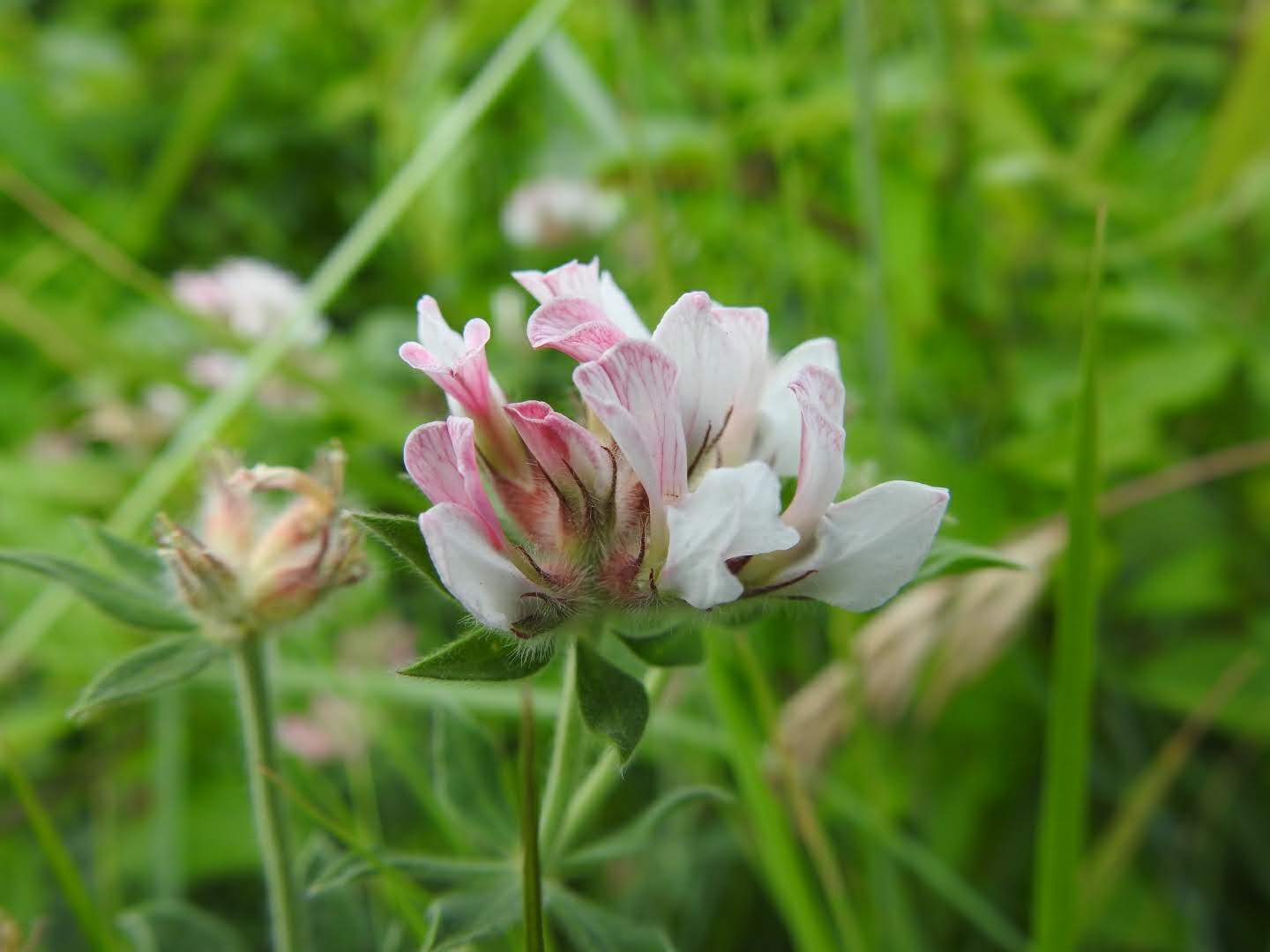
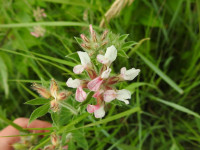
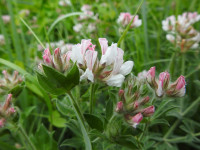
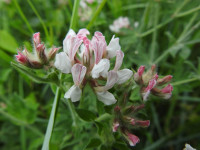
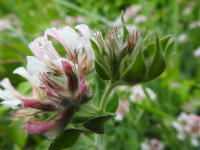
The flowers, just under 2 cm long, are grouped in terminal globose capitulum inflorescences, each composed of 5-11 flowers on a peduncle of 10-30 mm, surrounded by a tripartite leafy bract. The calyx is pink-brownish or purplish, with linear-lanceolate teeth longer than the calyx tube. The corolla is papilionaceous, with a spatulate and erect standard, and lateral wings of white-pinkish color, giving the flowers a delicate light tone. The androecium has partially free filaments shorter than the tube.
The fruit is a dehiscent legume, cylindrical and blunt, 6-12 mm long, reddish-brown in color. At the apex there is a mucro derived from the hardened residue of the style. The legume contains several oval and spotted seeds. During maturation, the fruits arrange themselves in a star shape and the valves twist, facilitating seed dispersal by launching them far from the mother plant.
The root system is not described in detail in the sources, but as in many Fabaceae, the presence of roots with nitrogen-fixing nodules can be assumed, useful for life in nutrient-poor environments.
Habitat and distribution
Canary Clover is a typical species of Mediterranean regions, with a range extending along the Mediterranean coasts and reaching north and east up to the area of Vite. In Italy it is mainly found in mountainous and hilly environments, up to about 1300 meters altitude.
It prefers dry habitats such as dry meadows, uncultivated areas, slopes, screes, dunes, and sandy soils. These environments are generally well-drained and nutrient-poor, where the plant effectively colonizes thanks to its adaptability. The preferred exposure is sunny, in open and well-lit areas.
Flowering period
Flowering mainly occurs in May and June, with possible local variations related to climatic conditions and altitude. Generally, flowers develop in late spring, contributing to a vegetative cycle that exploits mild Mediterranean conditions.
Ecology and pollination
The species is a good melliferous plant, with flowers attracting numerous pollinating insects, particularly bees and other hymenopterans, which collect nectar and pollen. The pollen produced is gray or brown and together with nectar contributes to the production of light and delicately scented honeys.
Reproduction occurs through seeds contained in legumes that, at maturity, open by twisting and facilitate long-distance dispersal. This dispersal mechanism improves colonization of suitable new habitats.
Curiosities and traditional uses
Canary Clover is a medicinal species with sedative, calming, and antispasmodic properties. The flowers are used in teas to combat insomnia; moreover, external preparations such as tinctures or baths based on this plant are employed for their astringent and vulnerary virtues, useful in skin inflammations.
From an apicultural point of view, it is an important melliferous plant, appreciated for the production of light and delicate honey.
Caution is recommended in therapeutic or food use, as the information is provided for informational purposes and does not replace medical advice.
Etymology
The generic name "Lotus" derives from the Greek "lotos" and indicated various valuable forage plants, reflecting the importance of these species in animal diet and ancient agriculture. The adjective "hirsutus" refers to the hairy appearance of the plant, characterized by dense and rough pubescence on stem, leaves, and flowers.
The Italian common name "Canary Clover" refers both to the shape of the leaves, similar to clovers, and to the characteristic pubescence that makes the plant visibly rough to the touch and sight.
Sources
- Acta Plantarum - Flora delle regioni italiane (scheda di Giuliano Salvai)
Characteristics
Where I found it (7 sightings)
Classification
- Kingdom
- Plantae
- Family
- Fabaceae
- Full name
- Lotus hirsutus L.
- Synonyms
- Dorycnium hirsutum (L.) Ser.
- Life form
- Camefite suffruticose
Similar species
Search for species with similar characteristicsNoticed an error in the identification? Write to me
Other species of the same family
Fabaceae
Explore
Other species of Fabaceae