Botanical species
Lotus cytisoides
L.
Ginestrino delle scogliere
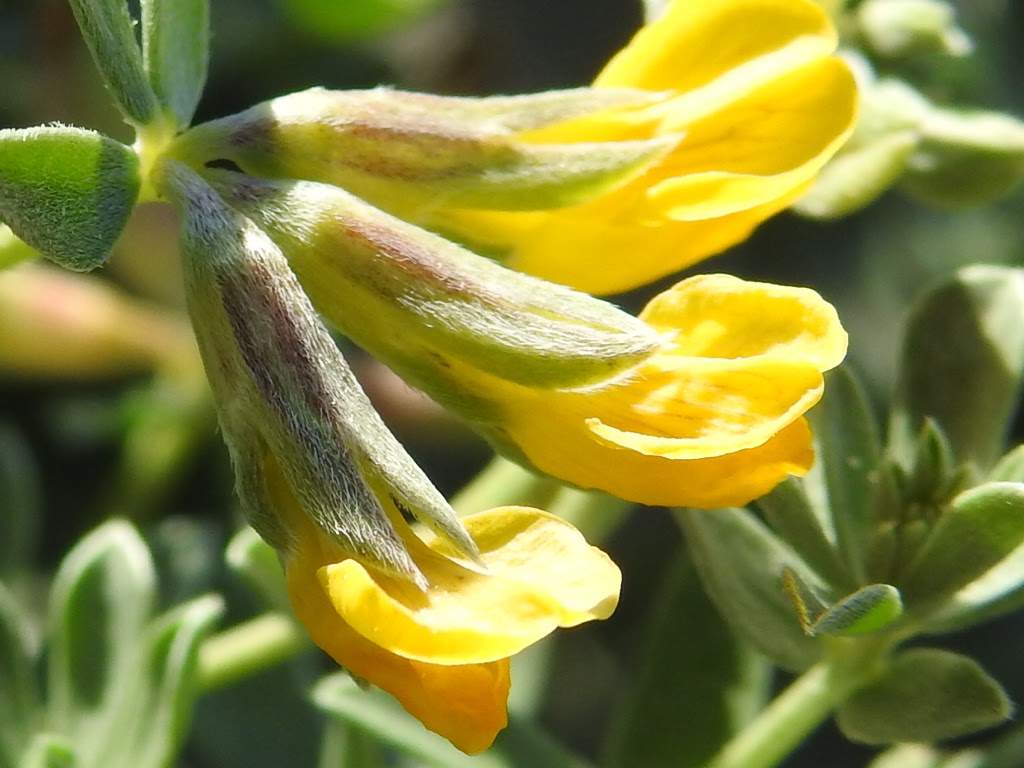
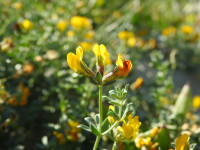
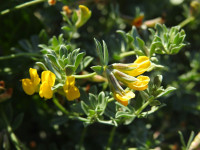
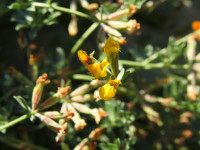
Description
Morphological description
Perennial suffrutescent plant, with a creeping habit and woody base, typical of Mediterranean coasts. The stem is prostrate or decumbent, often branched, with the ability to root at the nodes in contact with the substrate, giving the plant an expanded habitus adhering to the ground or rocks. The leaves are fleshy, succulent in texture, green-grayish in color and covered with a fine tomentose hairiness that gives a gray-silvery appearance. The leaves are compound, with leaflets of obovate or oblanceolate shape, 4 to 18 mm long, sessile or with a short petiole (1-4 mm).
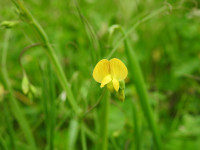
The flowers are gathered in umbels of 2-6 specimens, protruding beyond the foliage thanks to well-developed peduncles. Each flower measures about 10-14 mm in length and is characterized by a bright yellow corolla, sometimes with yellow-greenish shades. The calyx is bilabiate, 6-7.5 mm long, with the lateral teeth shorter than the others, and has a shape with a rounded upper lip. The standard part of the corolla is slightly notched, while the keel is projected forward and has a beak-like fold about halfway along its length. The fruit is a thin legume, straight or slightly curved, up to 4 cm long and about 2 mm in diameter.
The roots are typical of coastal plants, well adapted to sandy or rocky soils, with anchoring and absorption capacity in environments often poor in nutrients.
Habitat and distribution
This species is typical of marine and coastal environments, particularly adapted to the extreme conditions of cliffs, sandy dunes, sea rocks, and coastal gravel. It prefers well-drained substrates, often calcareous or sandy, with sunny and windy exposure, near the sea. In Italy, it is present along the Mediterranean coasts, from Liguria to Sicily and Sardinia, as well as in other Mediterranean areas. It grows mainly at low altitudes, close to sea level, where salinity and exposure to weather shape the local flora.
Its presence in coastal areas contributes to soil stabilization and the biodiversity of coastal ecosystems.
Flowering period
Flowering mainly occurs in spring, from April to June, depending on climatic trends and latitude. In some particularly mild Mediterranean locations, flowering can begin as early as late March or extend until July. The yellow flowers stand out against the gray and fleshy foliage, attracting pollinating insects.
Ecology and pollination
The flowers, with their bright yellow corolla, are adapted to entomogamous pollination, mainly carried out by bees and other pollinating insects attracted by the color and nectar. The flower structure, with well-developed keel and standard, facilitates mechanical pollination during insect visits, promoting pollen transfer.
Seed dispersal occurs through the legumes which, once mature, open releasing the seeds into the surrounding substrate, facilitating propagation in rock crevices or sandy soils typical of their habitat.
Curiosities and traditional uses
No particular ethnobotanical applications or widespread traditional uses are known for this species, probably due to its specific ecological niche and limited biomass. However, like many members of the Fabaceae family, it may contribute to soil fertility through nitrogen fixation, thus improving the environmental quality of the coastal habitats where it lives.
Etymology
The generic name Lotus derives from Latin and ancient Greek, a term used to indicate various leguminous plants. The specific name cytisoides indicates the resemblance to plants of the genus Cytisus (such as brooms), highlighting the habit and flower appearance. The Italian common name "ginestrino delle scogliere" precisely recalls the resemblance to brooms and the prevalent habitat on sea cliffs.
Sources
- Prof. S. Pignatti, "Flora d'Italia"
- World Flora Online (WFO)
Characteristics
Where I found it (1 sightings)
Classification
- Kingdom
- Plantae
- Family
- Fabaceae
- Full name
- Lotus cytisoides L.
- Life form
- Camefite suffruticose
Similar species
Search for species with similar characteristicsFurther reading
Noticed an error in the identification? Write to me
Other species of the same family
Fabaceae
Explore
Other species of Fabaceae