Botanical species
Lathyrus latifolius
L.
Perennial Pea
Description
Morphological description
Perennial Pea is a rhizomatous perennial herbaceous plant with a prostrate, ascending, or climbing habit, whose stems can reach from 1 up to 3 meters in length. The stems are glabrous and flattened, characterized by two opposite wings 2.5 to 6 mm wide, with a serrated margin. The wings give the stem a winged appearance, often with a smooth surface.
The leaves are composed of a pair of lanceolate or elliptic-lanceolate leaflets, varying in size between 3 and 8 cm in length and 1-3 cm in width, with five well-marked parallel veins. They are glaucous underneath and have a winged rachis that ends in branched and prehensile tendrils, allowing the plant to cling and climb on surrounding vegetation. The stipules are broad, ovate or lanceolate, often acuminate and with a characteristic basal tooth shaped like a leaf gland; their size ranges from 1 to 3 cm.
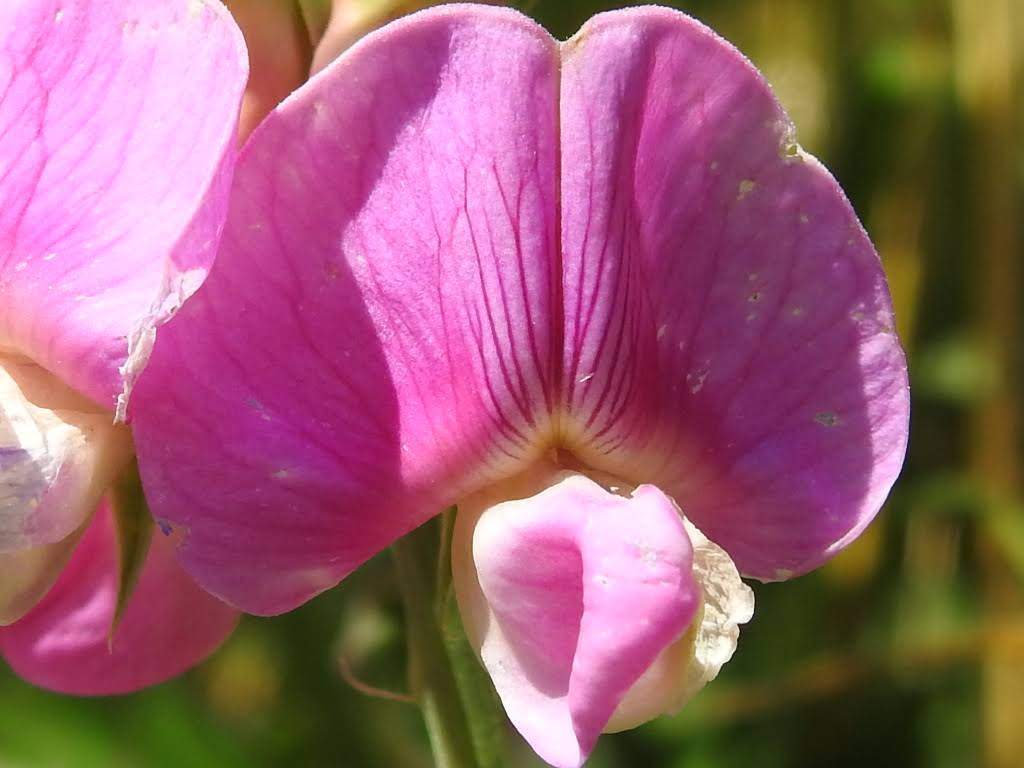
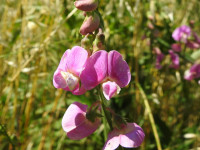
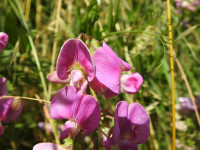
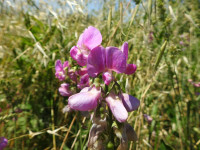
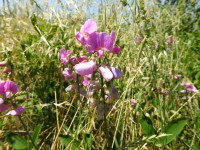
The inflorescence is a loose and pedunculate raceme bearing from 3 up to 15 flowers, with peduncles 10-20 cm long. The flowers, papilionaceous in shape, measure 2-3 cm in length. The standard petal is spatulate, pink-purple or intense fuchsia in color, often with prominent purple veins, while the wings and keel vary in shades from bright pink to whitish-green. The calyx is tubular with unequal teeth: the upper ones are short and almost absent, while the lower ones are longer and triangular-lanceolate. The ovary is densely glandular, with a twisted style.
The fruit is a cylindrical legume, smooth with faint dorsal ribs, 5 to 11 cm long, containing 10-15 reddish-brown, sub-spherical seeds. The rhizome is woody and vertical, from which new stems develop every year.
Habitat and distribution
The species is widespread throughout Italy, from coastal areas up to mountainous regions, reaching about 1200 meters in altitude. It is naturally present in southern Europe and the Mediterranean basin, with particular concentration in temperate and submontane regions.
It prefers forest edges, thickets, hedges, and small woods, where it can climb by exploiting nearby plants through its prehensile tendrils. It frequents well-drained soils, often calcareous or siliceous, with sunny or semi-shaded exposure. It is capable of colonizing disturbed environments and sometimes grows spontaneously at the edges of cultivated fields or in abandoned areas, showing a certain rusticity and adaptability.
Flowering period
Flowering generally occurs from May to August, with local variations related to altitude and climate. In more southern territories and at lower elevations, flowering can begin as early as May, while in cooler or mountainous areas it tends to extend until August.
Ecology and pollination
The plant reproduces mainly through seed production, dispersed by mature legumes. The reproductive strategy is entomophilous, with pollination mediated by pollinating insects, especially bees and bumblebees attracted by the showy, brightly colored papilionaceous flowers. The presence of prehensile tendrils allows the plant to climb and exploit surrounding vegetation, increasing its capacity for colonization and competition for light.
The woody rhizome also enables vegetative reproduction by budding, ensuring the longevity of the individual even under adverse conditions.
Curiosities and traditional uses
The genus name recalls ancient beliefs attributed to these legumes, considered aphrodisiacs in antiquity. The term "Lathyrus" derives from Greek and indicated a leguminous plant with presumed stimulating effects.
The Italian common name "cicerchione" is linked to the similarity with other species of the genus Lathyrus, such as grass pea (Lathyrus sativus), but it is distinguished by broader leaves and a climbing habit.
No particular widespread food or medicinal applications have been reported for this species, which however in the past could be locally used as fodder or for decorative purposes thanks to its large colorful flowers. Its climbing ability and elegant habit also make it an interesting plant for the natural enhancement of spontaneous green spaces.
Etymology
The scientific name derives from Latin: "Lathyrus" is a Latinization of the Greek term that once indicated a legume considered “exciting” or aphrodisiac, while "latifolius" means “broad-leaved,” referring to the wide leaflets that characterize this species compared to related ones.
The Italian common name "cicerchione" refers to the similarity with grass pea, but with larger leaves (“-one” as an augmentative suffix), thus distinguishing the species by its leaf size.
Sources
- Prof. S. Pignatti, "Flora d'Italia"
- Acta Plantarum - Flora delle regioni italiane (scheda di Mirna Medri)
- World Flora Online (WFO)
Characteristics
Scheda botanica
| Famiglia | Fabaceae |
|---|---|
| Fioritura | maggio – agosto |
| Forma biologica | Scandent |
| Habitat | with fuchsia flowers, Perennial plant, plant with a prostrate-ascending habit |
Domande frequenti
- Quando fiorisce Perennial Pea?
- Perennial Pea fiorisce maggio – agosto.
- Che tipo di pianta è Perennial Pea?
- Perennial Pea è una Hemicryptophytes (Scandent) secondo la classificazione di Raunkiaer.
- A quale famiglia appartiene Perennial Pea?
- Perennial Pea appartiene alla famiglia botanica Fabaceae.
Where I found it (8 sightings)
Classification
- Kingdom
- Plantae
- Family
- Fabaceae
- Full name
- Lathyrus latifolius L.
- Life form
- Hemicryptophytes scandent
Similar species
Search for species with similar characteristicsNoticed an error in the identification? Write to me
Other species of the same family
Fabaceae
Explore
Other species of Fabaceae