Botanical species
Lathyrus annuus
L.
Fodder Pea
Description
Morphological description
The Fodder Pea is an annual herbaceous plant that can reach a height between 20 and 100 cm. The habit is scapose, with ascending and highly branched stems especially at the base. The stems have a triangular cross-section, are angular and characterized by wide and well-developed wings, ranging from 0.5 to 2.5 mm in width, giving the plant a winged and angular appearance.
The leaves are imparipinnate and consist of a single pair of very elongated, linear-lanceolate leaflets, with dimensions ranging between 6-15 cm in length and 0.6-1.1 cm in width. These leaflets are acute and end with a small point (aristulate), with well-visible parallel veins on the underside. The leaves have a winged petiole and a very branched tendril, which allows the plant to climb or support itself on nearby substrates. The stipules are thin, linear and acuminate, about 0.3-1 cm wide and 1-1.6 cm long.
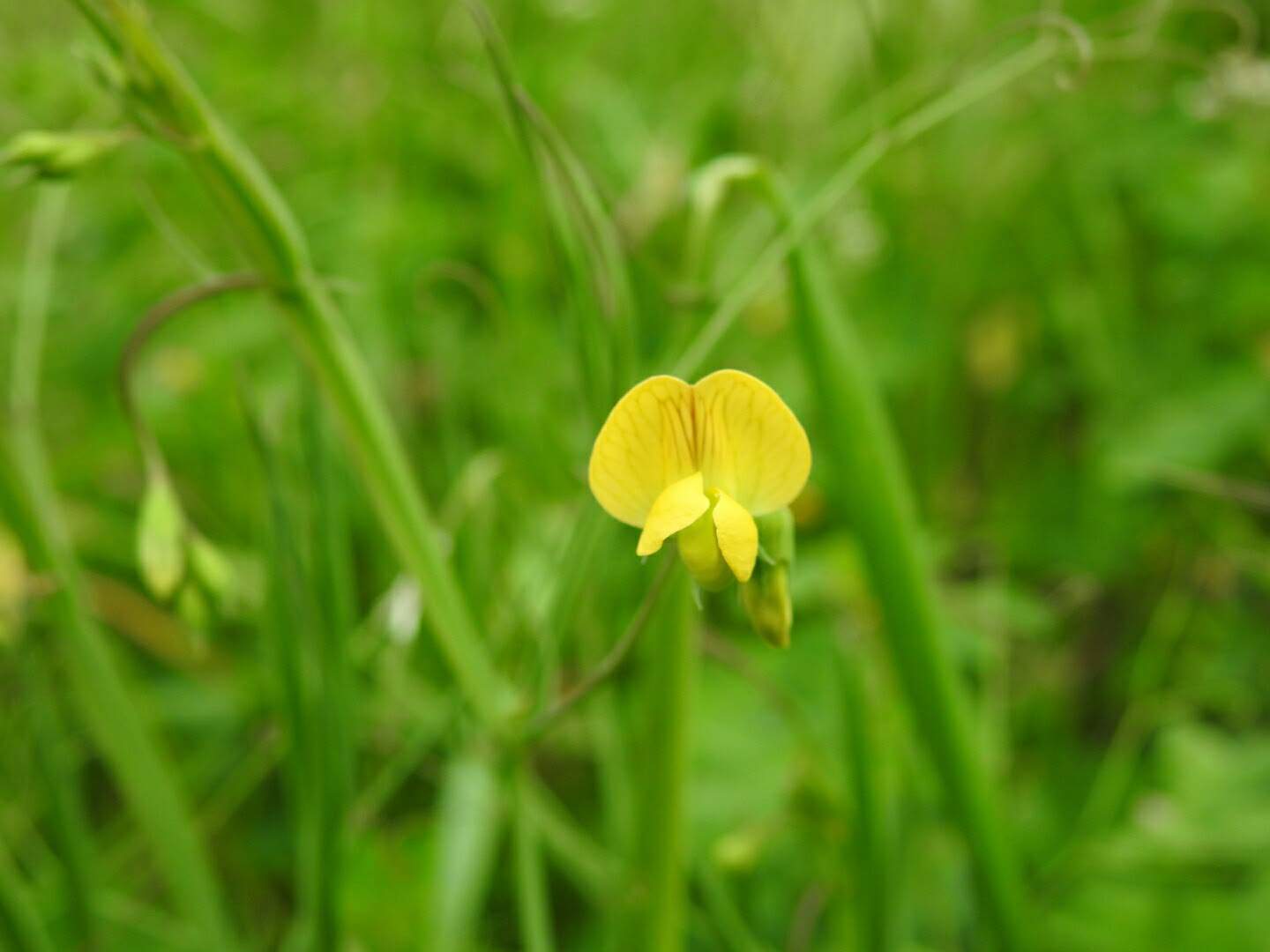
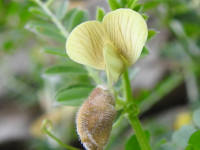
The inflorescence consists of a scapose raceme bearing one to three flowers, positioned on peduncles shorter or at most the same length as the axillary leaves. The flowers have a papilionaceous corolla, yellow or yellow-orange in color, measuring between 12 and 15 mm. The standard petal is obcordate and often shows a slight notch, while the corolla has contrasting orange veins. The calyx is gamosepalous, with a tube about 4 mm long and triangular acuminate teeth of the same length, with hyaline edges and pronounced veins.
The fruit is a glabrous legume, about 5-6 cm long and about 1 cm wide, elongated and broadly linear in shape, with a reticulated surface and a canaliculate dorsal vein. Inside it contains 5 to 9 spherical seeds, brown-black in color and with a tuberculate surface.
Habitat and distribution
The Fodder Pea is a typically Mediterranean species, widespread in coastal regions and the Mediterranean area of Europe, Asia, and Africa. In Italy it is mainly present in the Central-Southern regions and the major islands, such as Corsica, Tuscany, Lazio, Sardinia, and Sicily, but it can also be found in other areas with similar habitats. It grows mainly in open environments such as dry fields, pastures, uncultivated lands, and disturbed areas, where it prefers well-drained soils and sunny exposures.
The growth altitude ranges from 0 up to 1500 meters above sea level, adapting to Mediterranean climate conditions with dry summers and mild winters.
Flowering period
Flowering mainly occurs between March and June, with a higher concentration in May and June. In more northern areas or under particular climatic conditions, flowering may start slightly later or end earlier.
Ecology and pollination
This species presents a reproductive strategy typical of Fabaceae, with papilionaceous flowers that favor entomogamous pollination. The main pollinating insects are bees and other hymenopterans that visit the flowers attracted by the bright yellow color and the orange veins that act as nectar guides. Pollen is transferred during the visit, ensuring good cross-fertilization.
Seed dispersal occurs through the release of the mature legume that opens by dehiscence, releasing the seeds onto the surrounding soil. No particular long-distance dispersal strategies are known, therefore the species tends to colonize mainly areas adjacent to the maturation site.
Curiosities and traditional uses
The Fodder Pea has occasionally been cultivated as a forage plant, thanks to its protein content and its ability to fix nitrogen in the soil, improving its fertility. Sometimes it has also been used in traditional agriculture as a cover crop or for livestock feed.
In ethnobotany, the Fodder Pea has a long history of food use in some Mediterranean regions, although its use is limited due to the presence of toxic compounds in some related species (not specified for Lathyrus annuus). There are no particularly documented medicinal uses or specific folklore related to this species.
Etymology
The genus name Lathyrus derives from the Greek “λάθυρος” (láthuros), Latinized as Lathyrus, a term used to indicate the cicerchias and similar legumes. The specific epithet “annuus” highlights the annual life cycle of the plant.
The Italian common name “cicerchia annuale” derives from the similarity to the common cicerchia (Lathyrus sativus), but it is distinguished by the annual life cycle and specific morphological characteristics, such as the scapose habit and yellow flowers.
Sources
- Prof. S. Pignatti, "Flora d'Italia"
- Acta Plantarum - Flora delle regioni italiane (scheda di Anja Michelucci)
- Tela Botanica / H. Coste, "Flore descriptive et illustrée de la France"
- World Flora Online (WFO)
Characteristics
Scheda botanica
| Famiglia | Fabaceae |
|---|---|
| Fioritura | marzo – giugno |
| Forma biologica | Scapose |
| Habitat | with yellow flowers, annual plant, plant with a scapose habit |
Domande frequenti
- Quando fiorisce Fodder Pea?
- Fodder Pea fiorisce marzo – giugno.
- Che tipo di pianta è Fodder Pea?
- Fodder Pea è una Therophytes (Scapose) secondo la classificazione di Raunkiaer.
- A quale famiglia appartiene Fodder Pea?
- Fodder Pea appartiene alla famiglia botanica Fabaceae.
Where I found it (5 sightings)
Classification
- Kingdom
- Plantae
- Family
- Fabaceae
- Full name
- Lathyrus annuus L.
- Life form
- Therophytes scapose
Similar species
Search for species with similar characteristicsFurther reading
Noticed an error in the identification? Write to me
Other species of the same family
Fabaceae
Explore
Other species of Fabaceae