Botanical species
Cardamine hirsuta
L.
Hairy Bittercress
Description
Morphological description
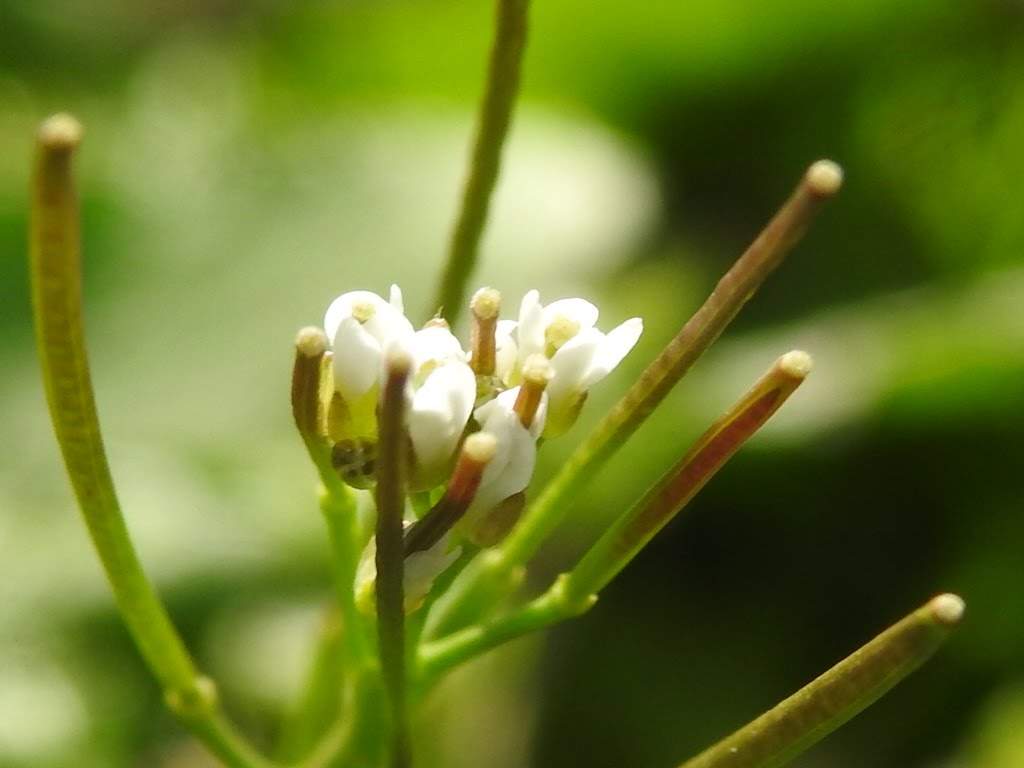
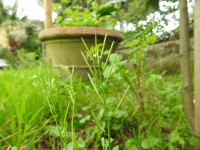
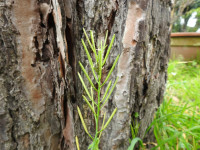
Annual herbaceous plant belonging to the family Brassicaceae, it presents a scapose habit, with erect or ascending stems, branched at the base and striated, generally between 3 and 25 cm tall, sometimes up to 35-45 cm. The stem surface is glabrous or with few scattered hairs, more evident especially in the lower part, often with a violet coloration corresponding to the siliques and the apices. The root system consists of a thin taproot, without capillary fibers.
The basal leaves are arranged in a rosette, persistent during flowering, petiolate, lyrate-pinnatisect, with 4-8 pairs of oval or suborbicular segments, obtusely lobed, and a larger apical segment of reniform or orbicular shape. The cauline leaves are fewer (from 1 to 6), smaller (1 to 6 cm long), without basal auricles, with spatulate-linear or cuneate-tridentate segments, and have tiny scattered hairs visible with a lens. The leaf margins are serrated or dentate, with herbaceous consistency.
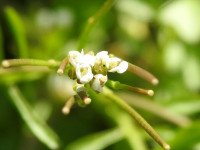
The inflorescence is a dense corymbiform raceme, which elongates during anthesis, bearing up to about 15 pedicellate flowers. The flowers are small, white, with four spatulate petals 2.5-4.5 mm long, sometimes absent, and green sepals about 1.5-2.5 mm long, pubescent in the upper half. The stamens are generally 4, with yellow anthers about 0.4 mm long; the chromosome number is 2n = 16.
The fruit is a linear silique, erect and appressed to the stem, 15-28 mm long and 1-1.4 mm wide, with a style 0.1-0.6 mm long. The siliques generally exceed the flowers and open suddenly at maturity to release numerous small, rectangular and compressed seeds, brown-reddish in color, about 1 mm long, with angled and slightly mamillate margins, lacking wings.
Habitat and distribution
Cosmopolitan species, it is very common and widespread throughout the Italian territory and the Mediterranean basin, present from the hilly environment up to about 1400 m altitude, with records up to 2900 m in alpine areas. It prefers anthropized habitats such as uncultivated lands, meadows, roadside edges, gardens, riverbeds and walls, often in humid and cool places. It is a synanthropic species and can rapidly become invasive especially in gardens and vegetable gardens.
The preferred soil type is varied, generally fertile and moist, with exposure from sunny to partially shaded.
Flowering period
Flowering extends from December-April up to June, with possible variations related to latitude and altitude. In Italy and the Mediterranean the main flowering months are from March to June.
Ecology and pollination
The species is characterized by rapid growth and a short vegetative cycle, typical of scapose therophytes. Pollination is predominantly entomogamous, with pollinating insects visiting the small white flowers. The presence of few stamens and the small flower also suggest some capacity for autogamy. Seed dispersal occurs thanks to the siliques that open suddenly, releasing numerous seeds that can be transported by wind, water or human activity.
Curiosities and traditional uses
Cardamine hirsuta is an edible medicinal plant, known for its pungent taste similar to that of watercress. The leaves are often used to flavor salads, soups and side dishes in cooking. It contains sulfur compounds rich in vitamins and minerals, conferring vitaminizing, diuretic, restorative, anti-anemic and anti-rheumatic properties.
Historically it has been cited as a medicinal herb since antiquity, appreciated for its purifying and stimulating qualities. However, medicinal and alimentary uses are to be considered informative and must always be evaluated under medical supervision.
Etymology
The genus name derives from the Greek "kárdamon", an ancient name for watercress, to which many Cardamine species resemble in appearance and taste. The specific epithet "hirsuta" refers to the presence of hairs, particularly at the base of the plant and on the leaf petioles.
The Italian common name "Hairy Bittercress" probably recalls the characteristics of the plant, with "billeri" possibly deriving from dialect terms related to small herbaceous vegetation and "primaticcio" from "spring-like", referring to the early flowering period.
Sources
- Prof. S. Pignatti, "Flora d'Italia"
- Acta Plantarum - Flora delle regioni italiane (scheda di Anja Michelucci)
- Tela Botanica / H. Coste, "Flore descriptive et illustrée de la France"
- World Flora Online (WFO)
Characteristics
Where I found it (8 sightings)
Classification
- Kingdom
- Plantae
- Family
- Brassicaceae
- Full name
- Cardamine hirsuta L.
- Life form
- Terofite scapose
Similar species
Search for species with similar characteristicsFurther reading
Noticed an error in the identification? Write to me
Other species of the same family
Brassicaceae
Explore
Other species of Brassicaceae