Botanical species
Alliaria petiolata
(M.Bieb.) Cavara & Grande
Garlic Mustard
Description
Morphological description
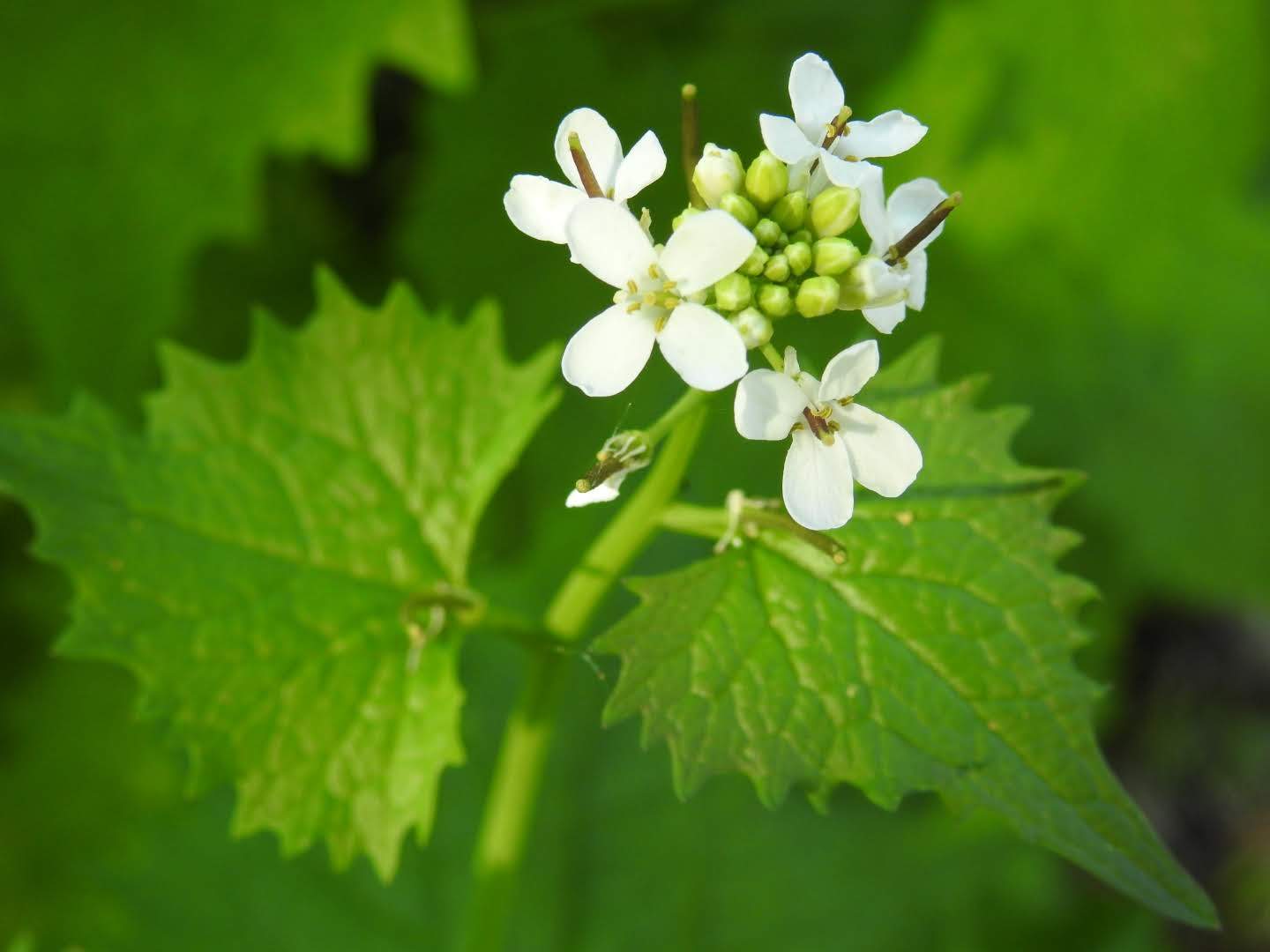
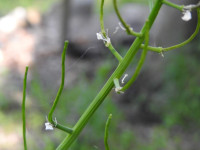
Biennial herbaceous plant, generally 30 to 80 cm tall, with an erect, rigid, cylindrical stem of glaucous color. The stem can be simple or branched only in the upper part, and is characterized by a variably pubescent surface: it has scattered hairs, especially at the base, with trichomes that can reach up to 1.5 mm in length. The base of the stem is sometimes slightly tomentose and wrinkled.
The leaves are alternately arranged along the stem and differ between basal and cauline leaves. The basal leaves, which form a rosette and wither with flowering, have a long petiole of 3-10 cm and a blade of cordate or reniform shape, with dimensions that can reach up to 7-8 cm in width. The margin is crenate or dentate, with sharp teeth and the texture is herbaceous. The upper surface of the leaves is glabrous, while the lower surface may have some scattered hairs; rubbing them releases a characteristic garlic odor. The cauline leaves are smaller, with shorter petioles, and have an ovate, cordate or deltoid shape, with acute or obtuse margins and a pointed apex.
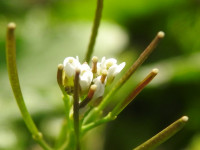
The flowers, hermaphroditic and fragrant, are grouped in terminal racemes, which elongate during fruiting up to 30 cm. Each flower consists of four light green sepals about 2.5 mm long and four white, oblanceolate petals, 4 to 6 mm long, with a claw-shaped attenuated base. There are six stamens with oblong anthers about 0.7-1 mm long and a very short style (1-2 mm). The flowers are pollinated by butterflies and bees, also attracted by the fragrance.
The fruits are siliques 5 to 7 cm long, cylindrical, tetragonal or subterete, with peduncles of length comparable to the fruit (4-5 mm), which are divergent or ascending and slightly swollen at the base. The valves are glabrous. Inside are small oblong-narrow seeds, brown or black, 2-4.5 mm long and finely longitudinally striated.
The root system is typical of biennial plants: a robust main root that allows the plant to survive during the basal rosette phase and to accumulate reserves for the subsequent flowering.
Habitat and distribution
This species is mainly widespread in the northern and central regions of Italy, also present along the coasts of Sicily and Corsica, but absent in Sardinia. It prefers wooded and moist, shady clearings, often near hedges, forest edges, and areas with enriched or fertilized soils. It frequents fresh and nutrient-rich soils, with predominantly shaded or semi-shaded exposure, typical of moist and sheltered environments. Its growth altitude ranges from sea level up to about 1700 meters, adapting to different conditions but showing a preference for temperate climates.
Flowering period
Flowering generally extends from spring to early summer, with typical months ranging from March to July. No significant variations in the flowering period are observed geographically in Italy, although the presence is more frequent in spring in hilly and mountainous areas.
Ecology and pollination
The plant emits a characteristic garlic odor when the leaves are rubbed, an adaptation that may also serve as a defense against some herbivores. The flowers, hermaphroditic and fragrant, are mainly pollinated by pollinating insects such as bees and butterflies, attracted by nectar and fragrance. The reproductive strategy is typical of Brassicaceae, with flowers having four white petals and siliques fruits that allow effective seed dispersal.
The seeds, contained inside the siliques, are small, brown or black, with a finely striated surface and are mainly dispersed by falling to the ground (barochory), but can also be transported by small animals or water in moist environments.
Curiosities and traditional uses
This species is also known for its medicinal and culinary properties. The fresh leaves and flowers, with a characteristic garlic aroma but more digestible, are used in cooking as substitutes for garlic, added to salads, soups, fillings, and other culinary preparations. In Great Britain, it is traditionally used to flavor sandwiches.
From a medicinal point of view, it has been used as an antiasthmatic, antiscorbutic, antistarnuto, diaphoretic, antiseptic, vermifuge, vulnerary, and expectorant plant. Fresh leaves can be used for poultices that promote wound healing and relieve itching.
The seeds contain an essential oil with characteristics similar to mustard oil, which stimulates appetite and is used to flavor dishes and appetizers.
Etymology
The generic name "Alliaria" derives from the characteristic garlic odor emitted by the leaves when crushed or rubbed. The specific name "petiolata" refers to the long petiole of the basal leaves, which is one of the distinctive traits of the species. The Italian common name "Alliaria comune" also recalls the garlic odor common to the plant and its frequent spontaneous presence in its growth areas.
Sources
- Prof. S. Pignatti, Flora d'Italia
- Acta Plantarum - Flora delle regioni italiane (scheda di Giuliano Salvai)
- World Flora Online (WFO)
Characteristics
Scheda botanica
| Famiglia | Brassicaceae |
|---|---|
| Fioritura | marzo – luglio |
| Forma biologica | Scapose |
| Habitat | with white flowers, edible plant, biennial plant |
| Uso alimentare | Commestibile |
Domande frequenti
- Quando fiorisce Garlic Mustard?
- Garlic Mustard fiorisce marzo – luglio.
- È commestibile Garlic Mustard?
- Garlic Mustard è considerata commestibile. Verifica sempre le parti eduli e la preparazione corretta prima del consumo.
- Che tipo di pianta è Garlic Mustard?
- Garlic Mustard è una Hemicryptophytes (Scapose) secondo la classificazione di Raunkiaer.
- A quale famiglia appartiene Garlic Mustard?
- Garlic Mustard appartiene alla famiglia botanica Brassicaceae.
Where I found it (5 sightings)
Classification
- Kingdom
- Plantae
- Family
- Brassicaceae
- Full name
- Alliaria petiolata (M.Bieb.) Cavara & Grande
- Synonyms
- Alliaria officinalis Andrz. ex DC.; Arabis petiolata M.Bieb.
- Life form
- Hemicryptophytes scapose
Similar species
Search for species with similar characteristicsFurther reading
Noticed an error in the identification? Write to me
Other species of the same family
Brassicaceae
Explore
Other species of Brassicaceae