Botanical species
Arabis hirsuta
(L.) Scop.
Hairy Rock-Cress
Description
Morphological description
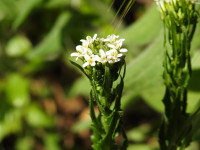
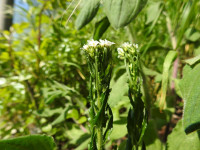
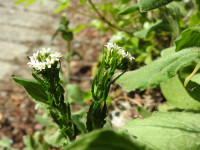
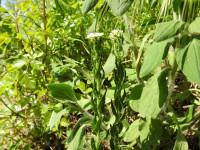
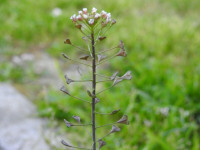
Biennial or perennial herbaceous plant, with an erect and rigid habit, which can reach a variable height between 10 and 100 cm, but more commonly between 40 and 80 cm. The stem is generally simple at the base, but can branch at the top. The surface of the stem is covered by a dense rough pubescence, formed by simple, forked or substellate hairs, giving the plant a tomentose or hirsute appearance.
The basal leaves are gathered in a rosette, lanceolate-obovate or spatulate in shape, with entire or dentate margins, and have a short petiole. These leaves have a densely hairy surface, with 2-4 rayed hairs and sometimes simple hairs. The cauline leaves, instead, are sessile, lanceolate, oval or oblong in shape, with a base sometimes cordate, sagittate or simply truncate, and generally have dentate or entire edges; the hairiness on the upper leaves decreases in density and complexity, with sparser simple or forked hairs. The cauline leaves can clasp the stem with auricles smaller than 1 mm.
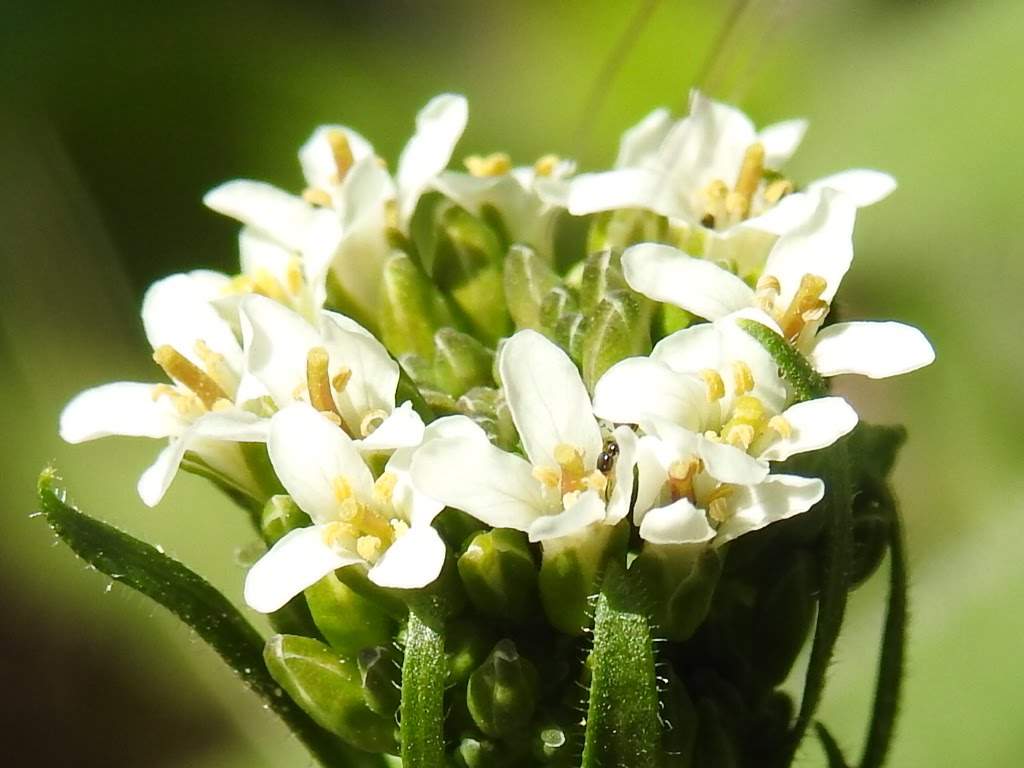
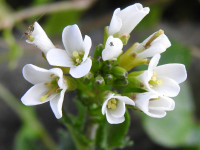
The flowers are small, usually arranged in terminal multiflorous racemes, with over 15–20 flowers per raceme. Each flower has four narrow and oblong-linear sepals (2.5-4 mm), not saccate at the base, and four white petals, sometimes slightly pinkish, of linear-cuneate or narrow oblanceolate shape and about 3.5-5 mm long. The apex of the petals is obtuse. The styles are wider than half of the ovary, with thin filaments and elongated anthers. The ovary contains from 30 to 80 ovules.
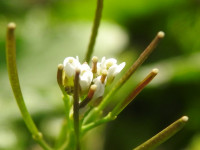
The fruit is a cylindrical, linear and elongated silique, with dimensions ranging from 1.5 up to 7 cm in length and 0.8-1.2 mm in width. The siliques are erect or ascending, often pressed against the raceme rachis, with flat, glabrous valves and a prominent median nerve extending along the entire length of the fruit. At maturity, the siliques open rapidly when touched. The seeds are oblong or suborbicular, brown in color, about 0.8-1.7 mm long, arranged in a single row inside the silique and surrounded by a thin membranous wing, present at least at the apex.
The root system is not described in detail in the available sources, but as common to Brassicaceae it is presumed to be taproot type.
Habitat and distribution
A species widely distributed throughout the Italian territory, it is also present in much of Europe, Asia, and some areas of North Africa (Algeria) and North America. In Italy it grows from the plains up to mountain elevations, up to about 2100 meters above sea level, with a preference for hilly and mountainous environments.
It prefers dry soils, poor in nutrients, often calcareous or sandy, and is commonly found in dry meadows, clearings, rocky environments, old walls and path edges. It is a species typical of sunny and well-exposed habitats, where vegetation is sparse or open, and can tolerate rather poor and dry soil conditions.
Flowering period
Flowering generally extends from spring to early summer, with a peak from April to June. In some more temperate or mountainous areas, flowering may continue until August. The presence of flowers can therefore vary slightly depending on latitude and altitude.
Ecology and pollination
The species is mainly pollinated by pollinating insects, although its floral structure also allows self-pollination. The flowers, although small and inconspicuous, attract various pollinating insects, including bees, flies and butterflies, thanks to the white petals and the nectar produced.
Seed dispersal occurs through the siliques which, at maturity, open suddenly releasing the seeds in the immediate vicinity. The seeds, wrapped in a membranous wing, can also benefit from secondary dispersal by wind or small animals.
Curiosities and traditional uses
There are no detailed and consolidated data regarding specific food, medicinal or folkloric uses for this species. The genus name refers to arid environments such as those of Arabia, suggesting an adaptive capacity to conditions of scarce water availability. The species, due to its hardiness and adaptability to poor soils, may have an important ecological role in colonizing difficult or degraded environments.
Etymology
The genus name Arabis probably derives from the geographical reference to Arabia, highlighting the ability of many species of this genus to adapt to arid and sandy soils. The specific epithet hirsuta indicates the characteristic rough and stiff pubescence covering the plant.
The Italian common name “arabetta cigliata” refers to the evident hairiness of the plant, with “cigliata” referring to the presence of stiff and long hairs, similar to eyelashes, especially along the stem and leaves.
Sources
- Prof. S. Pignatti, "Flora d'Italia"
- Acta Plantarum - Flora delle regioni italiane (scheda di Marinella Zepigi)
- Tela Botanica / H. Coste, "Flore descriptive et illustrée de la France"
- World Flora Online (WFO)
Characteristics
Where I found it (12 sightings)
Classification
- Kingdom
- Plantae
- Family
- Brassicaceae
- Full name
- Arabis hirsuta (L.) Scop.
- Synonyms
- Turritis hirsuta L.
- Life form
- Emicriptofite bienni
Similar species
Search for species with similar characteristicsFurther reading
Noticed an error in the identification? Write to me
Other species of the same family
Brassicaceae
Explore
Other species of Brassicaceae