Botanical species
Sisymbrium officinale
(L.) Scop.
Hedge Mustard
Description
Morphological description
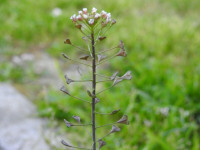
Annual or biennial herbaceous plant, 30 to 90 cm tall, with an erect habit and a single, rigid, angular stem, often dull green or purplish in color, covered with sparse hairs about 1 mm long that give a slight pubescence. The stem is branched with branches developing at right angles, spreading or erect-spreading.
The root system is taprooted, white in color, well developed.
The basal leaves are arranged in a rosette, petiolate, pinnatifid or lyrate, with oblong-ovate segments; the terminal lobe is longer, incised and toothed, generally measuring between 2-3 cm wide and 6-12 cm long. The intermediate leaves are semi-clasping, with two hairy lateral lobes and toothed margins, up to 5 cm long. The upper leaves are clasping, generally sagittate, with an oblong-lanceolate terminal lobe and two spreading lateral lobes, all with herbaceous texture and strigose (hairy) surface on both sides, although the lower leaves may become glabrous with age.
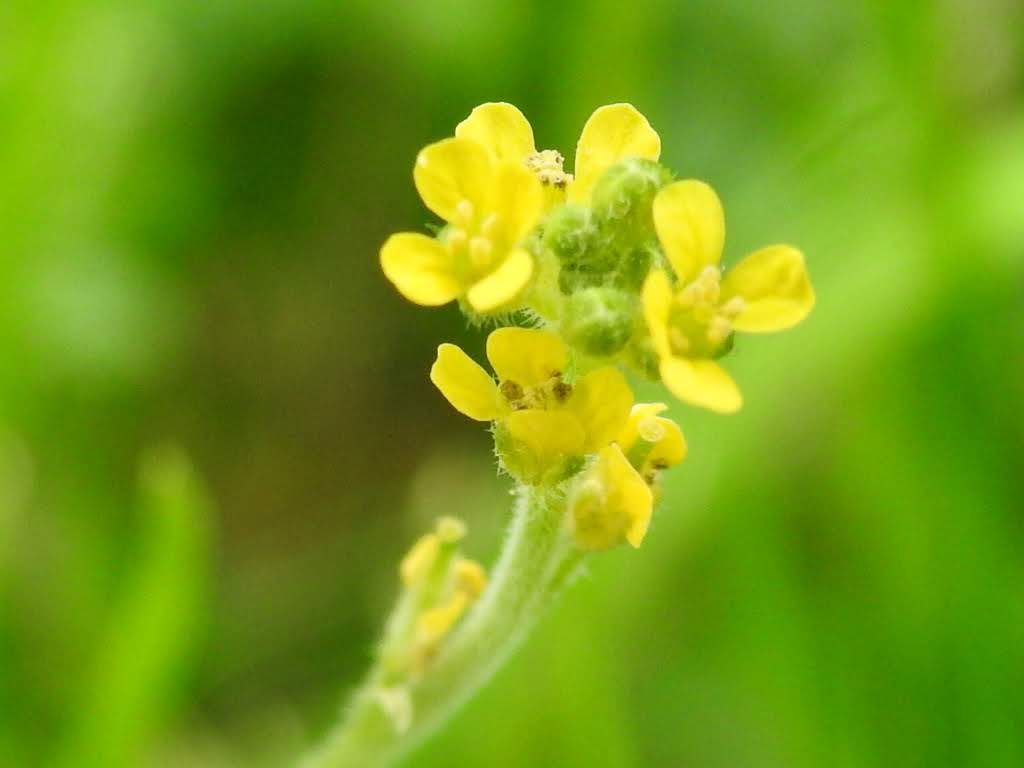
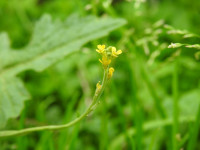
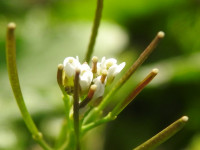
The inflorescence is a terminal spike-like raceme, initially dense and corymbose during anthesis, which elongates and becomes more lax during fruiting. The flowers are small, with four pale yellow petals, 2.5 to 4.2 mm long, narrowly obovate and wedge-shaped. The sepals are four, erect-spreading, about 2 mm long, with sparse hairs. The stamens are six, with yellow anthers about 0.4-0.5 mm.
The fruit is a cylindrical-conical siliqua, erect, 9 to 25 mm long and about 1.5 mm wide, appressed to the stem on a peduncle often 2-4 mm long. The surface is densely pubescent or sometimes glabrous, with three prominent nerves. At maturity it opens longitudinally releasing from each valve a row of brown, oblong seeds, 1-1.3 mm long and 0.5-0.8 mm wide.
Habitat and distribution
Species of Eurasian origin, today widespread almost worldwide as a spontaneous and weedy plant. In Italy and the Mediterranean area it commonly grows in anthropized environments such as uncultivated lands, edges of paths and roads, ruins, cultivated fields, up to about 1000 m altitude, but it has also been reported up to 2400 m in montane and subalpine environments.
It prefers well-drained soils, often rocky or stony, also in disturbed areas and poor soils. It favors sunny or semi-shaded exposures typical of open and degraded environments.
Flowering period
Flowering generally extends from May to July, with possible geographic variations that may anticipate the start in milder climates or at lower altitudes. In some areas flowering may begin as early as February-March.
Ecology and pollination
The small yellow flowers are mainly pollinated by small-sized pollinating insects, attracted by color and nectar. The racemose inflorescence favors entomogamous pollination by facilitating visitor access.
Seed dispersal occurs through the opening of the siliqua which releases seeds into the surrounding environment. The presence of peduncles appressed to the stem helps keep the fruits erect, facilitating gradual seed release onto the ground below, contributing to the colonization of new disturbed or open habitats.
Curiosities and traditional uses
Also known as "Hedge Mustard," this plant has a long tradition of use in folk medicine. It has historically been used as a decongestant of the pharyngeal mucosa, antiphonic (for voice disorders), diuretic, and expectorant. These effects are attributed to the presence of active principles such as inirosine (a sulfurous essence), mucilages, dextrin, pectin, and glucosides, although precise scientific evidence of these compounds is still limited.
The infusion prepared with the aerial parts is used as a traditional remedy to relieve throat irritations and for skin care, used in bath water to decongest the skin.
The name "Hedge Mustard" derives from its use by boys' choirs, already attested in the Renaissance, where it was believed that the plant could improve voice quality and prevent aphonia.
Etymology
The genus name Sisymbrium derives from the Greek "σισύμβριον" (sisymbrion), an ancient term referring to plants similar to watercress used since antiquity and cited by Theophrastus, Aristotle, and Aristophanes. Another hypothesis traces the name to the effigy of a woman called "Sisymbria" who adorned ancient theaters.
The specific epithet "officinale" indicates its traditional medicinal and pharmaceutical use, recalling that the plant was used in the "officina" or pharmaceutical laboratory.
The Italian common name "erba cornacchia" probably refers to its common and weedy presence, while "erba dei cantori" directly recalls its popular use related to the voice.
Sources
- Acta Plantarum - Flora delle regioni italiane (actaplantarum.org)
- Acta Plantarum - Flora delle regioni italiane (scheda di Antonino Messina)
- World Flora Online (WFO)
Characteristics
Scheda botanica
| Famiglia | Brassicaceae |
|---|---|
| Fioritura | maggio – luglio |
| Forma biologica | Scapose |
| Habitat | with yellow flowers, annual plant |
Domande frequenti
- Quando fiorisce Hedge Mustard?
- Hedge Mustard fiorisce maggio – luglio.
- Che tipo di pianta è Hedge Mustard?
- Hedge Mustard è una Therophytes (Scapose) secondo la classificazione di Raunkiaer.
- A quale famiglia appartiene Hedge Mustard?
- Hedge Mustard appartiene alla famiglia botanica Brassicaceae.
Where I found it (7 sightings)
Classification
- Kingdom
- Plantae
- Family
- Brassicaceae
- Full name
- Sisymbrium officinale (L.) Scop.
- Synonyms
- Erysimum officinale L.
- Life form
- Therophytes scapose
Similar species
Search for species with similar characteristicsFurther reading
Noticed an error in the identification? Write to me
Other species of the same family
Brassicaceae
Explore
Other species of Brassicaceae