Botanical species
Arabis collina
Ten.
Rosy Cress
Description
Morphological description
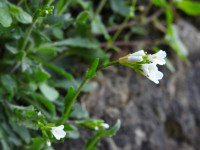
Perennial herbaceous plant belonging to the family Brassicaceae, generally 10 to 30 cm tall, with a scapose habit. The main stem is erect, undivided and often accompanied by other ascending lateral stems, all without branches. The surface of the stem and leaves has a more or less dense indumentum, consisting of simple hairs and stalked hairs with 3-5 (sometimes 6) rays, particularly evident on the lower part of the stem and at the leaf margins.
The basal leaves are lanceolate-obovate or almost spatulate, with a coarsely dentate margin and obtuse apex; these gradually narrow into the petiole. The cauline leaves number from 3 to 20, sessile or with a rounded or weakly cordate base, obovate, lanceolate or ovate in shape, generally dentate. The lower leaves are obtuse while the upper ones may become glabrous on the upper surface. The cauline leaves are often gray-tomentose.
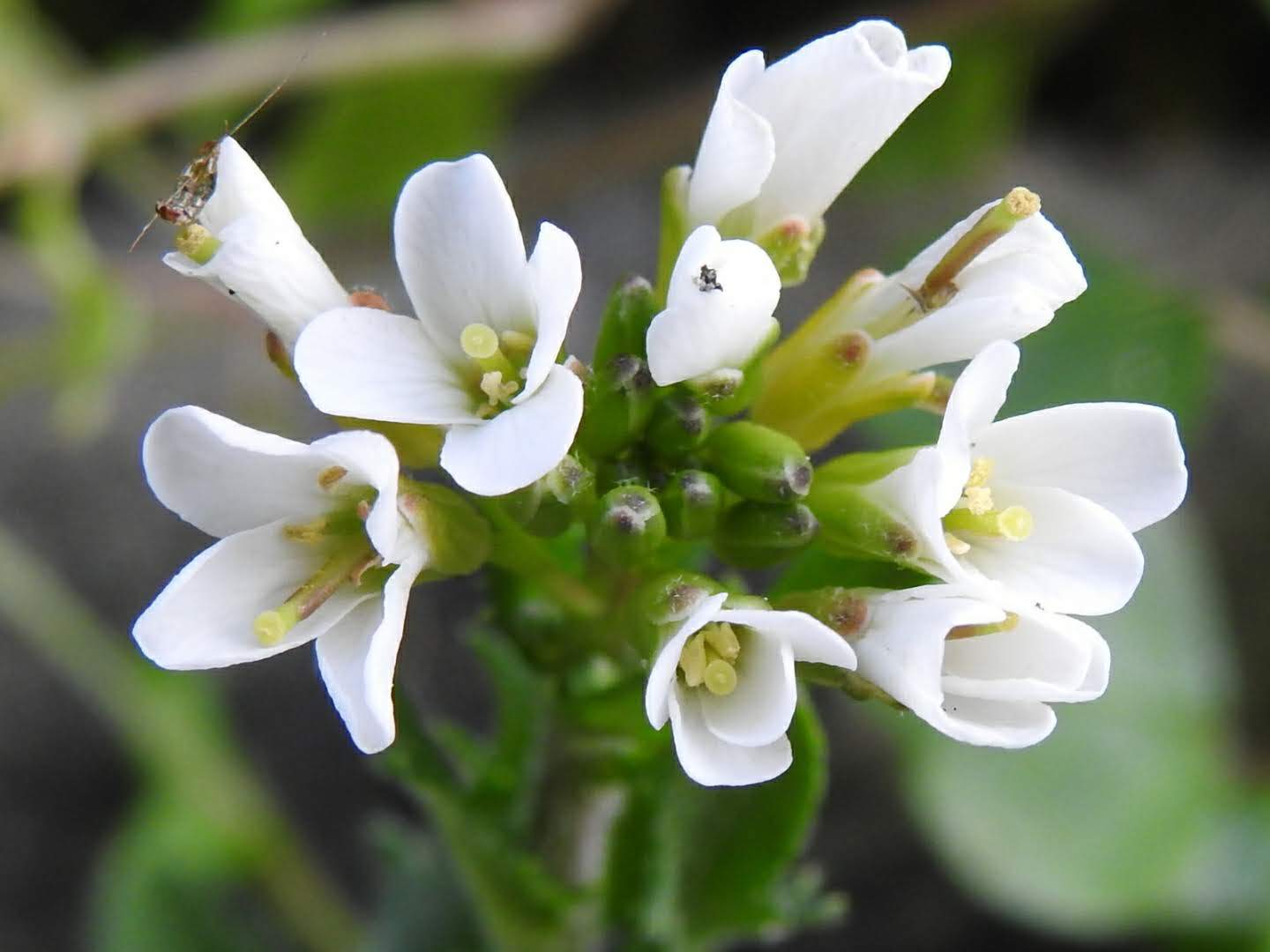
The inflorescence is a dense and initially compact raceme, which elongates with fruiting, bearing from 7 up to 25 white flowers (rarely with slight pinkish shades). The flowers consist of four obovate-cuneate petals, 6 to 10 mm long, truncate at the apex, and sepals 1-2 mm wide and 2.5-5.5 mm long. The fruit peduncles, or siliques, are erect, 5-16 mm long, with narrow fruits pressed against the axis measuring 40-90 mm in length and about 1.5 mm in width, with a median nerve visible for ¾ of the valve. The seeds are broadly elliptical, 1.1 to 1.3 mm long and 1.6-2.1 mm wide, with a marginal wing up to 0.5 mm wide.
The root system is not described in detail in the sources, but as with other Brassicaceae, a taproot is assumed, typical of plants adapted to dry and rocky soils.
Habitat and distribution
Rosy Cress is a typical species of mountainous and hilly areas of the Mediterranean region, present in Italy mainly in the central-southern and insular regions, with reports also in southwestern alpine areas such as the Salève and Mont Vuache. It grows on rocky substrates, walls, dry pastures and scrublands, preferring warm and sunny exposures.
The growth altitude ranges from about 100 up to 2200 meters above sea level, indicating good adaptability to both hilly and mountainous, even subalpine, conditions. Soils are generally calcareous, stony or sandy, often poor in organic matter, where the plant finds a xerophilous environment.
Flowering period
Flowering extends from March to July, with particular intensity in the spring months. No significant variations in the flowering period are reported depending on altitude or latitude, although in more mountainous environments flowering may start later due to lower temperatures.
Ecology and pollination
Rosy Cress is a perennial plant that reproduces by seeds produced from siliques pressed against the floral axis. Pollination is entomogamous, favored by pollinating insects attracted by the white, visible and fairly large flowers. Although there are no specific data on pollinating insects, it is plausible that bees, bumblebees and other small pollinating insects visit the flowers.
Seed dispersal occurs through local dropping and spreading, facilitated by the presence of thin wings that can promote some short-distance transport. The plant is also a scapose hemicryptophyte, meaning it survives winter with buds at ground level, and develops an elongated floral axis, often leafless, to facilitate flower exposure.
Curiosities and traditional uses
There are no certain data regarding medicinal, food or folkloric uses specific to this species. The genus name Arabis seems to recall the arid environments of Arabia, emphasizing the ability of these plants to adapt to particularly dry and sandy conditions.
In a naturalistic context, the species is interesting for its ability to colonize dry and rocky environments, contributing to soil stabilization and the biodiversity of Mediterranean mountainous and hilly ecosystems.
Etymology
The genus name Arabis probably derives from reference to Arabia, intending to emphasize the adaptation of species of this genus to arid and sunny environmental conditions typical of Middle Eastern territories. The Italian name “arabetta collinare” refers both to the genus and the typical growth habitat of the species, that is, hilly areas.
Sources
- Prof. P.V. Arrigoni, "Flora analitica della Toscana", "Flora dell'Isola di Sardegna"
- Acta Plantarum - Flora delle regioni italiane (scheda di Gianluca Nicolella)
- World Flora Online (WFO)
Characteristics
Scheda botanica
| Famiglia | Brassicaceae |
|---|---|
| Fioritura | marzo – luglio |
| Forma biologica | Scapose |
| Habitat | with white flowers, Perennial plant, plant with a scapose habit |
Domande frequenti
- Quando fiorisce Rosy Cress?
- Rosy Cress fiorisce marzo – luglio.
- Che tipo di pianta è Rosy Cress?
- Rosy Cress è una Hemicryptophytes (Scapose) secondo la classificazione di Raunkiaer.
- A quale famiglia appartiene Rosy Cress?
- Rosy Cress appartiene alla famiglia botanica Brassicaceae.
Where I found it (8 sightings)
Classification
- Kingdom
- Plantae
- Family
- Brassicaceae
- Full name
- Arabis collina Ten.
- Synonyms
- Arabis muralis Bertol.; Arabis tenella Guss. & Ten.
- Life form
- Hemicryptophytes scapose
Similar species
Search for species with similar characteristicsNoticed an error in the identification? Write to me
Other species of the same family
Brassicaceae
Explore
Other species of Brassicaceae