Botanical species
Erysimum pseudorhaeticum
Polatschek
Violaciocca appenninica
Description
Morphological description
The plant is a perennial herbaceous species reaching a height ranging from 50 to 75 cm, with erect, branched stems that are woody at the base. In more mature individuals, the remains of stems from previous years are often observed, while the root tends to develop upwards, partially emerging from the soil. The stem, quadrangular in cross-section, has a hirsute surface and a branched-ascending habit.
The cauline leaves are numerous, from 8 up to 17 per individual, and are longer than the internodes. They are narrowly lanceolate or linear-spatulate in shape, with typical dimensions between 2-5 mm in width and 17-110 mm in length. The leaves are herbaceous, entire, and acute at the apex; the lower ones have a slightly narrowed base into a short petiole. They are densely arranged along the stem and often associated with axillary fascicles.
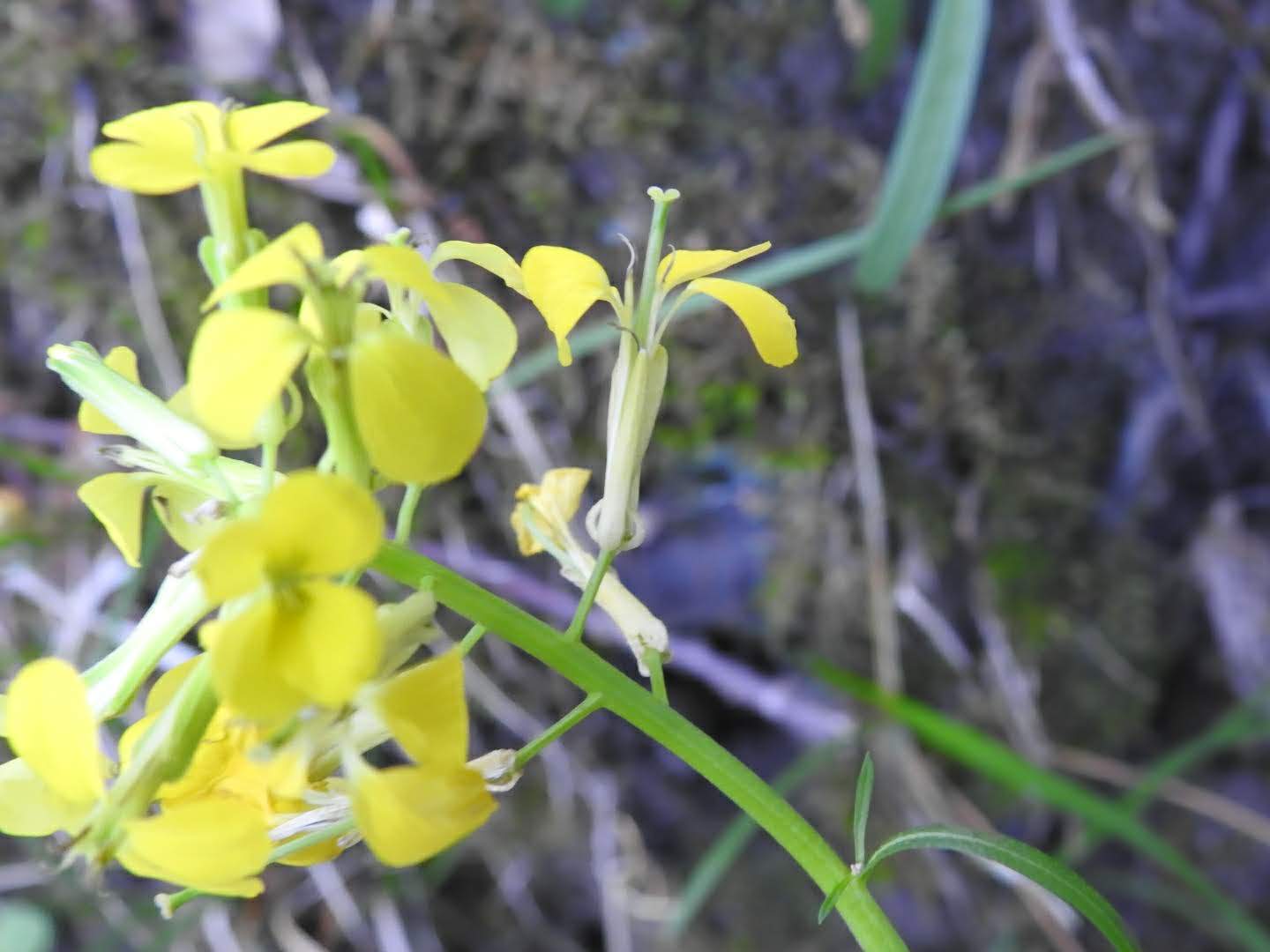
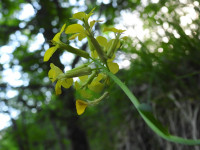
The flowering is characterized by apical racemes of 10-45 flowers, which progressively elongate during fruiting. The flowers are fragrant and bright yellow, with four spatulate petals 3-6 mm wide and 13-18.5 mm long. The calyx consists of lanceolate sepals measuring 1.3-1.8 mm by 7-12 mm. The floral peduncles measure 1.5-3 mm, elongating up to 3-6.5 mm in the fruiting phase.
The fruit is an erect-patent silique, elongated and quadrangular in cross-section, ranging from 35 to 100 mm in length, with a glabrescent surface on the edges. The style measures about 0.5-1.5 mm, while the stigma is capitate and emarginate.
The root system is typical of perennial species in mountain environments, with buds at ground level that allow persistence and annual regeneration.
Habitat and distribution
The species is endemic to Italy, mainly distributed in the northern and central Apennines, from the Apuan Alps to Campania. It grows in montane and submontane environments, at altitudes ranging from about 100 to 1800 meters above sea level.
It prefers dry and rocky soils, often poor in organic matter, such as poor pastures, screes, debris, gravel, cliffs, and road edges. These environments offer sunny exposures and conditions of low herbaceous competition, ideal for this species which can also assume an invasive character in some situations.
Flowering period
The flowering extends from April to June (months 4-6), with possible variability linked to altitude and local climatic conditions. During this period, the flowers emit a characteristic scent that favors pollination.
Ecology and pollination
The Apennine wallflower is a scapose hemicryptophyte, with an elongated floral stem often leafless. Its reproductive strategy is based on fragrant and visually conspicuous flowers, which attract numerous pollinating insects, mainly entomophilous pollinators such as bees and butterflies.
The fruits, long erect-patent siliques, contain seeds that are dispersed mainly by falling and by the action of wind or small animals, facilitating colonization of new dry and rocky habitats.
Curiosities and traditional uses
The genus Erysimum is known for some traditional medicinal uses, especially related to expectorant properties (use for respiratory diseases), as suggested by the Greek name from which it derives. Although no specific uses of this endemic species are documented, wallflowers in general have been used in phytotherapy for treating respiratory problems and as diuretics.
There are no precise references to food uses or specific folkloric traditions for this species; however, its presence in Italian mountain areas makes it a characteristic element of the local spontaneous flora.
Etymology
The scientific name of the genus, Erysimum, seems to derive from the Greek “éruo” (I save) and “oïmé” (the song), alluding to the ancient therapeutic properties of the plant, particularly as an expectorant remedy, hence the French name “Herbe-au-chantre” (herb of the singer). Another possible origin is from the Greek verb “eruomaï” (to save, to heal), emphasizing its traditional medicinal use.
The Italian common name “violaciocca appenninica” derives from the appearance of the flowers, similar to those of wallflowers, and from the predominantly Apennine geographical distribution of the species.
Sources
- Prof. S. Pignatti, "Flora d'Italia"
- Acta Plantarum - Flora delle regioni italiane (scheda di Giuliano Salvai)
Characteristics
Where I found it (6 sightings)
Classification
- Kingdom
- Plantae
- Family
- Brassicaceae
- Full name
- Erysimum pseudorhaeticum Polatschek
- Life form
- Emicriptofite scapose
Similar species
Search for species with similar characteristicsFurther reading
Noticed an error in the identification? Write to me
Other species of the same family
Brassicaceae
Explore
Other species of Brassicaceae