Botanical species
Erysimum cheiri
Wallflower
Description
Morphological description
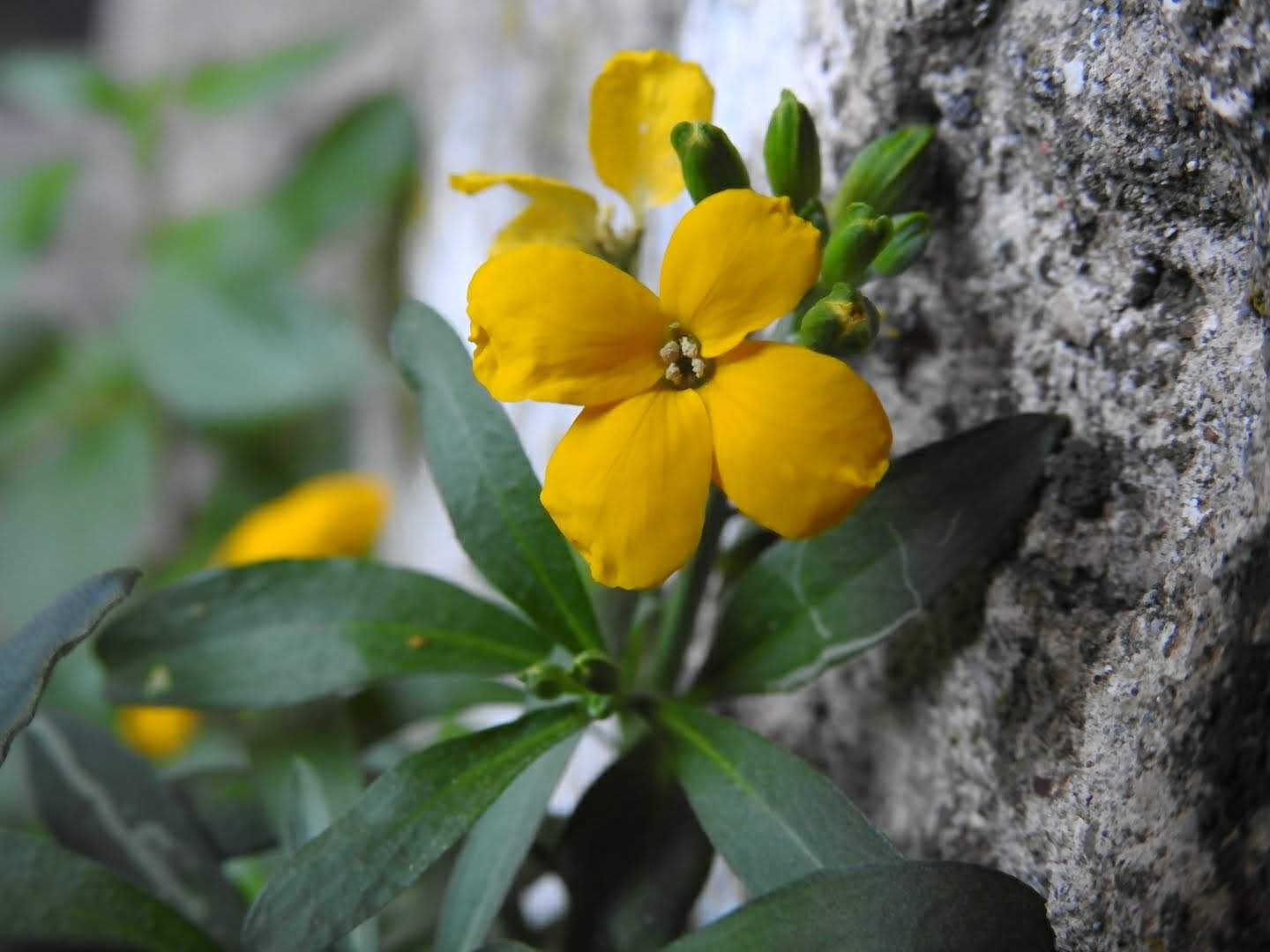
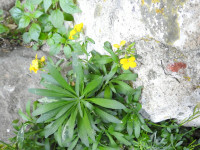
The yellow wallflower is a semi-woody perennial plant, with an erect and branched habit, reaching a height ranging from 20 to 80 cm. The stem is angular and branched from the base, sometimes with candelabra-shaped branches. The base of the stem is lignified, while the upper part retains an herbaceous consistency. The surface of the stem and leaves is covered with forked or stellate hairs, which contribute to giving the plant a slightly woolly appearance.
The leaves are arranged closely along the stem, with the lower ones generally petiolate and sometimes gathered in small axillary clusters, while the upper ones are sessile and smaller. The shape of the leaves varies from ovate-elongated to lanceolate, with entire margins, rarely with some dentation, and acute or acuminate apex. The leaf length can range between 4 and 10 cm, with a width between 1.3 and 1.5 times greater than the internode above.
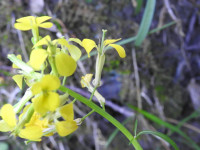
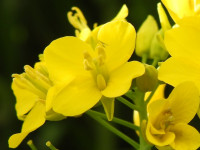
The flowers, gathered in dense and undivided racemes, consist of 7 to 15 elements, developing on peduncles 5-7 mm long (8-10 mm during fruiting). The corolla is formed by four spatulate petals, 12 to 20 mm long, of intense yellow color that can shift towards brown-orange or rusty tones, sometimes with violet shades. The sepals, 4 per flower, are oblanceolate and may show a slight violet coloration, more evident on the lateral sepals. The flowers emit a strong vanilla scent, a characteristic that makes them easily recognizable.
The fruit is a subparallel, compressed silique, 2.5 to 7 cm long (45-65 mm according to some sources), with an angular section and clearly narrowed at the base. The surface is generally smooth and light-colored, with valves having a single vein. Inside are oval, compressed seeds provided with a narrow wing at the upper part, arranged in a single row.
The root system is not described in detail in the available sources, but being a species adapted to rocky substrates and walls, it is presumably well anchored and capable of penetrating cracks and fissures in calcareous soil.
Habitat and distribution
The yellow wallflower is present throughout Italy, especially in mountainous and hilly environments, up to about 1000 meters altitude. It prefers habitats characterized by calcareous substrates such as old walls, cliffs, and rocks, often in sunny and well-drained exposures. In Italy it is considered a naturalized element, native to the Aegean basin, where it is endemic, but widely spread thanks to cultivation and naturalization in the Mediterranean territory.
The species is also widespread in central and southern Europe, up to western Asia, with a euro-Mediterranean range. In France it is mainly found in calcareous regions and often occurs on walls and rocks, where it has been naturalized for a long time.
Flowering period
Flowering extends from spring to early summer, generally from March to June, with a peak in May and June. This period can vary slightly depending on latitude and altitude: in warmer and lower areas an earlier flowering can be observed, while in the mountains it tends to be delayed.
Ecology and pollination
The flowers of the yellow wallflower, thanks to their intense vanilla scent and bright colors, attract various pollinating insects, particularly bees and butterflies, which favor cross-fertilization. The structure of the corolla and the presence of four spatulate petals facilitate access to nectar, while the arrangement of flowers in dense racemes promotes continuous insect visits.
Seed dispersal occurs through the siliqua fruits, which once mature open releasing winged seeds, facilitating dissemination mainly by falling and, partly, by wind action, given the presence of wings on the seeds. The species tends to colonize open and rocky environments, often exploiting cracks and fissures in calcareous walls and rocks.
Curiosities and traditional uses
The yellow wallflower has a long history of use in medicinal and cultural contexts, dating back to antiquity. Both the Greeks and Arabs used it for its diuretic, cleansing, and menstrual flow stimulating properties. Decoctions prepared with flowers and seeds were employed as abortive practices.
Chemically, the plant contains cardiotonic glycosides such as cheirantin and glucocheirolin, endowed with an action similar to digitalis. These compounds, although effective at low doses, are toxic and can cause paralyzing effects on the nervous system at high doses. For this reason, traditional medicinal use has been abandoned and domestic use is discouraged.
In the Middle Ages the yellow wallflower was highly appreciated by minstrels and storytellers, who wore it pinned as a symbol of affection and resistance to adversity. This tradition could refer indistinctly to this species or to other related species of the genus Matthiola, all characterized by fragrant and colorful flowers.
Etymology
The scientific name derives from the genus "Erysimum", of uncertain origin but perhaps linked to the Greek "eruomaï" meaning “to heal” or “to save”, referring to the therapeutic properties historically attributed to the plant. The specific name "cheiri" comes from the Greek "cheir" (hand) and "anthos" (flower), probably indicating a flower held in the hand, appreciated for its fragrance and symbolic meaning.
The Italian common name "violaciocca gialla" recalls the resemblance to other wallflower species (Matthiola), but is distinguished by the characteristic intense yellow color of the flowers.
Sources
- Prof. S. Pignatti, "Flora d'Italia"
- Acta Plantarum - Flora delle regioni italiane (scheda di Mirna Medri)
- Tela Botanica / H. Coste, "Flore descriptive et illustrée de la France"
Characteristics
Where I found it (5 sightings)
Classification
- Kingdom
- Plantae
- Family
- Brassicaceae
- Full name
- Erysimum × cheiri (L.) Crantz
- Synonyms
- Cheiranthus × cheiri L.
- Life form
- Camefite suffruticose
Similar species
Search for species with similar characteristicsFurther reading
Noticed an error in the identification? Write to me
Other species of the same family
Brassicaceae
Explore
Other species of Brassicaceae