Botanical species
Capsella bursa-pastoris
Shepherd's-purse
Description
Morphological description
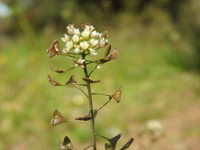
Annual or biennial herbaceous plant, Shepherd's-purse has an erect habit, with height varying from 10 up to 60 cm, sometimes reaching 70 cm. The stem is thin, simple or branched, glabrous or covered with short hairs and appressed trichomes, simple or stellate with 3-5 rays. The stem surface can be smooth or slightly striated.
The root system consists of a taproot, woody and robust, which allows the plant to adapt to different soil types.
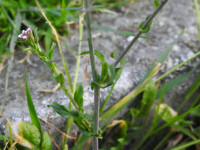
The basal leaves are gathered in a rosette, with a short petiole and a blade of oblong-spatulate, oblanceolate or lanceolate shape, varying in size between 0.5-2 cm in width and 3-10 (up to 15) cm in length. The margin is entire or more frequently deeply incised, with lobes rounded, acute or obtuse, and can be dentate or pinnatifid. The cauline leaves, smaller, are sessile, sagittate and amplexicaul (clasping the stem), with entire or dentate margins and herbaceous texture.
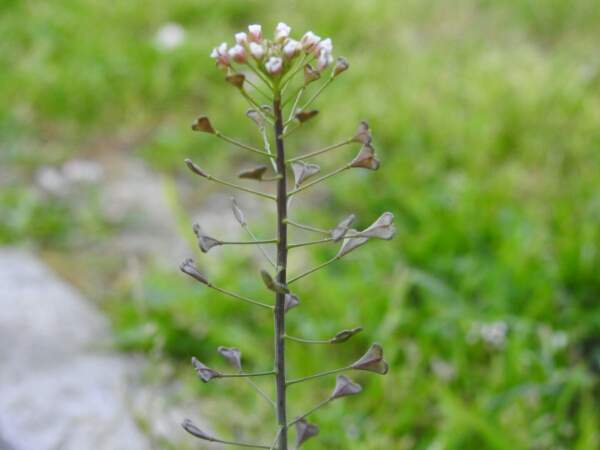
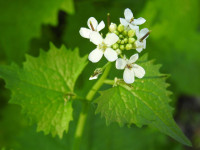
The flowers, hermaphroditic and small, are gathered in dense and elongated racemes placed at the apex of the stems or branches. Each flower is composed of 4 oval and greenish sepals, about 1.5-2 mm long, and 4 white petals, 2-3 (up to 5) mm long, larger than the sepals and arranged alternately. The corolla has the typical shape of Brassicaceae, with opposite petals and a delicate appearance.
The fruit is a flattened silique, triangular or inverted heart-shaped (obcordate), with almost straight or slightly convex sides. The dimensions vary from 4-6 mm up to 9-10 mm in length and 3-7 mm in width. The surface is glabrous, with subparallel veins and a persistent style about 0.2-0.7 mm long. The fruit peduncles are patent (open laterally) and range from 0.3 up to 2 cm in length. Inside are contained up to 12 oblong, brown seeds, about 0.8-1.1 mm long.
The plant emits a characteristic sulfurous odor when crushed, due to the presence of essential oils containing sulfur compounds.
Habitat and distribution
Shepherd's-purse is a cosmopolitan species, present in almost all temperate and subtropical areas of the world, with indigenous origin in Europe and western Africa. In Italy and the Mediterranean it is extremely common and widespread, present in all types of human-modified habitats.
A highly adaptable plant, it colonizes open and disturbed environments such as gardens, vineyards, uncultivated lands, roadsides, forest clearings and old walls. It grows on a wide range of soils, from clayey to sandy, preferring sunny or semi-shaded exposures. It is common from sea level up to mountain elevations, generally up to 1,800 m, but can reach altitudes of up to 2,600 m.
Its adaptability and rapid seed production make it one of the most widespread and resilient weeds, often present also in urban and agricultural environments.
Flowering period
Shepherd's-purse has a long flowering period extending from January to July, and in some areas it can continue flowering almost all year round, thanks to multiple cycles and rapid seed germination. Under favorable conditions and in temperate climates, flowering can extend until November.
This continuous flowering contributes to its spread and ability to quickly colonize new habitats.
Ecology and pollination
The species is hermaphroditic and has a reproductive strategy mainly based on self-pollination, thus ensuring a high capacity for genetic fixation in natural populations. However, it is also pollinated by pollinating insects, particularly small hymenopterans and dipterans, attracted by the white flowers.
Seed dispersal occurs mainly by falling near the mother plant, favoring the formation of dense local colonies. Once fallen to the ground, seeds can germinate rapidly, allowing the presence of flowering plants throughout the year, especially in temperate environments.
Interesting is the ability of the seeds to secrete a viscous substance when moistened, which can trap small insects; although digestive enzymes and the ability to absorb organic substances have been observed, it is not yet clear whether this characteristic provides the plant with any nutritional or ecological advantage.
Curiosities and traditional uses
Shepherd's-purse has been used by humans for millennia, both as food and in traditional medicine. Seeds of this plant have been found in Neolithic archaeological sites such as Çatal Hüyük (6000 BC) and in the stomach of the Tollund Man (ca. 500 BC–400 AD), confirming its ancient food use.
From a medicinal point of view, the plant contains tannins, flavonoids (including hesperidin, diosmin and rutin), sulfur-containing essential oils, alkaloids, organic acids and saponins. Traditionally it has been used for the treatment of mild metrorrhagia and menorrhagia, acting as a regulator of menstrual flow thanks to its ability to promote uterine muscle contraction. It has also been used for epistaxis, diarrhea, hemorrhoids and varicose veins.
The fresh stem, macerated in vinegar, was applied locally on skin infections. However, after the discovery of toxic alkaloids in ergot, its medicinal use has partly been abandoned due to variability and uncertain reliability of effects.
In cooking, although edible, it is usually consumed together with other wild salads, often raw or boiled, and pairs well with wild radicchio.
In scientific contexts, Shepherd's-purse is used as a model organism for the study of morphogenesis and in agriculture and industry it is known for the production of natural insecticides.
Etymology
The generic name Capsella derives from the Latin capsa, meaning "container", "box" or "small purse", referring to the rather characteristic shape of the fruit. The specific epithet bursa-pastoris means "Shepherd's-purse", recalling the triangular and flattened shape of the silique, which resembles the pocket or bag traditionally used by shepherds to carry provisions.
An alternative interpretation suggests that the fruit does not resemble a purse but rather a wedge, linking the etymology to the Akkadian burussu ("plug" or "stopper") and paštu ("axe" or "hatchet"), with the overall meaning of "axe-shaped plug".
The Italian common name "Shepherd's-purse" derives from the same analogy with this small portable container, used in the past by those working in the fields or with livestock.
Sources
- Prof. S. Pignatti, "Flora d'Italia"
- Acta Plantarum - Flora delle regioni italiane (scheda di Marinella Zepigi)
- Tela Botanica / H. Coste, "Flore descriptive et illustrée de la France"
- World Flora Online (WFO)
Characteristics
Scheda botanica
| Famiglia | Brassicaceae |
|---|---|
| Fioritura | gennaio – luglio |
| Forma biologica | Biennials |
| Habitat | with white flowers, with small flowers, plant with leaves with irregularly toothed margin |
Domande frequenti
- Quando fiorisce Shepherd's-purse?
- Shepherd's-purse fiorisce gennaio – luglio.
- Che tipo di pianta è Shepherd's-purse?
- Shepherd's-purse è una Hemicryptophytes (Biennials) secondo la classificazione di Raunkiaer.
- A quale famiglia appartiene Shepherd's-purse?
- Shepherd's-purse appartiene alla famiglia botanica Brassicaceae.
Where I found it (12 sightings)
Classification
- Kingdom
- Plantae
- Family
- Brassicaceae
- Full name
- Capsella bursa pastoris (L.) Medik.
- Synonyms
- Thlaspi bursa-pastoris L.
- Life form
- Hemicryptophytes biennials
Similar species
Search for species with similar characteristicsFurther reading
Noticed an error in the identification? Write to me
Other species of the same family
Brassicaceae
Explore
Other species of Brassicaceae